
 X
X WeiBo
WeiBo WeChat
 Facebook
 LinkedIn
 Reddit
 Bluesky
Optical reconfigurable intelligent surfaces assisted visible light positioning and communications: performance analysis and design optimization
- Volume
- CitationWang F, Jiang W, Li R, Li X, Nallanathan A. Optical reconfigurable intelligent surfaces assisted visible light positioning and communications: performance analysis and design optimization. Adv. Inf. Commun. 2026(1):0001, https://doi.org/10.55092/aic20260001.
- DOI10.55092/aic20260001
- CopyrightCopyright2026 by the authors. Published by ELSP.
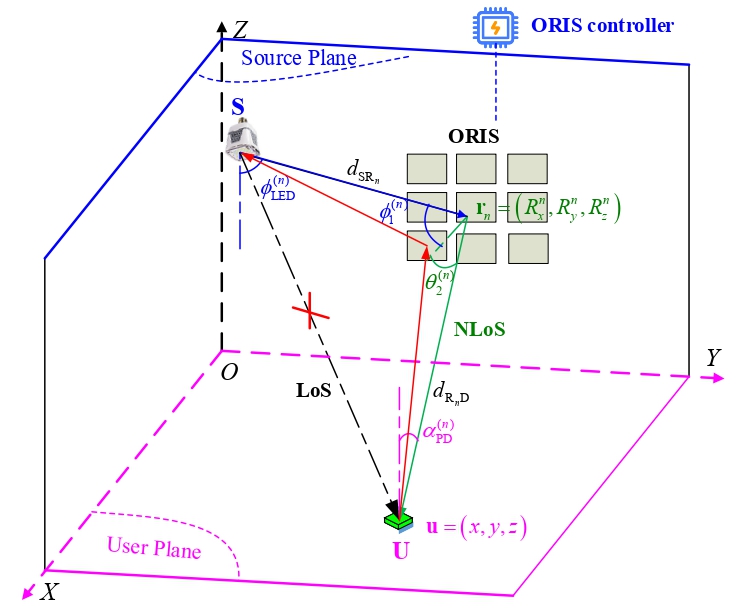
This paper investigates the integration of visible light positioning and communication (VLP&C) facilitated by optical reconfigurable intelligent surfaces (ORIS) to address line-of-sight (LoS) blockage challenges within indoor environments. In contrast to conventional VLP&C systems, which experience significant performance deterioration under LoS blockage, the proposed ORIS-assisted framework dynamically adjusts the reflection patterns to establish reliable non-LoS (NLoS) links. Initially, a comprehensive system model is formulated, encompassing the physical properties of ORIS, including an analysis of time delays and strategies for ORIS deployment. Subsequently, the Cramér-Rao lower bound (CRLB) for positioning accuracy is rigorously derived from the underlying signal models, thereby providing a realistic theoretical performance benchmark. Additionally, closed-form expression for the average mutual information (AMI) and bit error rate (BER) of the communication subsystem are developed, accounting for the finite-alphabet characteristics of on-off keying (OOK) modulation. The study further investigates the trade-offs between positioning accuracy and communication performance across various system parameters, such as the number of ORIS reflection units, half-power angle, and spatial distribution of users. Extensive simulation results demonstrate that the proposed ORIS-assisted system attains centimeter-level positioning accuracy alongside reliable communication performance, even in scenarios where LoS links are blocked. The theoretical findings are validated through Monte Carlo simulations, and the practical implementation challenges are discussed to inform future real-world deployments.
VLP&C; VLC; CRLB; AMI; ORIS
