
 X
X WeiBo
WeiBo WeChat
 Facebook
 LinkedIn
 Reddit
 Bluesky
Casting of complex open cellular structures using high manganese steel
- Volume
- CitationDrebenstedt C, Hohlfeld J, Hannemann C, Berndt N, Krupp U, et al. Casting of complex open cellular structures using high manganese steel. Adv. Manuf. 2026(1):0001, https://doi.org/10.55092/am20260001.
- DOI10.55092/am20260001
- CopyrightCopyright2026 by the authors. Published by ELSP.
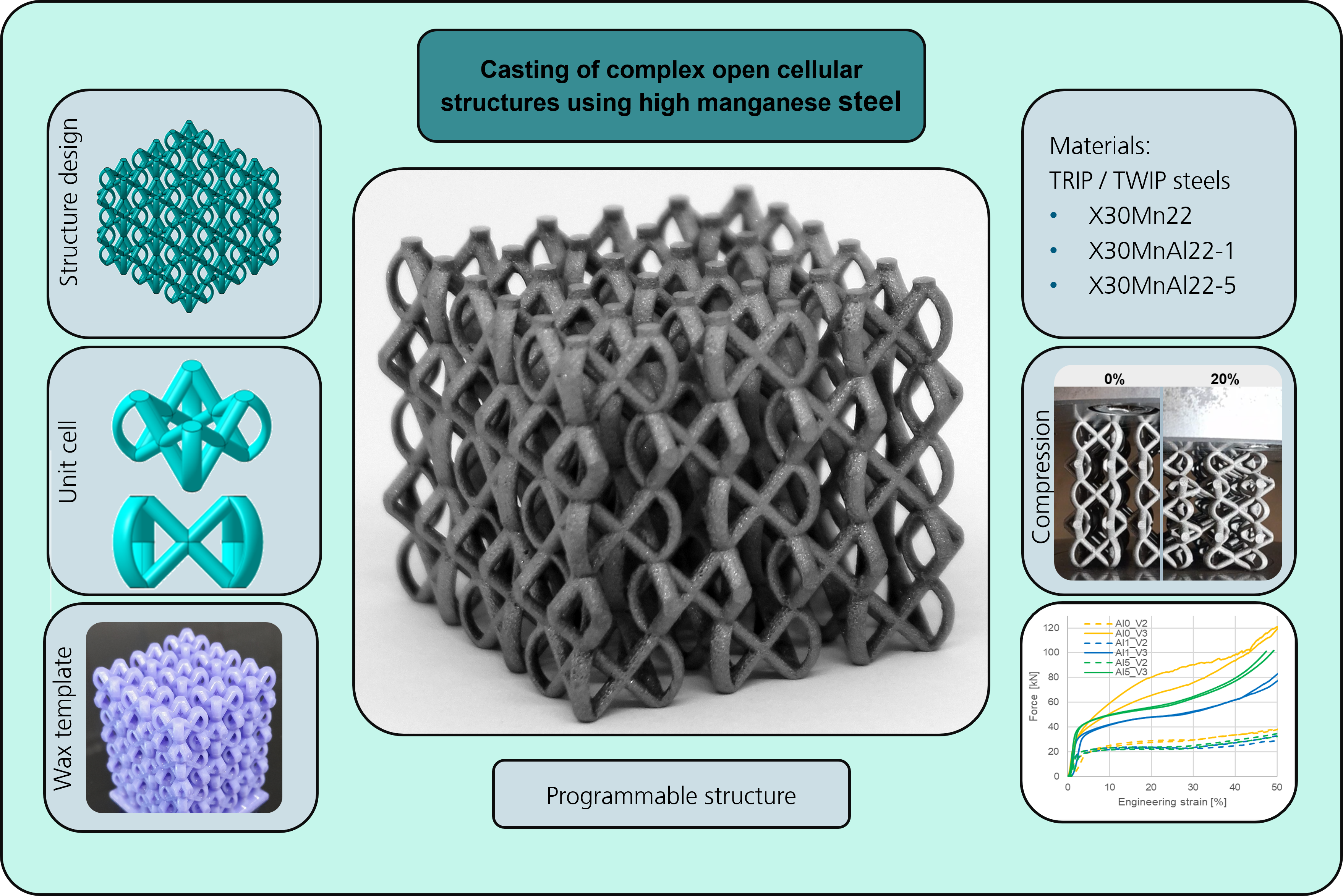
High manganese steels offer an excellent combination of high strength and good ductility, making them ideal for lightweight and energy absorbing applications such as open cellular structures. Additive manufacturing is often used to produce metallic open cellular structures since it allows a high complexity of the geometry and high material efficiency, but the structures often exhibit anisotropic behavior and processing requires specific powder sizes with correspondingly high prices. This study therefore addresses the feasibility of investment casting to produce open cellular structures. A high manganese X30Mn22 base alloy with different contents of aluminum (0, 1 and 5 wt %) was used for the manufacturing of a newly designed cell structure. Processing parameters and mold materials needed to be adjusted due to pronounced chemical reactions with the commercial SiO2-based mold material. Using an Al2O3-based mold material and increasing the mold temperature during casting to 1000 °C allowed for the successful casting of high manganese steel structures with different designs regarding the strut diameter. Quasi-static compression tests of the structures confirm the cast quality and illustrate the effect of increasing alloying contents of Al on the deformation behavior, building the foundation for the development of programmable cellular structures for energy absorbing applications.
open-cell metal structures; periodic open cellular structures; POCS; investment casting; high manganese steels; HMnS; lost form process; TRIP-effect; TWIP-effect
