
 X
X WeiBo
WeiBo WeChat
 Facebook
 LinkedIn
 Reddit
 Bluesky
Transforming machining waste into functional SS316 foams through inert-atmosphere microwave sintering intended for crash boxes and improving crashworthiness of vehicles
- Volume
- CitationShinde S, Adi S, Bajakke P, Malik V. Transforming machining waste into functional SS316 foams through inert-atmosphere microwave sintering intended for crash boxes and improving crashworthiness of vehicles. Adv. Manuf. 2026(1):0004, https://doi.org/10.55092/am20260004.
- DOI10.55092/am20260004
- CopyrightCopyright2026 by the authors. Published by ELSP.
- Special Issue
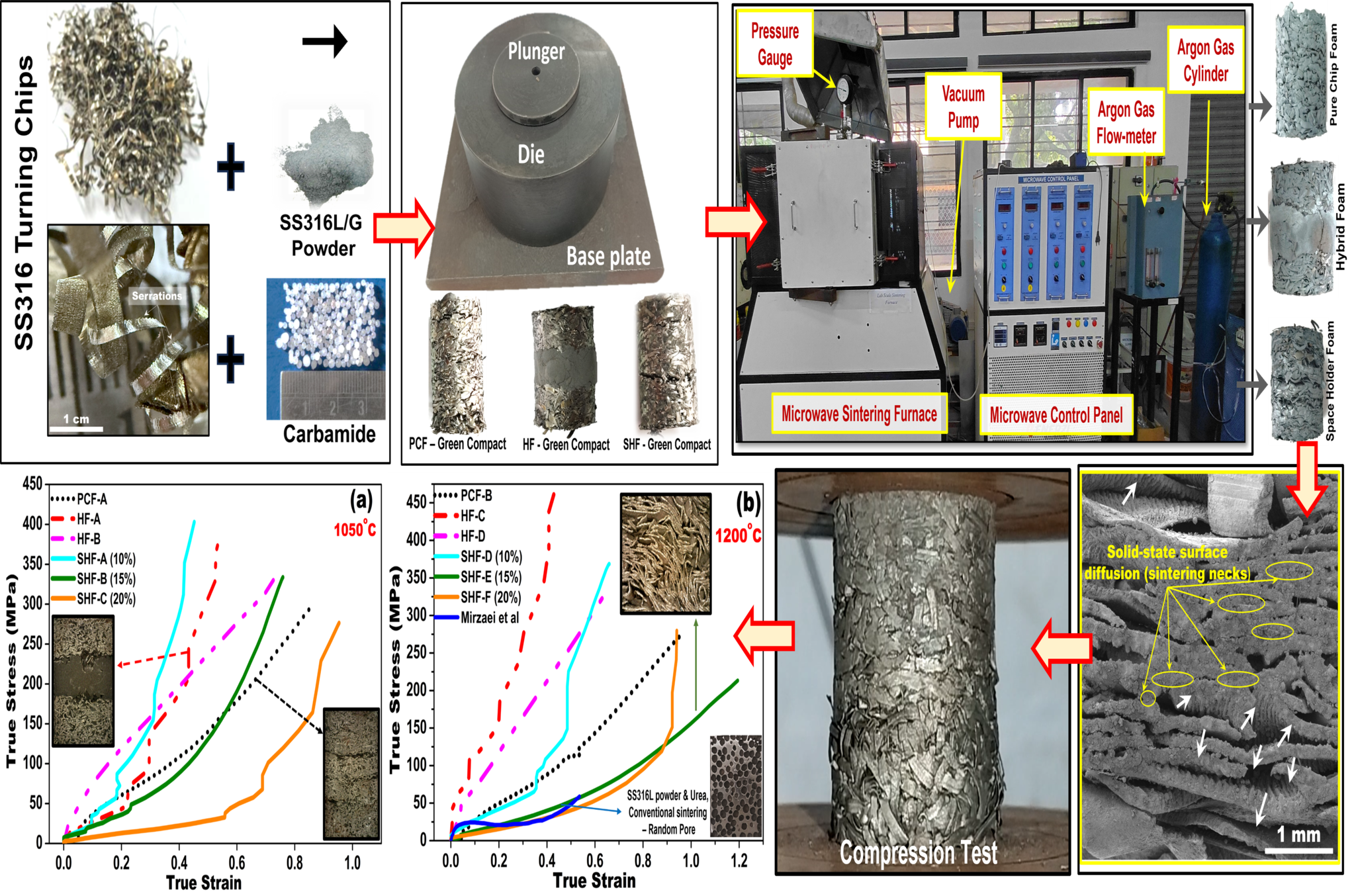
The rate of recycling and scrap recovery is poised to rise significantly in the near future, reflecting a strategic commitment to long-term environmental and sustainable manufacturing practices. Advancing circular economy goals in line with UN SDG-12 requires innovative strategies, such as reusing machining chips in to metal foams. Machining chips have increasingly become a preferred feedstock for solid-state reuse, offering a sustainable alternative to conventional remelting. The present research aims to develop a novel and sustainable manufacturing route for reusing Stainless Steel 316L turning chips in metallic foam fabrication. The process employed microwave sintering at 1050 °C and 1200 °C under an inert-argon atmosphere. Sintering in an inert environment offers the added advantage of minimizing oxidation and contamination while enabling a more efficient sintering cycle. Three types of foams were fabricated: pure chip foams, hybrid foams and space-holder foams, and subsequently characterized for macrostructure, microstructure and compressive behavior to evaluate their physical and mechanical properties. Foams sintered at 1200 °C exhibited a more stable plateau region with enhanced energy absorption, while their lower plateau stress facilitated easier deformation under compression, rendering them highly impact-resistant and suitable for crashworthiness applications.
Stainless Steel 316 Foams; turning chips; inert atmosphere; microwave sintering
