
 X
X WeiBo
WeiBo WeChat
 Facebook
 LinkedIn
 Reddit
 Bluesky
Surface subsidence patterns and mechanisms of underlying goaf beneath a railway tunnel
- Volume
- CitationMa H, Gu T, Cui , Li S, Tang Y, et al. Surface subsidence patterns and mechanisms of underlying goaf beneath a railway tunnel. Cont. Life Evol. 2026(1):0003, https://doi.org/10.55092/cle20260003.
- DOI10.55092/cle20260003
- CopyrightCopyright2026 by the authors. Published by ELSP.
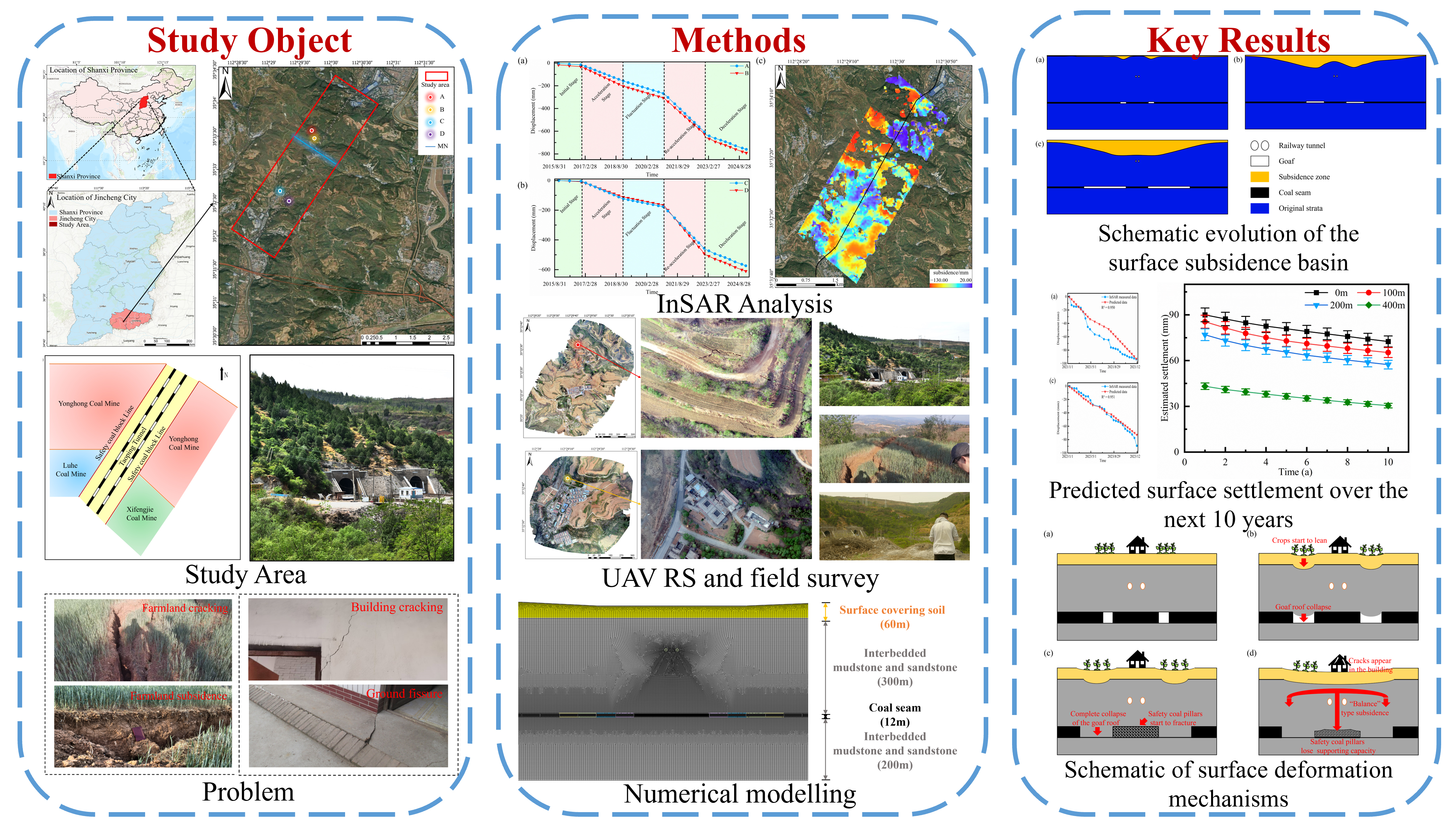
Long-term deformation of abandoned mine workings endangers surface infrastructure, causing wall cracking, beam–column distortion and, in extreme cases, tilting or collapse. Here we track surface movement above the Taoping tunnel goaf beneath the Houyue railway (Shanxi, China) by combining 2015–2024 InSAR time-series, numerical modelling and probability-integral analysis. Contrary to widely held stability assumptions, subsidence is still accelerating more than a decade after extraction ceased. Five evolutionary stages are identified: (1) initial roof failure and local basin formation; (2) stress redistribution that loads the safety coal pillar; (3) progressive pillar crushing; (4) merger of adjacent goafs into a “balanced” instability structure; and (5) transformation of the local basin into a regional trough. Probability-integral forecasting indicates residual settlement will continue for roughly ten years before stabilization. The proposed stage-based framework enables long-term stability assessment and targeted remediation of similar legacy goafs, and supports safe railway operation and future land reuse.
goaf; surface subsidence; InSAR; numerical modelling; subsidence mechanism
