
 X
X WeiBo
WeiBo WeChat
 Facebook
 LinkedIn
 Reddit
 Bluesky
From biomarkers to therapeutics: extracellular vesicle RNA as a pivotal player in inflammatory bowel disease management
- Volume
- CitationRen R, Xu M, Jiang X, Wei X. From biomarkers to therapeutics: extracellular vesicle RNA as a pivotal player in inflammatory bowel disease management. ExRNA 2026(1):0003, https://doi.org/10.55092/exrna20260003.
- DOI10.55092/exrna20260003
- CopyrightCopyright2026 by the authors. Published by ELSP.
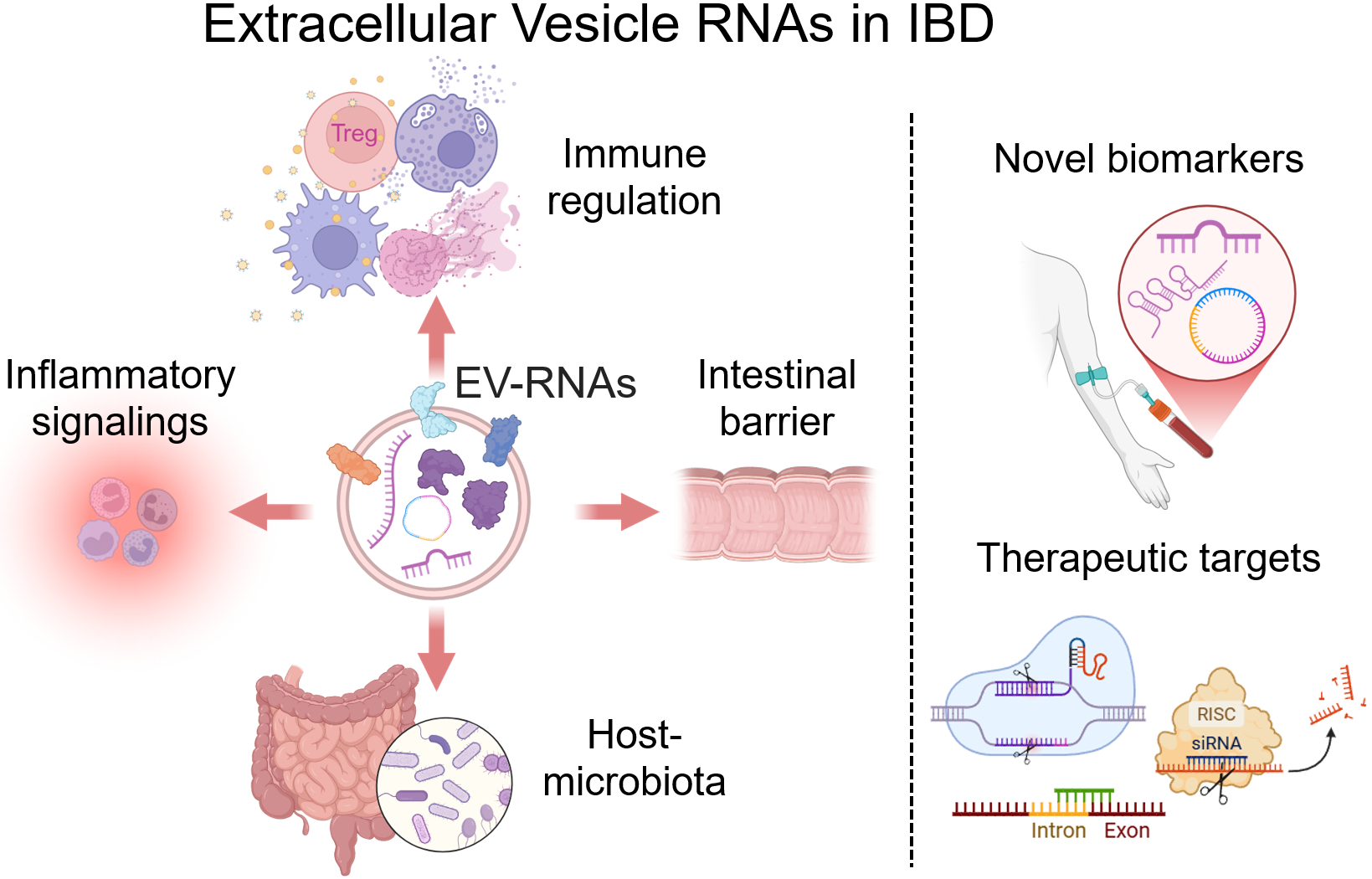
Inflammatory Bowel Disease (IBD), comprising Crohn’s disease (CD) and ulcerative colitis (UC), is a group of chronic relapsing inflammatory disorders of the gastrointestinal tract with complex etiology and significant clinical challenges. Extracellular vesicles (EVs) act as key mediators of intercellular communication, carrying diverse RNA species—especially non-coding RNAs such as microRNAs and long non-coding RNAs—which have emerged as critical regulators in IBD pathogenesis and progression. This review synthesizes current understanding of how EV-associated RNAs modulate fundamental IBD-related processes, including inflammatory signaling, intestinal barrier function, immune regulation, and host–microbiota interactions. By integrating recent evidence from multi-omics studies and animal models, we highlight the promise of EV-derived RNAs as novel biomarkers and therapeutic targets. We further discuss advances in EV-RNA-based therapeutics and examine the challenges and future directions for translating these insights into clinical practice. By elucidating the multifaceted roles of EV-RNAs in IBD, this article aims to provide a theoretical foundation and inform future research toward precision diagnosis and personalized treatment strategies for IBD patients.
EVs; EV-RNAs; IBD; molecular mechanisms; therapeutic potential
