
 X
X WeiBo
WeiBo WeChat
 Facebook
 LinkedIn
 Reddit
 Bluesky
Personalized law and personalized medicine: a critical study of normative divergence in the age of AI governance
- Volume
- CitationLevy H. Personalized law and personalized medicine: a critical study of normative divergence in the age of AI governance . Law Ethics Technol. 2026(1):0002, https://doi.org/10.55092/let20260002.
- DOI10.55092/let20260002
- CopyrightCopyright2026 by the authors. Published by ELSP.
- Special Issue
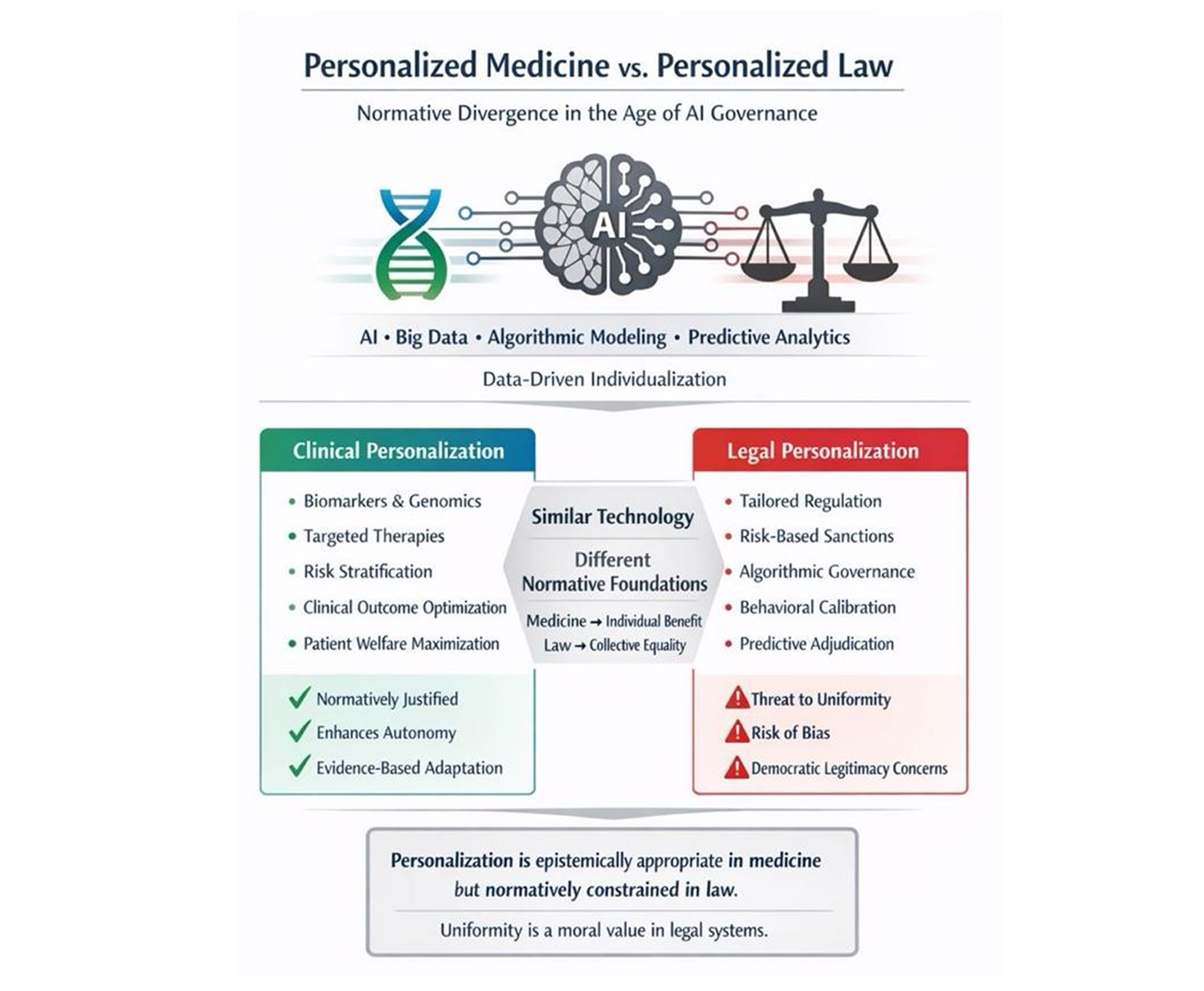
Personalized law seeks to tailor legal obligations, permissions, and sanctions to individual traits and predicted behaviors, drawing inspiration from developments in personalized medicine. This article focuses on algorithmically mediated forms of ex ante legal personalization, in which legal obligations are systematically tailored to individuals through data-driven design rather than discretionary adjudication. While personalization has produced tangible benefits in medicine within a fiduciary, professionally regulated, and evidence-based framework, its transposition into law raises distinct normative and institutional concerns. Focusing on algorithmically designed, ex ante personalization in public and hybrid regulatory contexts, the Article argues that personalized law poses a unique challenge to the rule of law—understood as a commitment to generality, transparency, contestability, and public justification—that cannot be resolved by appeals to efficiency alone. The analysis develops a working typology of legal personalization to clarify scope and avoid conceptual overreach, reserving detailed distinctions for the main text. It then examines the ethical asymmetry between medicine and law, emphasizing that legal systems lack the fiduciary and professional infrastructures that legitimize individualized treatment in clinical practice. The Article further argues that emerging forms of automation and AI-mediated decision-making may erode the very forms of human behavioral variation on which personalized legal regimes depend, calling into question their long-term coherence. Drawing on comparative examples and contemporary debates on manipulation and behavioral governance, the Article concludes that personalized law can be normatively defensible only within narrowly confined domains and under stringent safeguards. Absent such constraints, legal personalization risks undermining democratic legitimacy by fragmenting legal generality, obscuring public accountability, and transforming law into a system of opaque behavioral steering.
artificial intelligence; algorithmic profiling; algorithmic regulation; big-data analytics; democratic legitimacy; machine learning; personalized law; personalized medicine; normative analysis
