
 X
X WeiBo
WeiBo WeChat
 Facebook
 LinkedIn
 Reddit
 Bluesky
EEG processors for brain-machine interface in the era of artificial intelligence: a systematic review
- Volume
- CitationZhang C, Guo T, Zhu J, Tang Z, Zhang M. EEG processors for brain-machine interface in the era of artificial intelligence: a systematic review. Neuroelectronics 2026(1):0001, https://doi.org/10.55092/neuroelectronics20260001.
- DOI10.55092/neuroelectronics20260001
- CopyrightCopyright2026 by the authors. Published by ELSP.
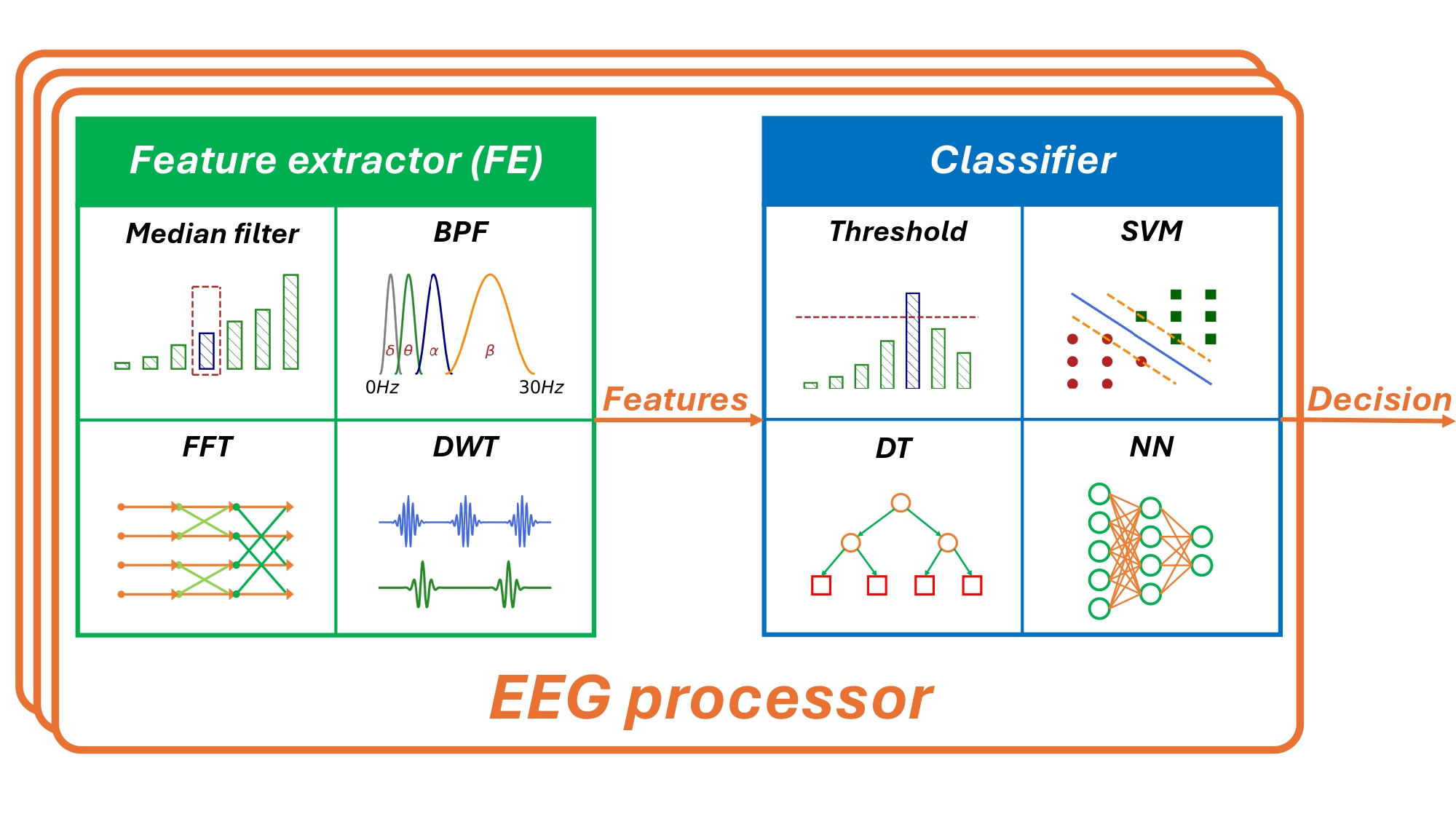
Electroencephalography (EEG) is one of the most important biomedical signals in the evaluation of brain activities in frontier research and clinical practice. Based on EEG processing, electrical activity from human brain could be decoded and understood, which benefits many scenarios such as seizure detection, sleep staging and motor imagery. In this review, Application Specific Integrated Circuits (ASICs) for EEG processing in literature of the past decades are carefully investigated. The EEG processors are divided into four types according to their architectures. A thorough analysis is performed on all the four EEG processor types, including quantitative cross-task comparisons in terms of energy efficiency, accuracy, and hardware complexity. The challenges and opportunities for the researches in hardware EEG processing are also included.
EEG processor; biomedical signal processing; brain-machine interface; brain-computer interface; low power ASIC
