
 X
X WeiBo
WeiBo WeChat
 Facebook
 LinkedIn
 Reddit
 Bluesky
A review of wireless power and data transfer systems for biomedical implants
- Volume
- CitationHong B, Wei X, Shi C, Mai S, Tang X, et al. A review of wireless power and data transfer systems for biomedical implants. Neuroelectronics 2026(1):0004, https://doi.org/10.55092/neuroelectronics20260004.
- DOI10.55092/neuroelectronics20260004
- CopyrightCopyright2026 by the authors. Published by ELSP.
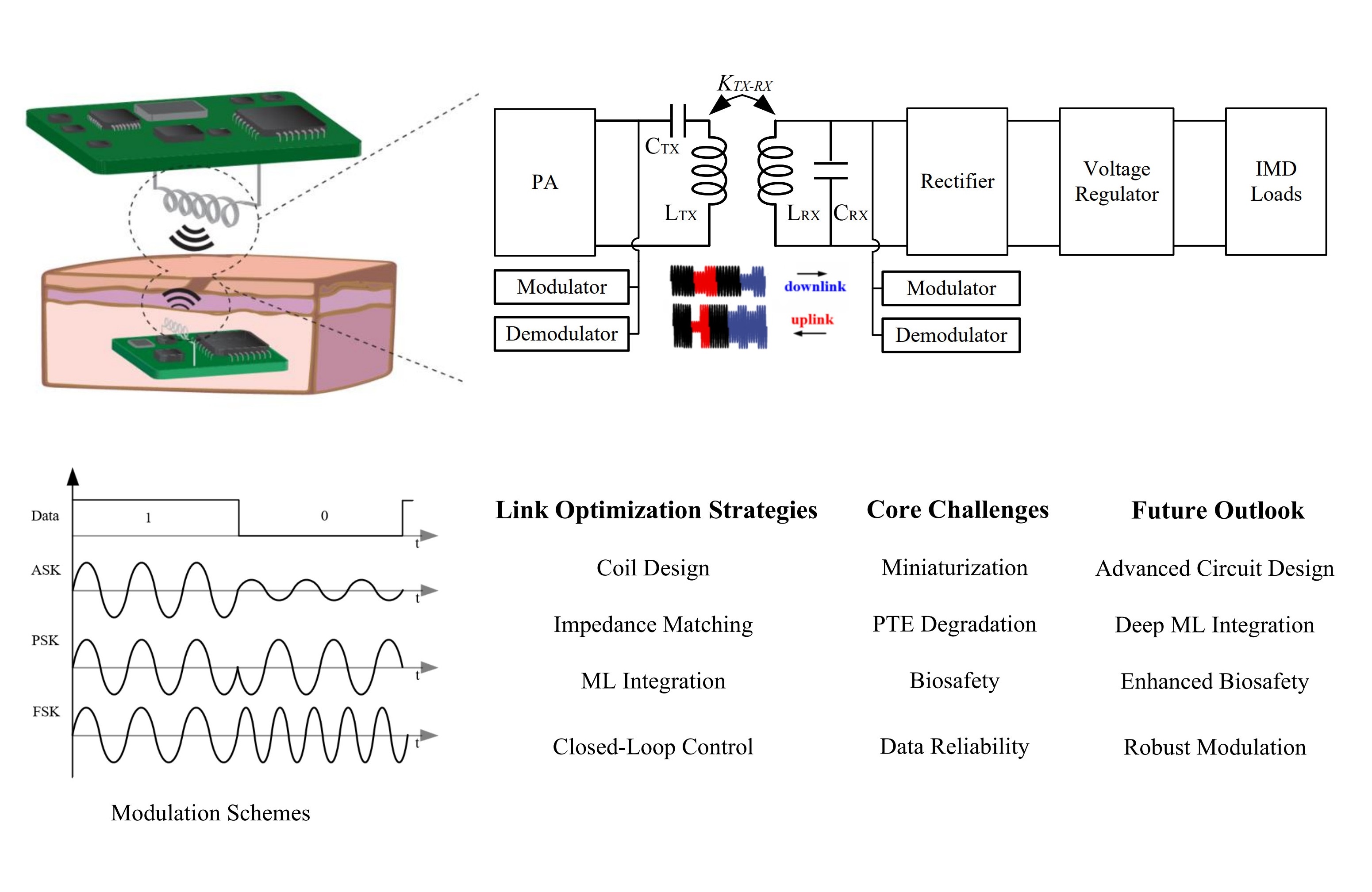
This paper reviews recent research on wireless power and data transfer (WPDT) systems for implanted medical devices (IMDs). Focusing primarily on inductive WPDT systems, the review incorporates theoretical analyses and discussion of link optimization strategies. These strategies target power transfer efficiency (PTE) degradation caused by impedance mismatch, coil misalignment, inter-coil distance, and coupling angle-induced magnetic field inhomogeneity, summarizing referable solutions to mitigate such performance losses. The review also details key WPDT system components: in the power path, it covers power amplifiers, rectifiers, and voltage regulators; in the data path, it involves modulation schemes such as Amplitude-Shift Keying (ASK), Phase-Shift Keying (PSK), Frequency-Shift Keying (FSK), and Load-Shift Keying (LSK). Addressing the core challenge of balancing high PTE (typ. 50%) and data rate (typ. 0.1–2Mbps) under dynamic coupling and load variations, it summarizes the circuit innovation directions of each component, extending to integrated innovation paths at the system level. Finally, future directions are outlined, focusing on miniaturization, efficiency optimization via advanced circuits, biosafety, and robust modulation to enhance data reliability and speed, as well as the deep integration of machine learning for performance improvement.
wireless power and data transfer; implanted medical devices; inductive WPDT systems; power transfer efficiency; link optimization; modulation schemes; system miniaturization
