
 X
X WeiBo
WeiBo WeChat
 Facebook
 LinkedIn
 Reddit
 Bluesky
Automated BIM modelling from non-digital engineering drawings using improved YOLOv11n-based detection framework
- Volume
- CitationCai X, Deng J, Zhu Y, Zhao B, Mao X. Automated BIM modelling from non-digital engineering drawings using improved YOLOv11n-based detection framework. Smart Constr. 2026(1):0003, https://doi.org/10.55092/sc20260003.
- DOI10.55092/sc20260003
- CopyrightCopyright2026 by the authors. Published by ELSP.
- Special Issue
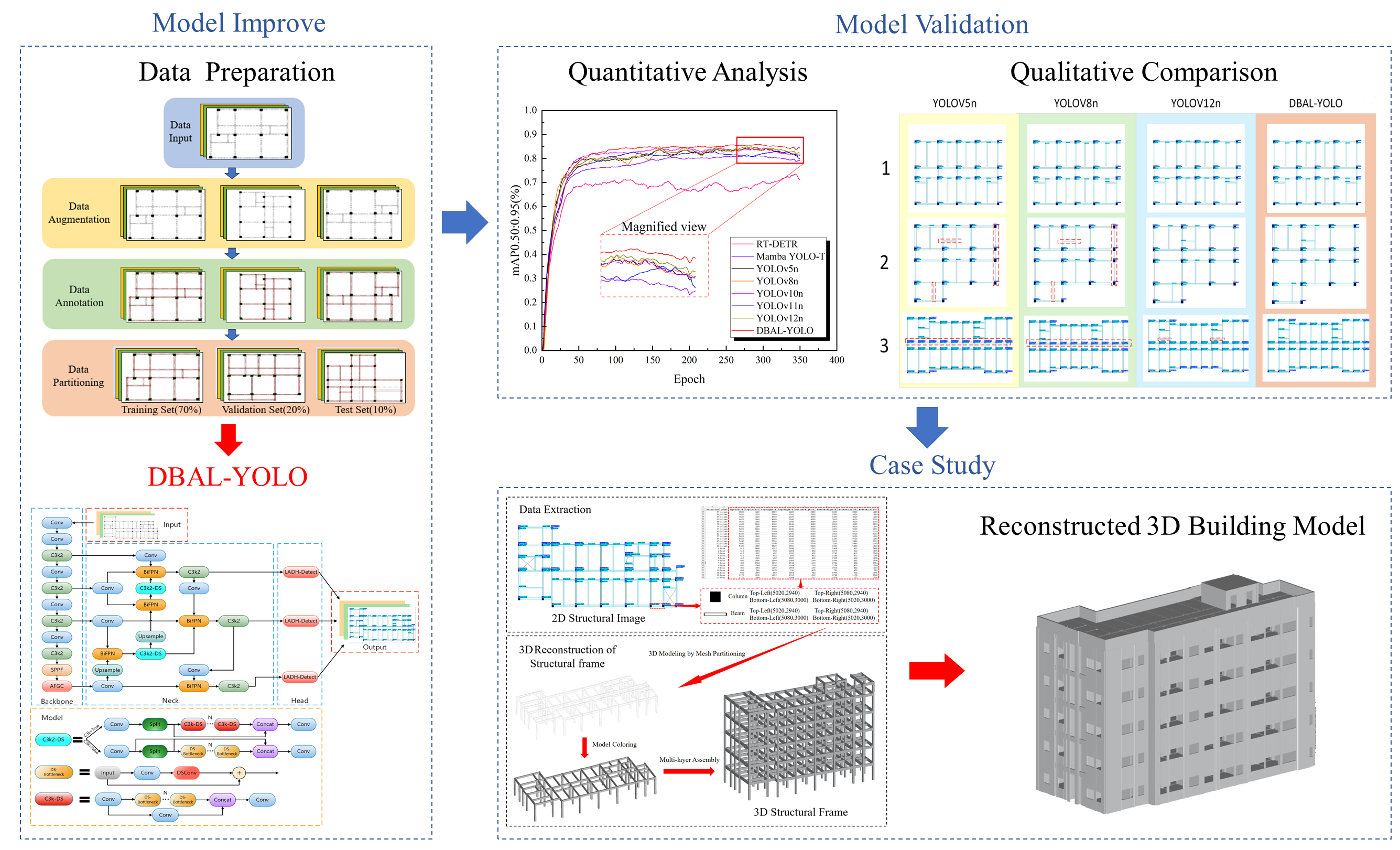
Digital twin city systems are key foundations for intelligent urban management and real-time resilience monitoring, consisting of digital models of buildings, roads and functional units. Efficient 3D modelling technologies for these units—especially existing buildings—are critical for these systems. However, due to a lack of 3D digital models for many old buildings, digital reconstruction relies on scanned paper drawings. Thus, this work develops an efficient structural member detection and rapid 3D reconstruction approach. An improved lightweight YOLOv11n algorithm (DBAL-YOLO) enables efficient and accurate detection of main structural elements (columns and beams) in floor plans, while a parameter-optimised U-Net model achieves pixel-level segmentation of architectural walls in floor plans. By integrating 2D geometric parameter extraction with linear extrusion reconstruction (via architectural modulus check and self-correction), the method enables automated 3D generation of component geometries and their spatial topological relationships. Tests on 3,960 annotated single-story drawings demonstrate that DBAL-YOLO achieves a high precision of 98.8% and an excellent recall of 98.3%, along with notable improvements in computational efficiency. The optimised U-Net yields a Mean Pixel Accuracy (mPA) of 96.4% and a Mean Intersection over Union (mIoU) of 98.8%. Further validation via a five-story building modelling case confirms the proposed approach’s capability to efficiently realise rapid 3D modelling of buildings using scanned paper engineering drawings.
building information modelling; deep learning; image detection; 3D physical modelling
