
 X
X WeiBo
WeiBo WeChat
 Facebook
 LinkedIn
 Reddit
 Bluesky
Mechanical properties of Afghan vault integral structures based on simulated lunar soil
- Volume
- CitationZhang Q, Chen H, Zhang J, Qu Y, Kim S, et al. Mechanical properties of Afghan vault integral structures based on simulated lunar soil. Smart Constr. 2026(1):0004, https://doi.org/10.55092/sc20260004.
- DOI10.55092/sc20260004
- CopyrightCopyright2026 by the authors. Published by ELSP.
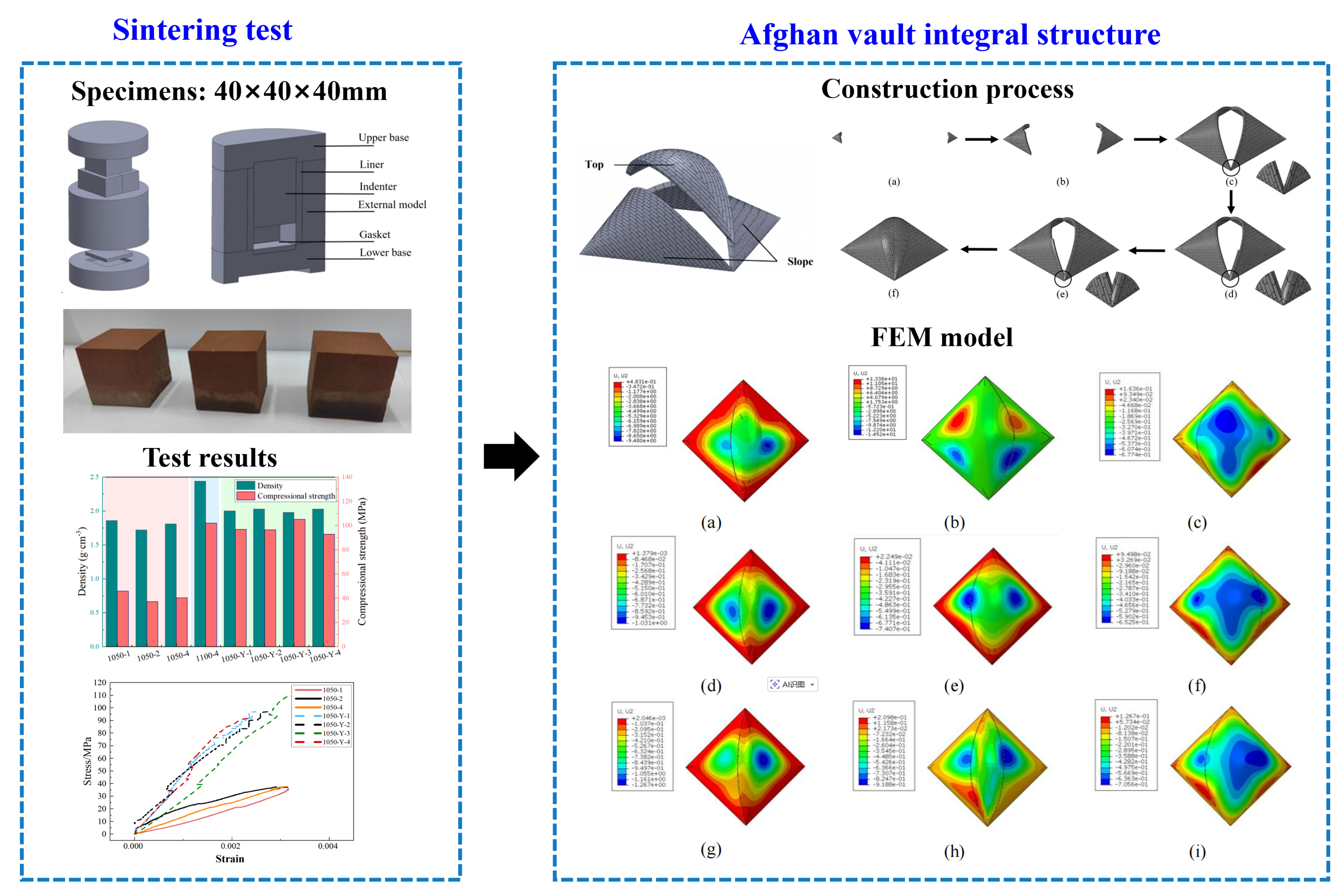
In-situ construction technology refers to the direct use of indigenous resources of celestial bodies for construction and production activities in space exploration activities. Focusing on in-situ construction technology aims to improve the sustainability and cost efficiency of lunar missions by utilizing lunar indigenous resources. The research methodology involved sintering experiments using simulated lunar soil, where cubic specimens (40 mm × 40 mm × 40 mm) were prepared based on material similarity analysis. Based on differences in pressure and temperature, three distinct sintering conditions were designed for the experiments. The experimental results yielded essential material properties, including density, compressive strength, and shrinkage rate. Based on these mechanical properties and the characteristics of mortarless masonry, a self-locking Afghan vault structure was developed. Designed as an external shielding shell to protect internal inflatable habitats from radiation and meteorites, this structure functions under unpressurized conditions. Finite element analysis was employed to develop a parametric model of the Afghan vault structure, enabling comprehensive evaluation of its mechanical properties under both static and dynamic loading conditions. The study specifically analyzed the optimal construction angles under two different loading conditions: self-weight load and typical seismic load. Analysis revealed that structural stability was optimized at inclination angles of α = 30° and θ = 80° for these respective conditions. These research advancements have laid a theoretical foundation for the practical application of Afghan vault structures in lunar construction engineering.
in-situ construction; simulated lunar soil; Afghan vault structure; high temperature sintering; Mortarless masonry
