
 X
X WeiBo
WeiBo WeChat
 Facebook
 LinkedIn
 Reddit
 Bluesky
Optimization of mechanical properties and microstructure of shell powder-modified geopolymer for sustainable construction
- Volume
- CitationFan L, Li Z, Zhang Y. Optimization of mechanical properties and microstructure of shell powder-modified geopolymer for sustainable construction. Smart Constr. 2026(1):0006, https://doi.org/10.55092/sc20260006.
- DOI10.55092/sc20260006
- CopyrightCopyright2026 by the authors. Published by ELSP.
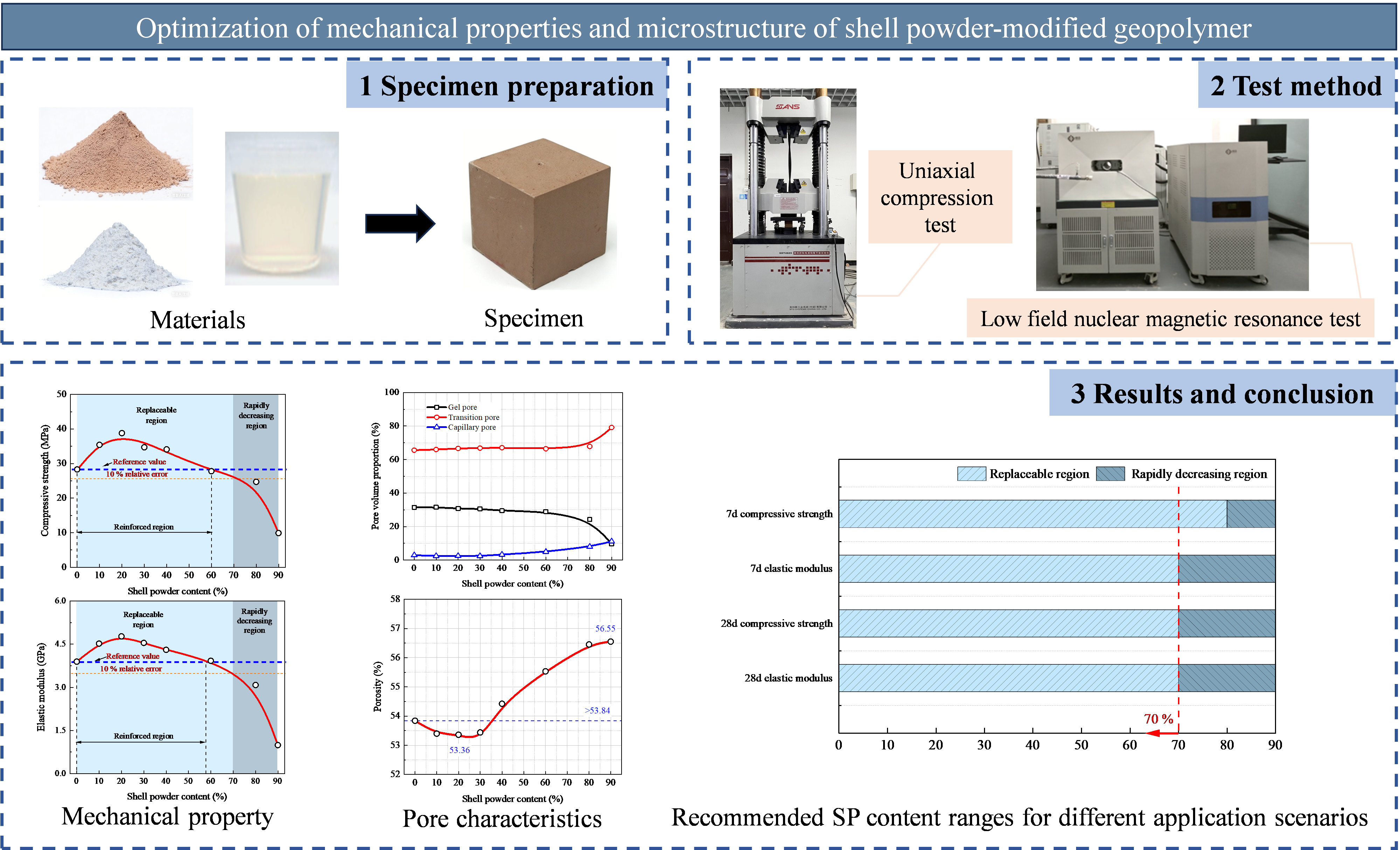
This study develops an innovative geopolymer material by incorporating shell powder (SP) as partial replacement for metakaolin. Eight mixtures with SP replacement levels from 0% to 90% were designed and systematically evaluated through density testing, P-wave velocity measurement, uniaxial compressive strength testing, and low-field nuclear magnetic resonance (LF-NMR) tests. The effects of SP content on the physical properties, mechanical properties and microstructure of modified geopolymer were discussed. An optimal replaceable region of SP to metakaolin was recommended. The results demonstrate that as SP content increases, the geopolymer exhibits initial improvement followed by deterioration in density, P-wave velocity, and compressive strength, while porosity shows an initial decrease before increasing. The comprehensive mechanical testing at 7 and 28 days revealed that, while mechanical properties generally decline with high SP content, SP can still replace up to 80% of metakaolin by mass while maintaining acceptable compressive strength, and up to 70% while maintaining acceptable elastic modulus. Furthermore, based on the mechanical characteristics relative to the plain geopolymer, the research establishes a practical classification system. This system divides the range of SP content into three distinct performance regions: (1) the reinforced region, where mechanical properties exceed those of the plain geopolymer; (2) the replaceable region, where properties are comparable to or only slightly below the reference; and (3) the rapidly decreasing region, where a significant deterioration in performance occurs. This classification provides valuable guidance for material design optimization under various engineering conditions. The findings confirm that SP can be successfully transformed into a functional component of geopolymer materials, offering a sustainable solution for solid waste utilization in construction applications.
shell powder; geopolymer; metakaolin; mechanical properties; microstructure; solid waste utilization
