
 X
X WeiBo
WeiBo WeChat
 Facebook
 LinkedIn
 Reddit
 Bluesky
Green synthesis and limited antibacterial activity of silver nanoparticles mediated by neem leaf extract: a characterization-based assessment
- Volume
- CitationChowdhury M, Mahmud M, Sarker M, Rayhan M, Younus M, et al. Green synthesis and limited antibacterial activity of silver nanoparticles mediated by neem leaf extract: a characterization-based assessment. Biofunct. Mater. 2026(1):0002, https://doi.org/10.55092/bm20260002.
- DOI10.55092/bm20260002
- CopyrightCopyright2026 by the authors. Published by ELSP.
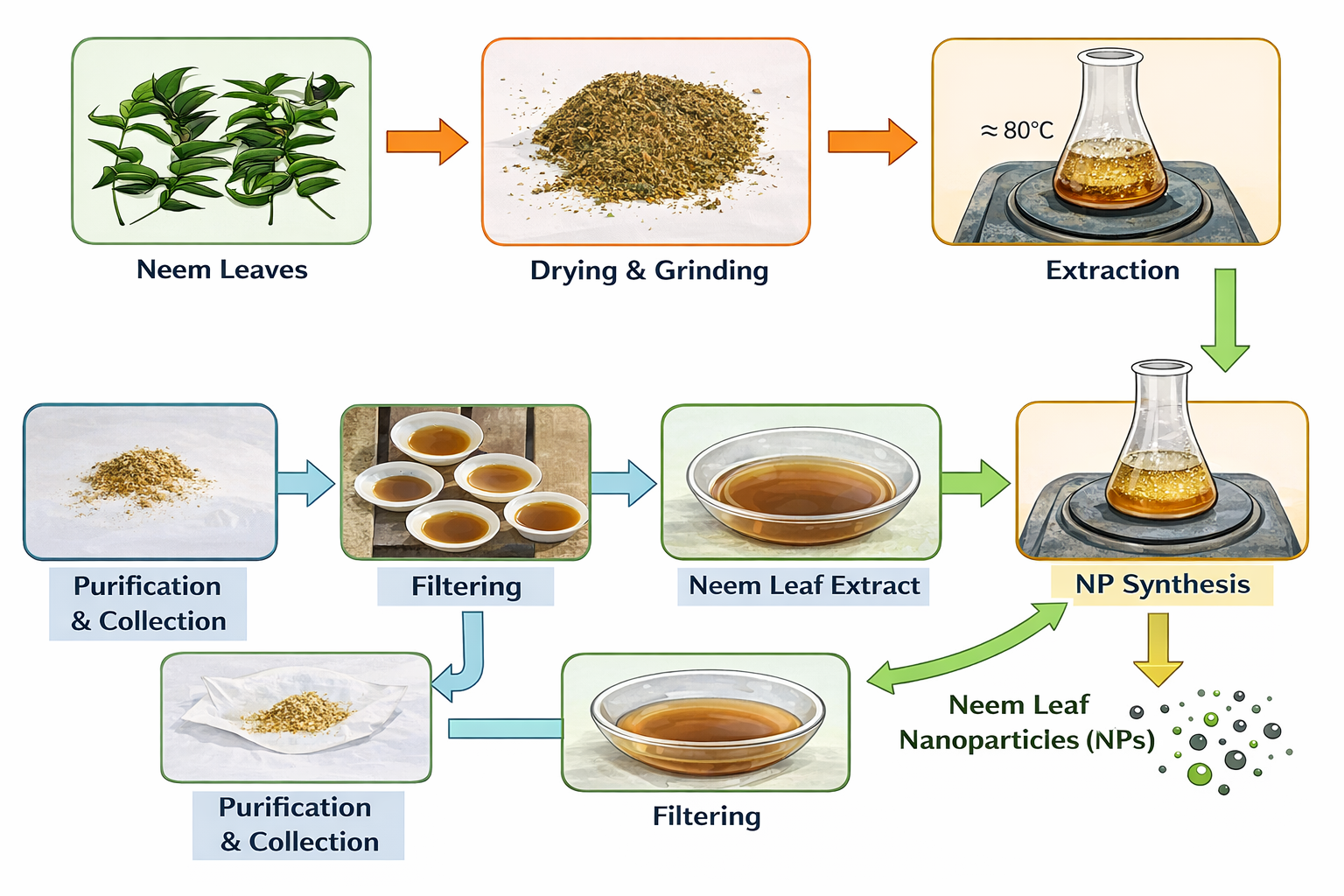
Green synthesis of silver nanoparticles (AgNPs) has become an ecologically safe substitute for traditional chemical methods; nonetheless, responsible use requires rigorous assessment of physicochemical characteristics and biological performance. In this work, Azadirachta indica (neem) leaf extract was used in ambient aqueous circumstances to create silver nanoparticles. UV-visible spectroscopy revealed a distinctive surface plasmon resonance peak at about 420 nm, confirming the creation of AgNPs. Neem phytochemicals, including phenolic compounds, flavonoids, proteins, and polysaccharides, have dual roles as surface-stabilizing ligands and reducing agents, according to Fourier Transform Infrared (FTIR) spectroscopy. Incomplete colloidal stabilization was indicated by irregular to quasi-spherical particle morphologies with noticeable aggregation and size heterogeneity, as revealed by scanning electron microscopy (SEM). The ASTM E2149–01 standard technique was used to assess the antibacterial activity of the produced AgNPs against Bacillus subtilis and Escherichia coli. For both bacterial strains, the nanoparticles’ poor antibacterial effectiveness resulted in inhibition zones of around 6 mm, which were much smaller than those of the positive control. Particle aggregation, excessive organic surface capping, and low effective nanoparticle concentration all contribute to the poor antibacterial activity by lowering the bioavailability of silver ions. Overall, our study shows that neem-mediated green synthesis of AgNPs is feasible and offers mechanistic insights into their generation and stability. However, before biomedical applications can be realistically considered, the biological data emphasize the necessity for more optimization, quantitative phytochemical analysis, aggregation control, stability assessment, and thorough biocompatibility evaluation.
green synthesis; silver nanoparticles; Azadirachta indica
