
 X
X WeiBo
WeiBo WeChat
 Facebook
 LinkedIn
 Reddit
 Bluesky
Frontier AI in computational civil engineering: a review of graph, sequence, physics-informed deep learning, and beyond (2020–2025)
- Volume
- CitationSong L, Fan J, Zeng S, Wang C. Frontier AI in computational civil engineering: a review of graph, sequence, physics-informed deep learning, and beyond (2020–2025). Smart Constr. 2026(1):0001, https://doi.org/10.55092/sc20260001.
- DOI10.55092/sc20260001
- CopyrightCopyright2026 by the authors. Published by ELSP.
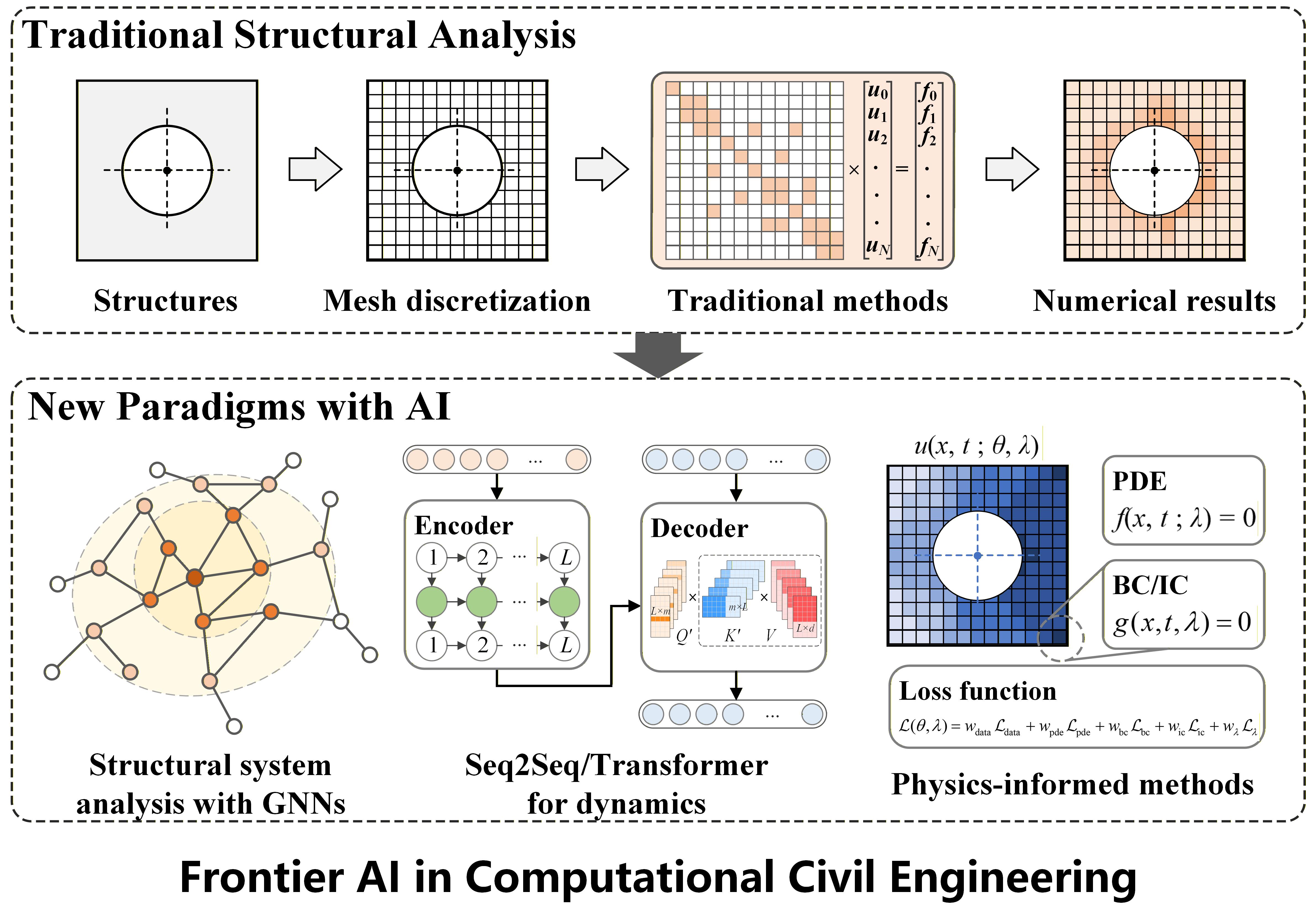
Structural computational analysis in civil engineering increasingly demands efficient, robust, and physics-aware methodologies capable of addressing non-Euclidean geometries, history-dependent behaviors, and multi-scale problems that remain challenging for conventional numerical approaches. Recent advances in frontier artificial intelligence (AI) techniques have shown promising potential to overcome these limitations. This paper presents a comprehensive review of frontier AI applications in computational structural analysis from 2020 to 2025, focusing on graph neural networks (GNNs), sequence-to-sequence (Seq2Seq) and Transformer-based architectures, and physics-informed methods. We synthesize fundamental concepts, typical model variants, and representative applications across diverse tasks, including constitutive modeling, static and dynamic structural analysis, data reconstruction, and parameter inversion. Furthermore, we identify critical research gaps and discuss potential future directions within each model family. A quantitative analysis of the reviewed studies is conducted, categorizing them by publication year, application task, and adopted model type. Common challenges regarding benchmarking, empirical–physics trade-offs, scalability and generalizability are summarized. Finally, we highlight several promising techniques for advancing intelligent structural computation and promoting practical engineering deployment.
AI-based computational analysis; graph neural network; transformer; physics-informed method; civil engineering
