
 X
X WeiBo
WeiBo WeChat
 Facebook
 LinkedIn
 Reddit
 Bluesky
Comparison and selection of support schemes for deep buried soft broken section of Xinjin expressway spiral tunnel—a case study of Hankou tunnel
- Volume
- CitationLu D, Liu X, Xu H, Guo C, Du X. Comparison and selection of support schemes for deep buried soft broken section of Xinjin expressway spiral tunnel—a case study of Hankou tunnel. Smart Constr. 2026(1):0002, https://doi.org/10.55092/sc20260002.
- DOI10.55092/sc20260002
- CopyrightCopyright2026 by the authors. Published by ELSP.
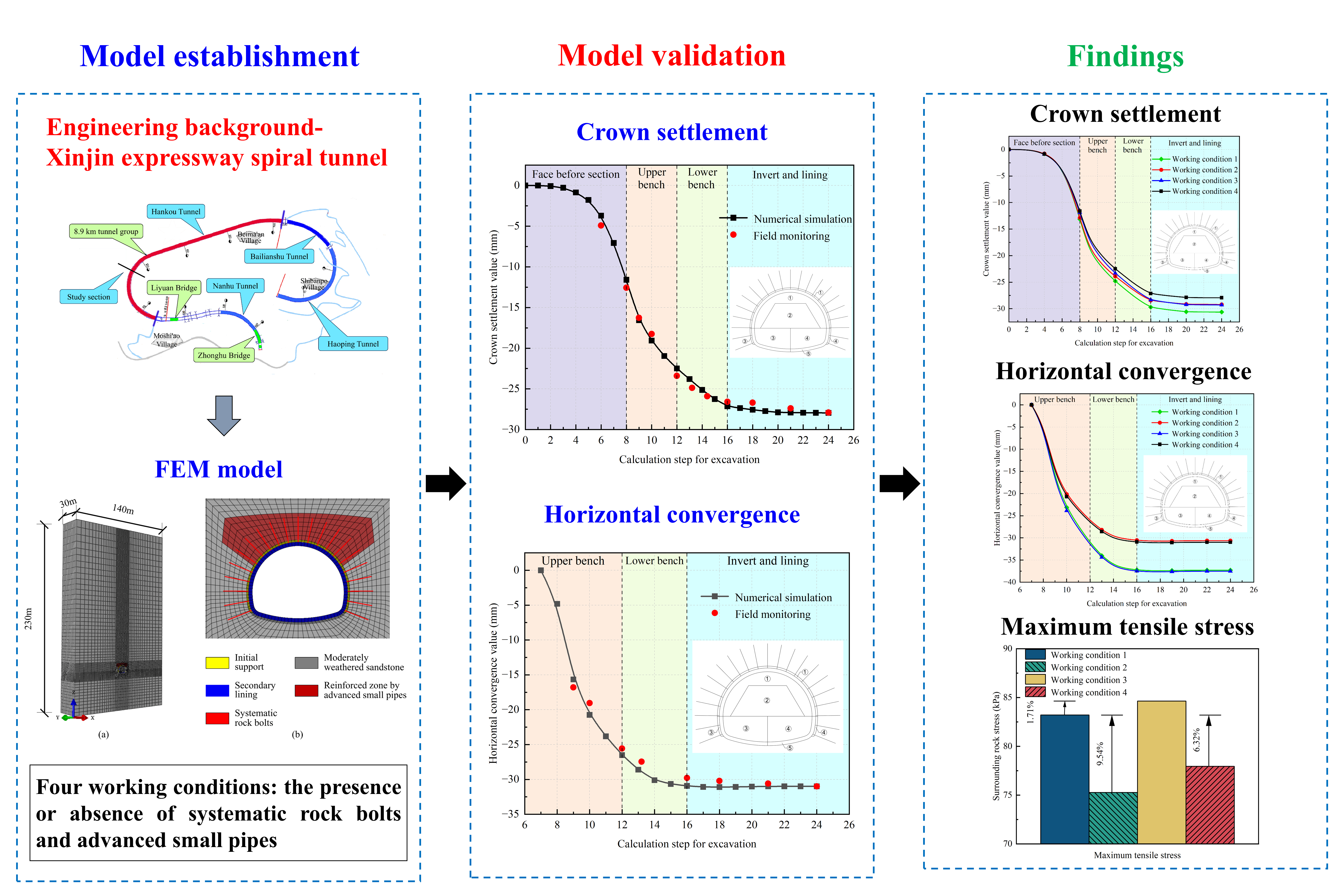
Based on the spiral tunnel group of Xinjin expressway, this paper takes the typical deep buried soft broken section of Hankou tunnel as the research object. On the basis of the composite lining structure with primary support and secondary lining, considering four working conditions: the presence or absence of systematic rock bolts and advanced small pipes. Utilizing the ABAQUS numerical simulation platform, refined numerical simulations of the entire construction process are conducted and compared with field-measured engineering data. The results indicate: (1) Under all four working conditions, the vault settlement and horizontal convergence exhibit a pattern of slow growth, followed by rapid growth, and eventual stabilization during tunnel excavation. When excavating the core soil of the upper bench after installing the primary support, the rate and magnitude of change in vault settlement and horizontal convergence are significant. However, after installing the secondary lining, the rates of change for both remain relatively stable; (2) The application of systematic rock bolts effectively controls vault settlement, horizontal convergence, and plastic zones in the surrounding rock. The use of advanced small pipes demonstrates good control over vault settlement and stress in the surrounding rock; (3) In terms of controlling vault stress in the surrounding rock, advanced small pipes outperform systematic rock bolts, whereas systematic rock bolts are more effective than advanced small pipes in controlling horizontal convergence, maximum tensile stress, and plastic zones; (4) Considering both numerical simulation results and the construction cost analysis, the combined use of primary support, secondary lining, and systematic rock bolts is sufficient to effectively control the stress and deformation of the surrounding rock. Advanced small pipes can serve as an auxiliary construction method in soft and fractured sections, providing pre-reinforcement to the surrounding rock.
expressway spiral tunnel; deep buried soft and weak surrounding rock; comparison and selection of multiple support schemes; refined simulation of the entire construction process
