
 X
X WeiBo
WeiBo WeChat
 Facebook
 LinkedIn
 Reddit
 Bluesky
Deconstructing the digital veil: criminal liability and ethical failures in AI-driven Sharia credit scoring systems in Indonesia
- Volume
- CitationAnggriawan R, Hamsin MK. Deconstructing the digital veil: criminal liability and ethical failures in AI-driven Sharia credit scoring systems in Indonesia. Law Ethics Technol. 2026(2):0004, https://doi.org/10.55092/let20260004.
- DOI10.55092/let20260004
- CopyrightCopyright2026 by the authors. Published by ELSP.
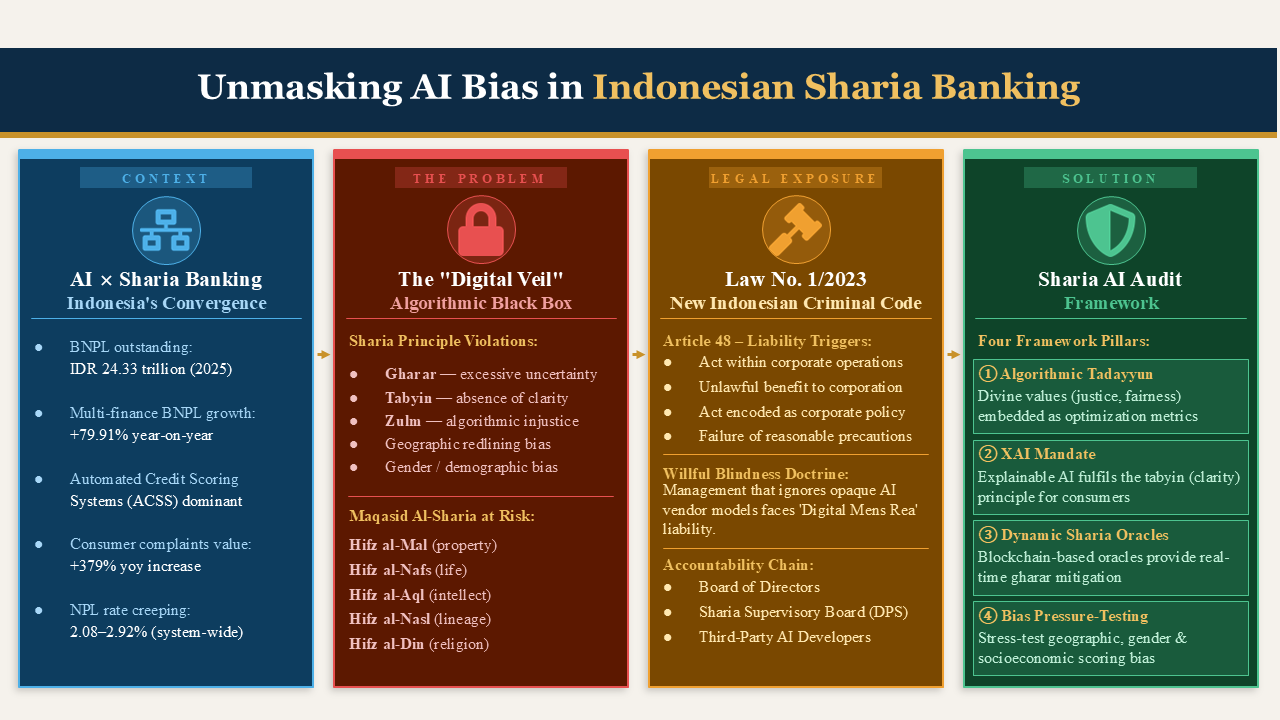
Artificial intelligence (AI) and Sharia banking are rapidly converging, resulting in fundamental transformations to the Indonesian financial system. A prime example of this convergence is the explosive growth of the buy now pay later (BNPL) industry. Whereas automated credit scoring can be leveraged to expand access to credit for consumers, it also raises important questions about financial inclusion versus creating a digital veil (i.e., the algorithms used to score applicants) which may consist of a black box algorithm that is opaque regarding how it determines an individual’s eligibility. As such, this form of automated scoring has raised concerns over the possibility of violating Sharia principles (e.g., clarity/tabyin, uncertainty/gharar). This study provides empirical and normative analysis of the inter-relationship between AI governance, Islamic juristic input, and the new Criminal Code of Indonesia (Law No. 1/2023). The findings indicate that there are likely to be algorithmic biases present, as well as willful blindness, by the management of these entities with respect to the corporate criminal liability standard applicable to the conduct of this opaque type of credit scoring system, which will render these entities subject to criminal fines of up to IDR 50 billion. Therefore, it concludes that Sharia-compliant banks must take proactive steps towards being Sharia-compliant in a digital manner by regularly conducting Sharia audits and using Explainable AI (XAI) for their automated systems, in order to ensure that the technical aspects of such systems remain consistent with the overarching objectives of Maqasid al-Sharia (higher objectives of Sharia).
algorithmic bias; corporate criminal liability; Indonesia; Maqasid Al-Sharia; Sharia banking
