
 X
X WeiBo
WeiBo WeChat
 Facebook
 LinkedIn
 Reddit
 Bluesky
An ensemble deep learning approach for surface defect detection in aluminum die-cast gas meter lids
- Volume
- CitationQian W, Ayorinde O, Chen S, Guo L, Jensen D. An ensemble deep learning approach for surface defect detection in aluminum die-cast gas meter lids. Artif. Intell. Auton. Syst. 2026(1):0006, https://doi.org/10.55092/aias20260006.
- DOI10.55092/aias20260006
- CopyrightCopyright2026 by the authors. Published by ELSP.
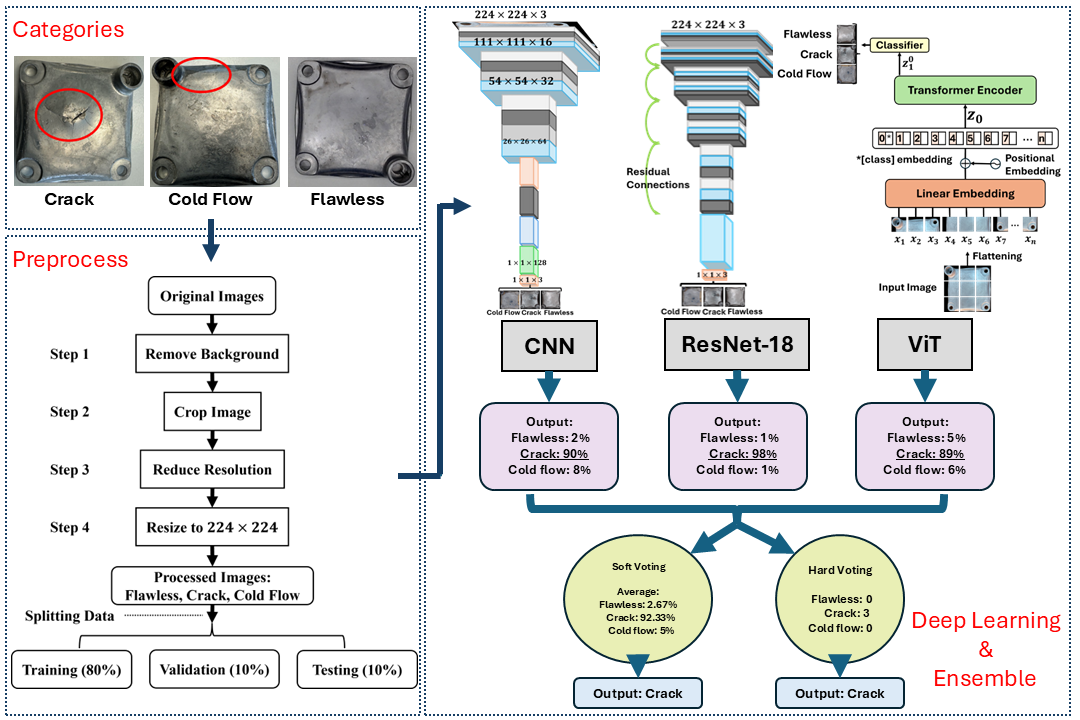
Aluminum die-cast products often exhibit surface defects that vary in type and severity depending on product function and design requirements. Current defect detection primarily relies on manual inspection, which demands significant expertise, raises health and fatigue concerns, and is prone to human error. Automated defect detection offers a promising solution to reduce costs, improve efficiency, resolve occupational safety and health concerns, and mitigate challenges in labor shortages and training. This paper presents an ensemble deep learning (DL) approach for detecting surface defects in aluminum die-cast lids for residential gas meters, a quality-critical component with stringent safety standards. Specifically, we implement and evaluate three state-of-the-art DL architectures: a convolutional neural network (CNN), residual networks (ResNet-18), and Vision Transformer (ViT). In addition, we develop an ensemble model to further enhance performance. We leverage grid search and cross-validation for hyperparameter tuning and train/test each model ten times for comprehensive performance evaluation. Experiments on a large real-world dataset demonstrate that all models achieve high accuracy, precision, and recall, with CNN and ResNet-18 slightly outperforming ViT. The ensemble model further improves prediction accuracy and robustness. The paired t-tests showed that the ensemble model significantly performed better compared to CNN and ViT model. In summary, this study contributes to the advancement of automated inspection of surface defects in die-cast products by systematically comparing state-of-the-art deep learning methods, discussing model selection criteria, and optimizing ensemble strategies. Centered on CNN, ResNet-18, and ViT architectures, it proposes a rigorous methodological framework for surface defect detection and provides a foundational basis for subsequent research in in-situ quality control. Our codes are available at https://github.com/Alexruoyun/Aluminum-Die-Casting-Surface-Defect-Detection.
surface defect detection; aluminum die casting; deep learning; convolution neural networks; residual networks; vision transformer; ensemble
