
 X
X WeiBo
WeiBo WeChat
 Facebook
 LinkedIn
 Reddit
 Bluesky
A physics-constrained and data-driven approach for thermal field inversion in chiplet-based packaging
- Volume
- CitationQi Y, Wu Y, Xiong , Hu , Pan D. A physics-constrained and data-driven approach for thermal field inversion in chiplet-based packaging. AI Mater. 2025(2):0016, https://doi.org/10.55092/aimat20250016.
- DOI10.55092/aimat20250016
- CopyrightCopyright2025 by the authors. Published by ELSP.
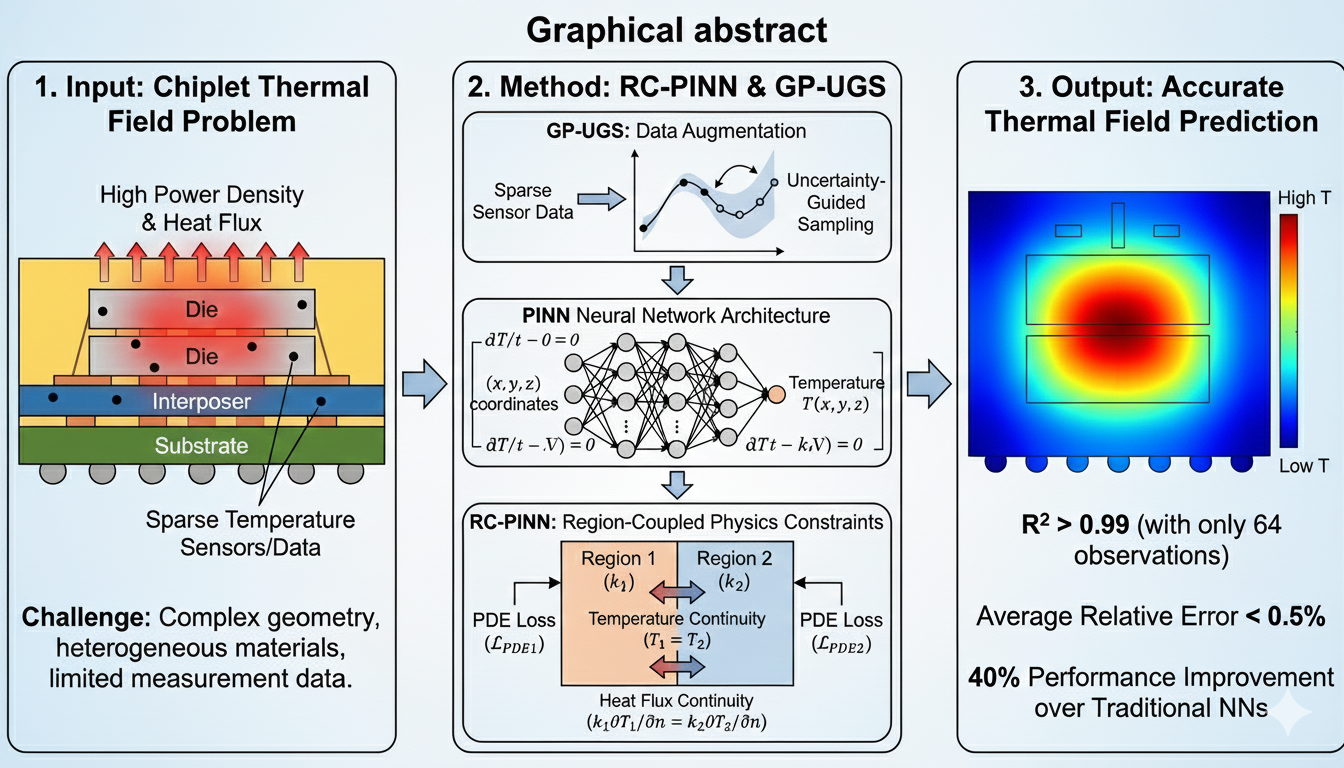
The chiplet-based packaging integrates multiple heterogeneous chiplets with distinct functionalities and materials as a promising alternative to traditional SoC designs, reducing manufacturing costs and improving chip yield. However, increased power density and deteriorating heat dissipation conditions severely affect the functionality and stability of such systems, whereas existing thermal field inversion methods often overlook the correlation between data constraints and physical constraints, leading to insufficient prediction accuracy. This paper proposes a method based on Region-Coupled Physics-Informed Neural Networks (RC-PINNs) to address the thermal field inversion of chiplet packaging using a small dataset. RC-PINN divides the solution domain into multiple regions based on material properties and incorporates physical constraints into the loss functions of each region to ensure the solutions comply with physical laws. Coupling between different regions is achieved through temperature and heat flux continuity conditions to maintain physical consistency. Additionally, a Gaussian Process Uncertainty-Guided Sampling (GP-UGS) method is developed for data augmentation, further improving prediction accuracy in data-sparse scenarios. Experimental results demonstrate that RC-PINN effectively solves the thermal field inversion for chiplet packaging, achieving an average relative error of less than 0.4% under limited data conditions, with a 40% improvement in performance over traditional neural network methods. The GP-UGS method further improves prediction accuracy and generalization, raising the R2 score to over 0.99 with only 64 observations.
chiplet-based packaging; physics-informed neural network; thermal field inversion; small dataset; data augmentation
