
 X
X WeiBo
WeiBo WeChat
 Facebook
 LinkedIn
 Reddit
 Bluesky
Application of artificial intelligence combined with density functional theory in materials
- Volume
- CitationZhu X, Yu J, Liu Y, Song Y, Zhang L, et al. Application of artificial intelligence combined with density functional theory in materials. AI Mater. 2026(1):0001, https://doi.org/10.55092/aimat20260001.
- DOI10.55092/aimat20260001
- CopyrightCopyright2026 by the authors. Published by ELSP.
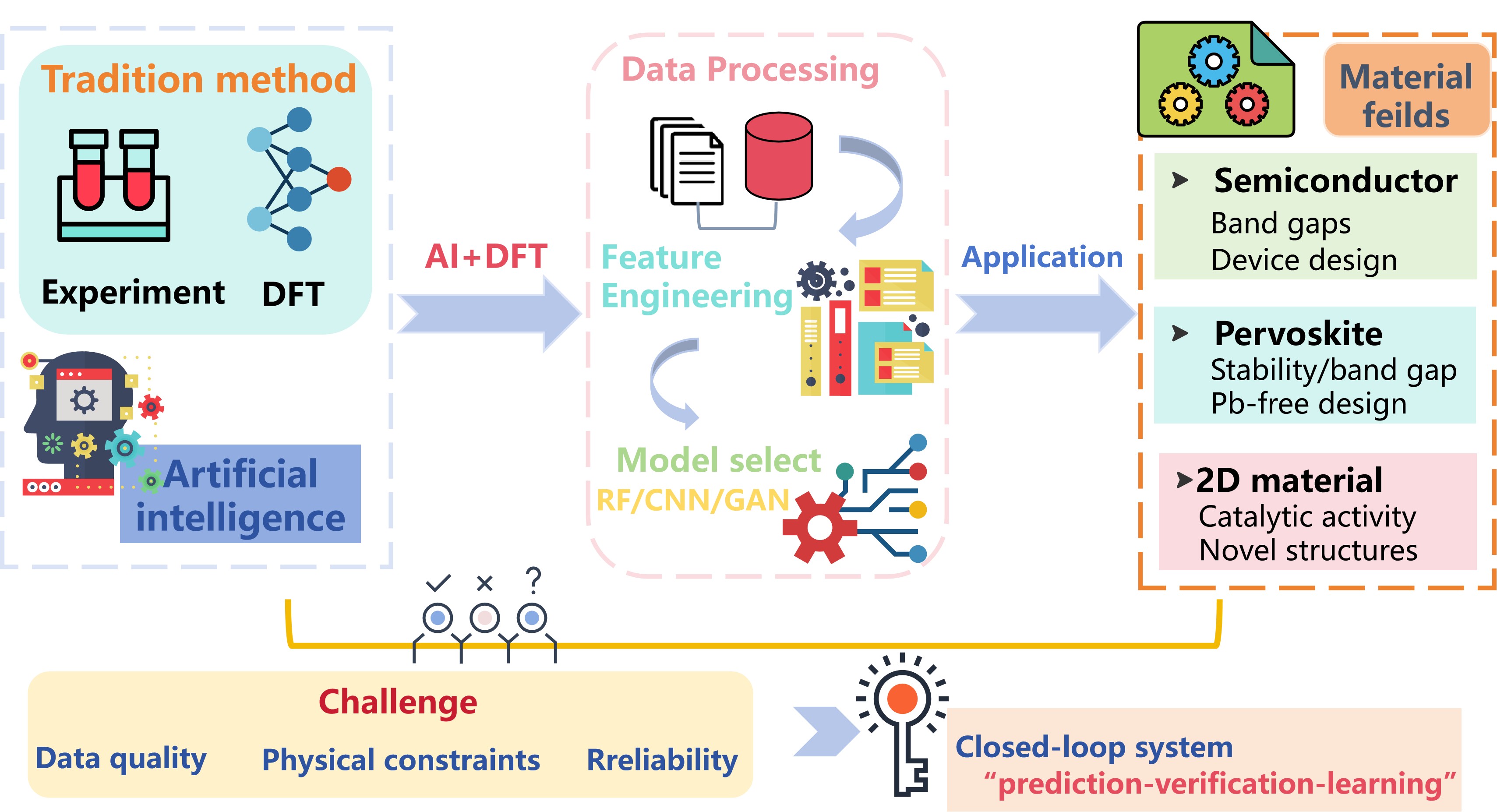
Artificial intelligence (AI), as an important driving force of the technological revolution, is changing the way humans produce, live, and learn. In recent years, massive training data, advanced algorithms, and efficient computational power have advanced the widespread application of AI. The cross-integration of AI and materials science is currently an important scenario and technological frontier for the application of AI. The application in the field of new materials has shown great potential and value. Compared to traditional experimental and Density Functional Theory (DFT)-based approaches, which are time-consuming and inefficient for studying material properties, the rapid advancement of AI technology is dramatically accelerating the exploration, design, synthesis, and optimization of novel materials. This review introduces the application of AI techniques combined with DFT theoretical computation in materials innovation, such as research on new materials, materials design, property prediction and synthesis. It highlights the advantages of AI techniques combined with DFT theoretical computation over traditional methods in the field of materials, as well as the future directions and unknown challenges of materials science.
artificial intelligence; machine learning; density functional theory; deep learning; semiconductor material; perovskite material; two-dimensional material
