
 X
X WeiBo
WeiBo WeChat
 Facebook
 LinkedIn
 Reddit
 Bluesky
Application of artificial intelligence in biofuel cell catalyst design and system optimization
- Volume
- CitationWang Y, Zhang M, Xiao M, Chen Y, Zhang Y. Application of artificial intelligence in biofuel cell catalyst design and system optimization. AI Mater. 2026(1):0002, https://doi.org/10.55092/aimat20260002.
- DOI10.55092/aimat20260002
- CopyrightCopyright2026 by the authors. Published by ELSP.
- Special Issue
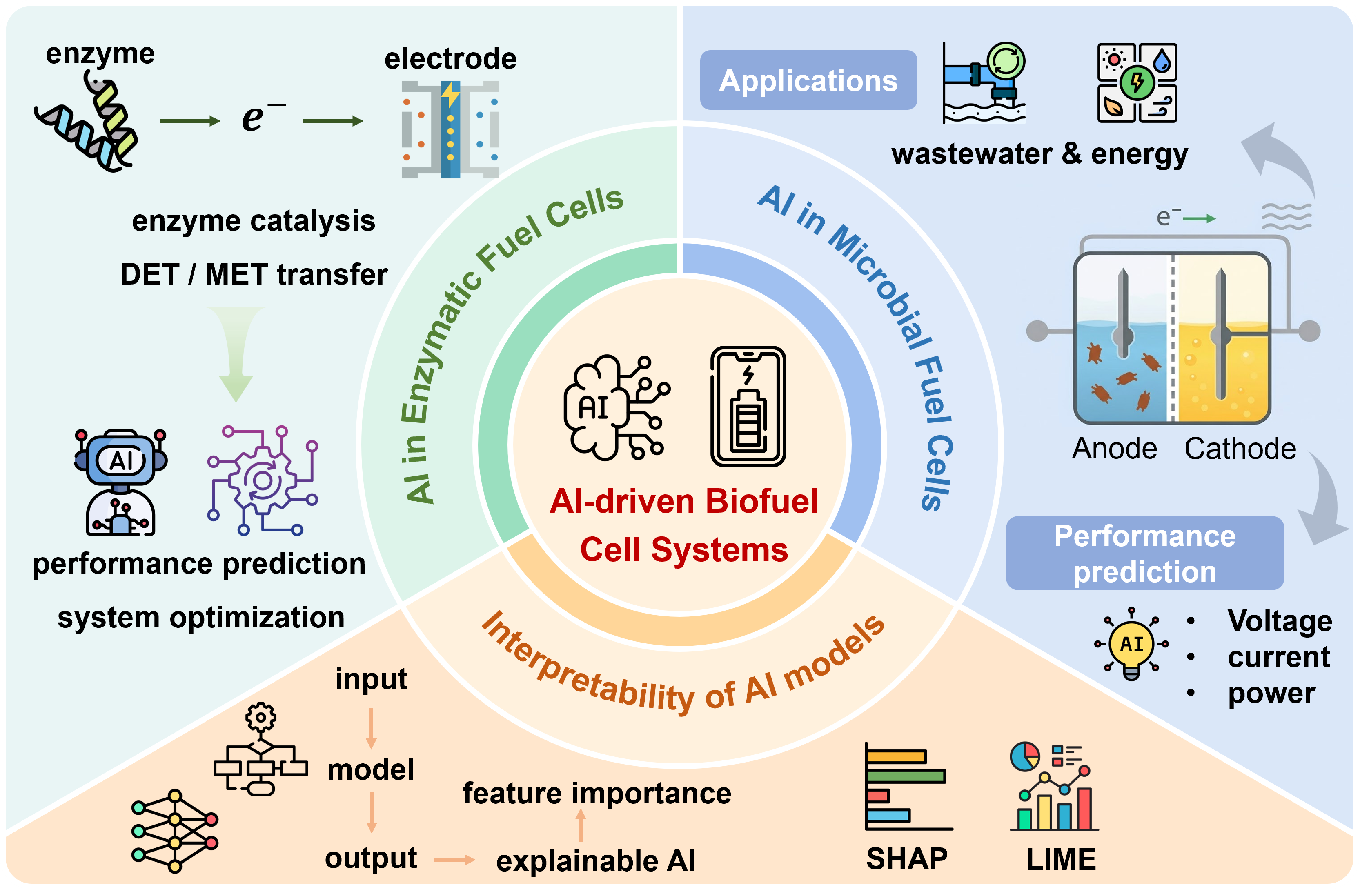
With the global energy transition underway, biofuel cells are gaining increasing attention as a clean energy technology capable of utilizing renewable biomass and organic waste for power generation. Despite the significant advantages of biofuel cells in terms of environmental friendliness and low carbon emissions, challenges related to catalyst efficiency, system complexity, and long-term stability still limit their large-scale application. This review examines the growing role of artificial intelligence (AI) in advancing biofuel cell technology, focusing on its advancements in catalyst screening, system modeling, and optimization. By leveraging AI technologies- including machine learning and deep learning-significant improvements have been demonstrated in material design, system parameter optimization, and performance prediction outcomes. Particular emphasis is placed on AI applications within enzymatic fuel cells and microbial fuel cells, analyzing progress in catalyst material discovery, system simulation, and operational control. By summarizing current breakthroughs and challenges, this analysis aims to offer theoretical support and technical guidance for future development of intelligent, AI-driven green energy systems.
artificial intelligence; deep learning; biofuel cells; enzymatic fuel; microbial fuel cells
