
 X
X WeiBo
WeiBo WeChat
 Facebook
 LinkedIn
 Reddit
 Bluesky
Advanced artificial intelligence algorithms and hardware acceleration techniques applied to material structure design
- Volume
- CitationZhang J, Yu J, Qiu N, Liu Y, Song Y, et al. Advanced artificial intelligence algorithms and hardware acceleration techniques applied to material structure design. AI Mater. 2026(1):0003, https://doi.org/10.55092/aimat20260003.
- DOI10.55092/aimat20260003
- CopyrightCopyright2026 by the authors. Published by ELSP.
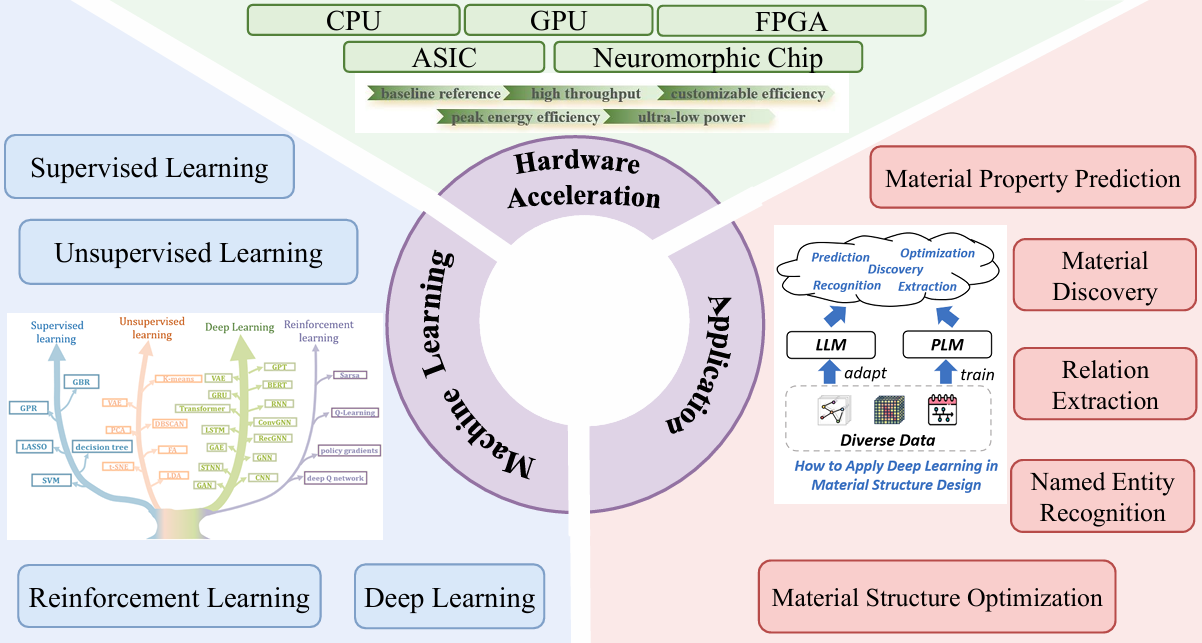
The ability of AI-based algorithms to reflect the physical properties of training data and accurately predict the properties of undeveloped materials has made artificial intelligence (AI) algorithms an important tool in the domain of materials science. Material structure design, as a multi-step and multi-scientific task, involves many aspects from the determination of design objectives to material selection, preparation methods, sample testing and performance evaluation, etc. Traditional experiment-driven, theory-driven and algorithm-driven approaches have accumulated a large amount of textual material text data. With the development of technology, the data-driven approach of “Big Data+AI” has accelerated the development of material structure design, and in particular, deep learning (DL) as a branch of machine learning has become the fastest growing topic in materials science because of its powerful capabilities to analyze unstructured data and automatically identify features. In this paper, we focus on the common deep learning methods in materials research, and then review the material property prediction, material structure optimization, material discovery and information extraction from materials literature in the context of deep learning-based material structure design. At the same time, we introduce the hardware acceleration technologies based on deep learning. Finally, the summary and future directions of deep learning in future materials research are discussed.
artificial intelligence; hardware acceleration; material structure design; machine learning; deep learning; data-driven
