
 X
X WeiBo
WeiBo WeChat
 Facebook
 LinkedIn
 Reddit
 Bluesky
Uncertainty-aware deep neural network for multi-scale temporal modeling in industrial equipment prognostics
- Volume
- CitationZhang B. Uncertainty-aware deep neural network for multi-scale temporal modeling in industrial equipment prognostics. Adv. Manuf. 2026(2):0007, https://doi.org/10.55092/am20260007.
- DOI10.55092/am20260007
- CopyrightCopyright2026 by the authors. Published by ELSP.
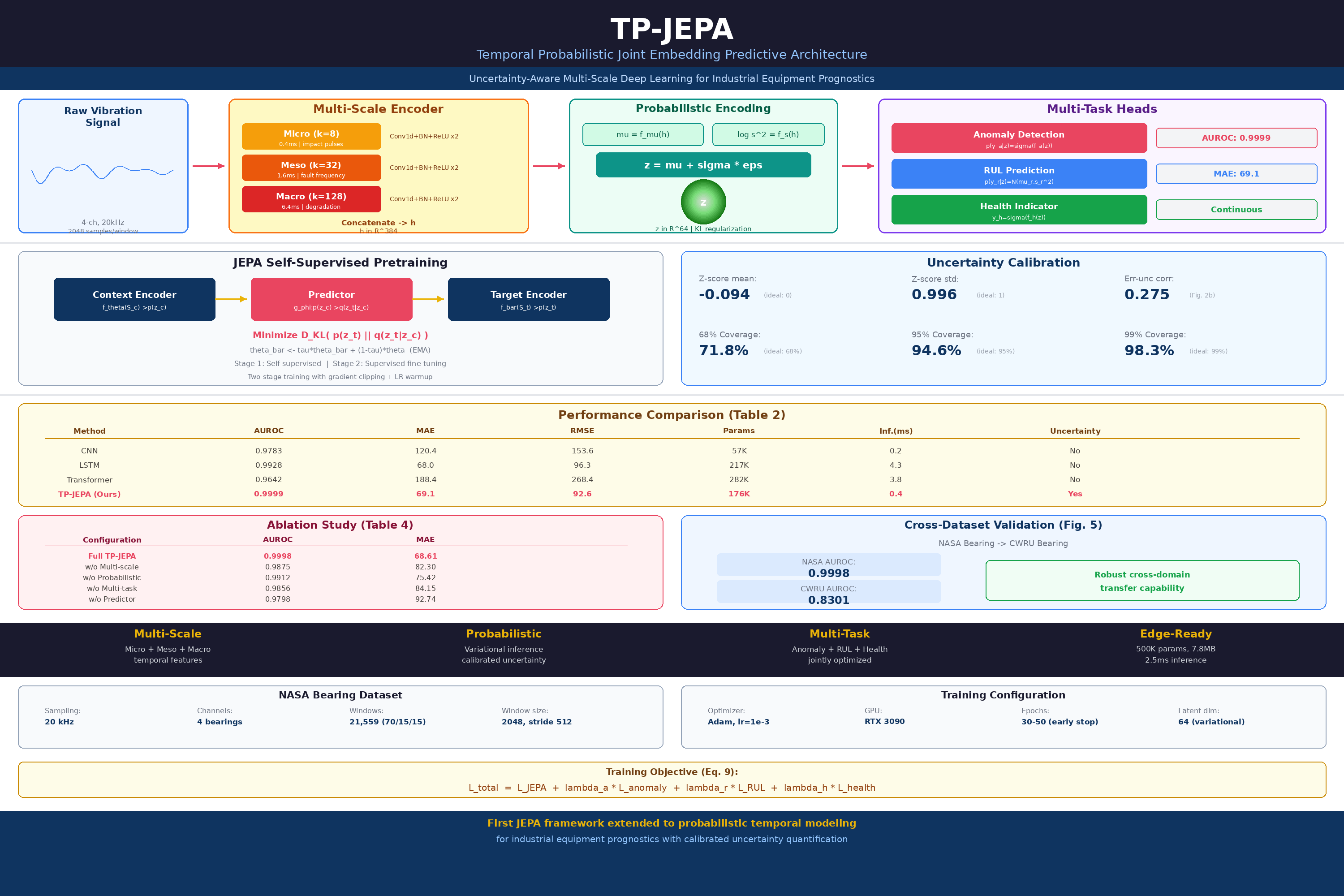
Predictive maintenance for industrial equipment is critical for improving production safety, reducing maintenance costs, and optimizing equipment utilization. However, existing deep learning methods face two key challenges in industrial equipment prognostics: the lack of uncertainty quantification to support risk-informed decision-making and the inability to simultaneously capture multi-scale temporal patterns in equipment degradation processes. This paper presents the Temporal Probabilistic Joint Embedding Predictive Architecture (TP-JEPA), a novel deep neural network framework that learns robust representations of equipment health states by predicting probabilistic distributions of future states in latent space. TP-JEPA’s innovations include: (1) a probabilistic encoding mechanism that extends deterministic representations to distributions, inherently quantifying prediction uncertainty; (2) a multi-scale temporal encoder designed to extract hierarchical features from high-frequency transients to long-term degradation trends; and (3) a multi-task learning paradigm that jointly optimizes anomaly detection, remaining useful life (RUL) estimation, and health state assessment, enabling synergistic task enhancements. Evaluations on the National Aeronautics and Space Administration (NASA) bearing dataset demonstrate that TP-JEPA achieves an Area Under the Receiver Operating Characteristic curve (AUROC) of 0.9999 for anomaly detection—outperforming state-of-the-art methods—and a mean absolute error of 69.1 cycles for remaining useful life prediction, with well-calibrated uncertainty estimates (95% confidence interval coverage of 94.6%). Cross-dataset validation and ablation studies confirm the framework’s efficacy and robustness.
deep learning; fault diagnosis; joint embedding predictive architecture; predictive maintenance; uncertainty quantification
