
 X
X WeiBo
WeiBo WeChat
 Facebook
 LinkedIn
 Reddit
 Bluesky
Artificial intelligence in additive and smart manufacturing: a critical review of design, process optimization, and quality control
- Volume
- CitationVerma R, Akhai S. Artificial intelligence in additive and smart manufacturing: a critical review of design, process optimization, and quality control. Adv. Manuf. 2026(3):0012, https://doi.org/10.55092/am20260012.
- DOI10.55092/am20260012
- CopyrightCopyright2026 by the authors. Published by ELSP.
- Special Issue
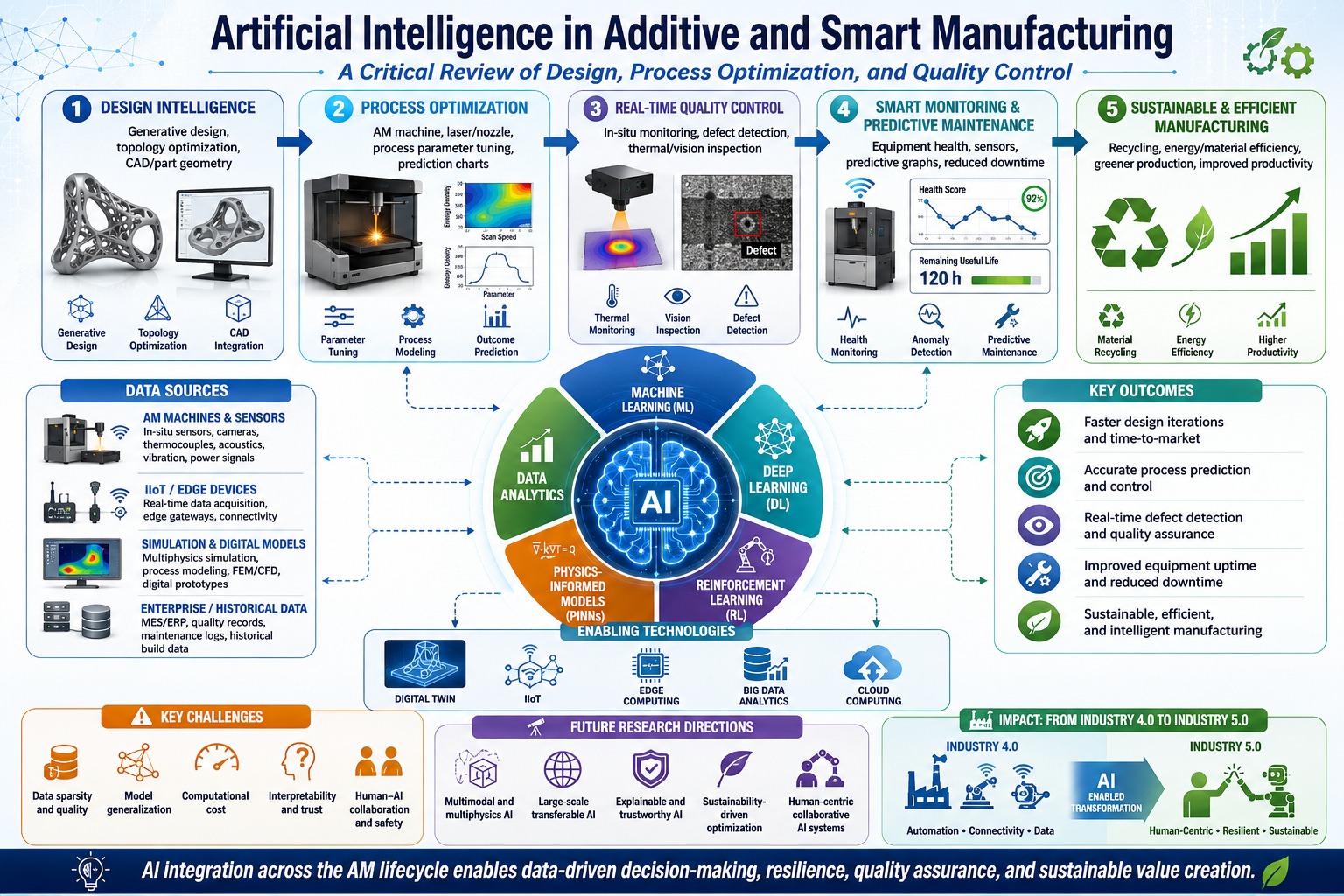
The rapid adoption of artificial intelligence (AI) in the production sector has triggered a revolutionary change in the design, manufacturing, monitoring, and optimization. The paper is a critical analysis of AI-based additive manufacturing (AM) and smart manufacturing systems with an emphasis on design intelligence and process optimization, real-time quality control, and sustainable production. Based on recent literature, this paper considers the major AI methods, such as machine learning (ML), deep learning (DL), reinforcement learning (RL), and physics-informed neural networks (PINNs) throughout the manufacturing lifecycle. The results show that AI can greatly decrease the time spent on design iterations, increase the accuracy of predictions of process parameters, and allow in-situ defect detection with high accuracy. Moreover, AI helps to ensure predictive maintenance strategies, reduce the number of unforeseen failures and enhance operational efficiency. The interplay of AI and digital twin technology, Industrial Internet of Things (IIoT), edge computing, and big data analytics is cited as a pillar of Industry 4.0 and the future Industry 5.0 paradigm. Regardless of these developments, the issues of data sparsity, the applicability of the model, computational expense, and interpretability are the key obstacles to large-scale industrial adoption. The value of human-AI cooperation and the necessity to have explainable and reliable AI systems in critical safety areas are also emphasized in the study. Lastly, the review provides future research directions, which focus on multi-modal AI, large-scale manufacturing models, and sustainability-based optimization frameworks. In general, the article is a thorough synthesis of the recent developments and realistic directions of introducing AI-enabled smart manufacturing.
artificial intelligence; additive manufacturing; machine learning; digital twin; smart manufacturing
