
 X
X WeiBo
WeiBo WeChat
 Facebook
 LinkedIn
 Reddit
 Bluesky
Constitutive and adaptive sorting of exosomal miRNAs: a novel classification framework and its implications for disease and therapy
- Volume
- CitationHuang Z, Zou Y, Zhang Y. Constitutive and adaptive sorting of exosomal miRNAs: a novel classification framework and its implications for disease and therapy. ExRNA 2026(3):0009, https://doi.org/10.55092/exrna20260009.
- DOI10.55092/exrna20260009
- CopyrightCopyright2026 by the authors. Published by ELSP.
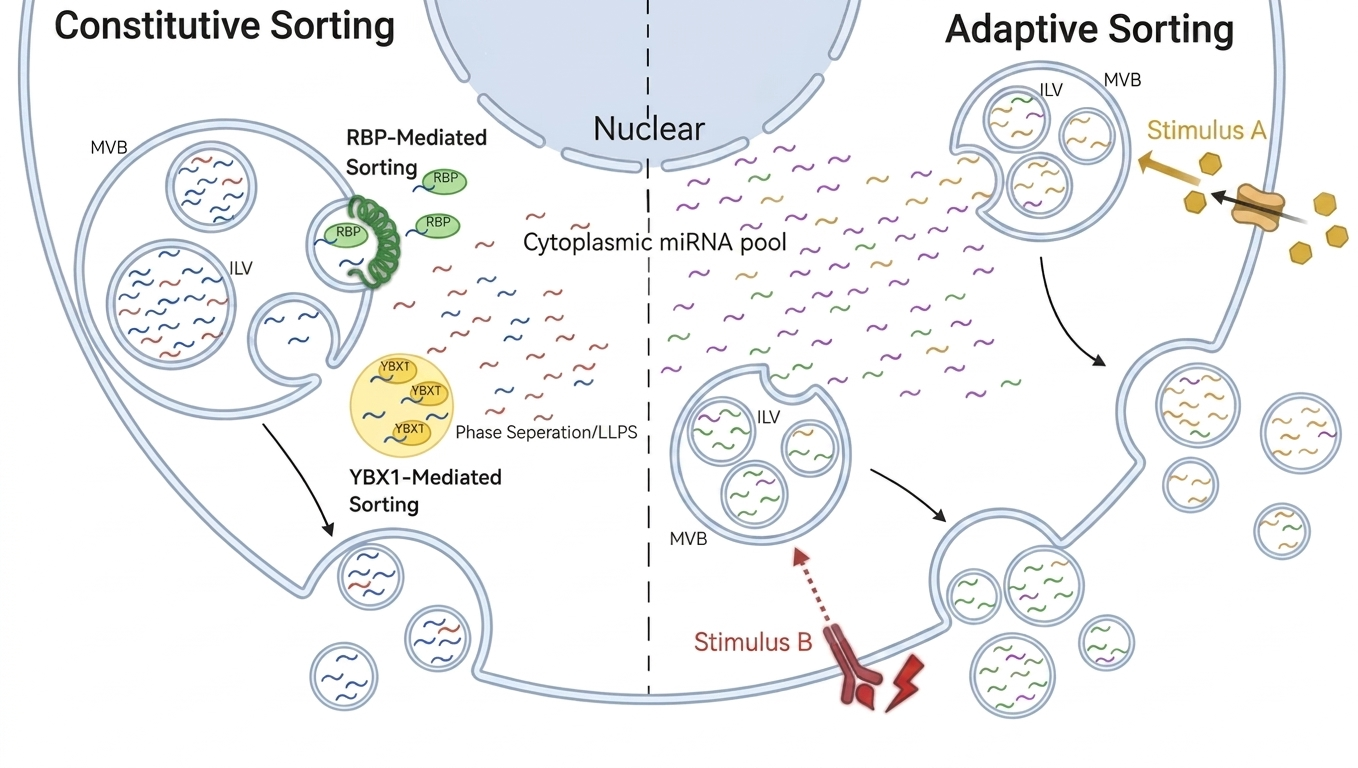
Exosomes are nanosized vesicles secreted by cells. By transporting cargo such as proteins, RNAs, and particularly miRNAs, they mediate intercellular and intertissue communication and play important roles in the pathogenesis of multiple diseases. Accordingly, the targeted inhibition of exosomal miRNAs has been explored as a therapeutic approach and has shown some therapeutic potential. However, this approach has considerable limitations. Some researchers have begun to elucidate the mechanisms underlying exosomal miRNA sorting. Based on an analysis of exosomal miRNA-sorting mechanisms, we classify exosomal miRNA sorting into two categories: constitutive sorting, which reflects a cell’s intrinsic, stimulus-independent miRNA-packaging preferences, and adaptive sorting, which is dynamically reconfigured in response to physiological or pathological stimuli. Crucially, both categories share a defining feature: abundance independence, meaning that the exosomal enrichment of a given miRNA is decoupled from its intracellular expression level. This classification reveals a striking gap: although the molecular mechanisms of constitutive sorting have been partially elucidated, those governing adaptive sorting remain almost entirely unknown, making adaptive sorting the most pressing frontier in the field. We hope this classification framework will guide future mechanistic studies more precisely, particularly toward the largely uncharted area of adaptive sorting, and ultimately deepen our understanding of disease pathogenesis and open new avenues for more targeted therapeutic strategies.
exosomes; miRNA; sorting; constitutive sorting; adaptive sorting; abundance-independence; stimulus-driven
