
 X
X WeiBo
WeiBo WeChat
 Facebook
 LinkedIn
 Reddit
 Bluesky
Inter-organ communication via extracellular vesicles and their encapsulated microRNAs mediates the pathogenesis of metabolic dysfunction-associated steatotic liver disease
- Volume
- CitationZhang Y, Sun H, Zhu Y. Inter-organ communication via extracellular vesicles and their encapsulated microRNAs mediates the pathogenesis of metabolic dysfunction-associated steatotic liver disease. ExRNA 2026(3):0010, https://doi.org/10.55092/exrna20260010.
- DOI10.55092/exrna20260010
- CopyrightCopyright2026 by the authors. Published by ELSP.
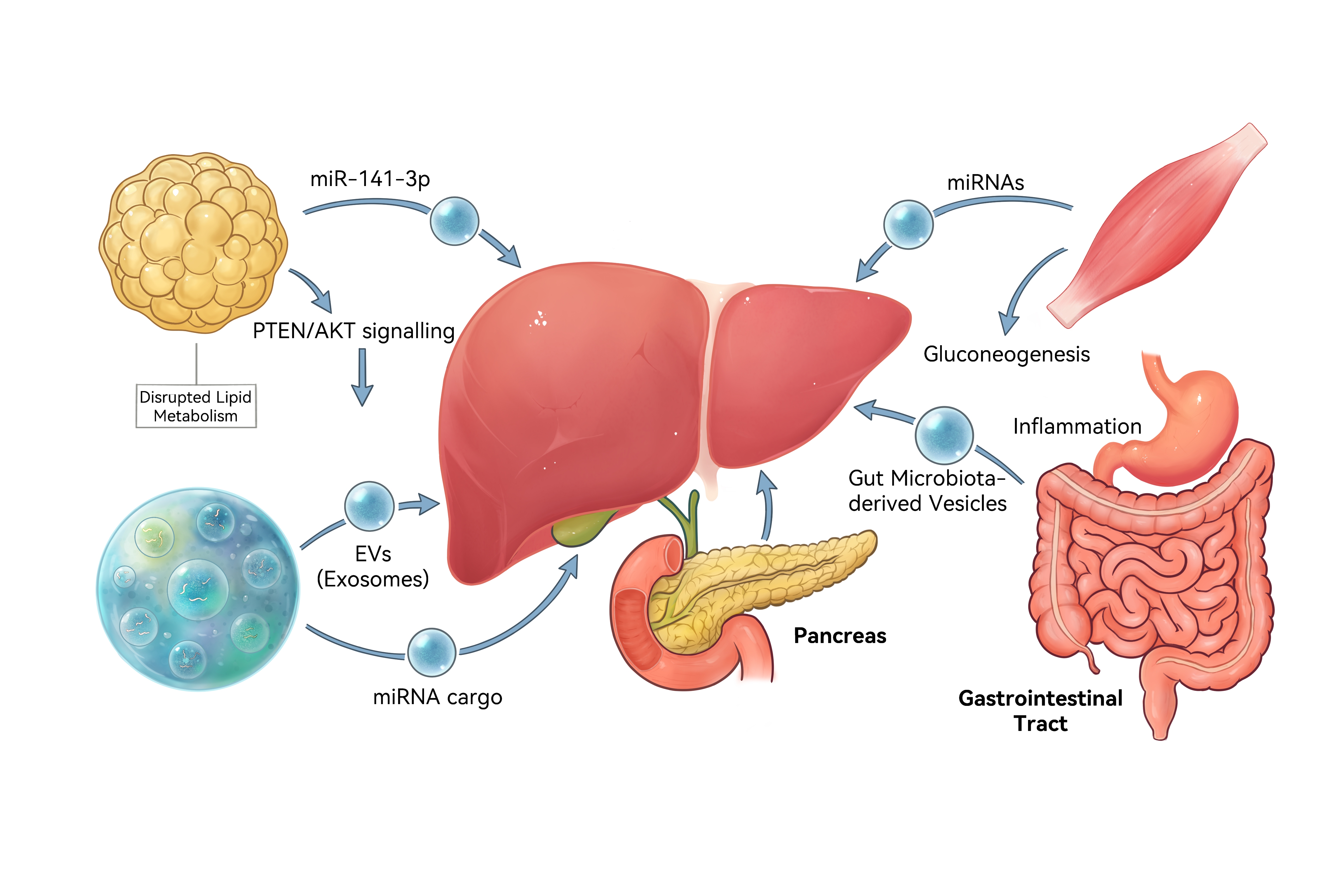
Metabolic dysfunction-associated steatotic liver disease (MASLD) is a multisystem disorder driven by dysregulated inter-organ communication. The liver integrates signals from adipose tissue, skeletal muscle, gut, and pancreas. Conventional frameworks focused on soluble factors, but extracellular vesicle (EV)-encapsulated microRNAs (miRNAs) are now identified as critical epigenetic mediators. This review systematically explores how EV-encapsulated miRNAs mediate MASLD pathogenesis and metabolic restoration across four core regulatory axes. In the adipose-liver axis, obesity-impaired delivery of miR-141-3p induces hepatic insulin resistance via disrupting the phosphatase and tensin homolog (PTEN)/AKT serine/threonine kinase (AKT) pathway, while pathogenic exosomal miR-122-3p drives de novo lipogenesis by suppressing hepatic fibroblast growth factor receptor 4 (FGFR4); conversely, exercise-upregulated miR-324 exerts hepatoprotective effects by inhibiting Rho-associated coiled-coil-containing protein kinase 1 (ROCK1) signaling. In the muscle-liver axis, high-intensity interval training stimulates muscle secretion of EVs enriched with miR-133b, which suppresses Forkhead box protein O1 (FoxO1)-mediated hepatic gluconeogenesis to improve systemic glycemic control; remote ischemic conditioning also triggers muscle-derived miR-181d-5p to alleviate steatohepatitis via targeting NR4A3. In the gut-liver axis, dysbiosis-associated bacterial EVs breach the gut barrier to drive hepatic inflammation and lipid metabolic abnormalities, while commensal bacterial EVs exert homeostatic protective effects. In the pancreas-liver axis, dysregulated miRNA cargo in β-cell-derived EVs disrupts hepatic glucolipid metabolism, with the miR-802-5p-Psmd2 axis acting as an early pathogenic trigger. Furthermore, this review highlights the diagnostic potential of circulating EV-miRNA panels (represented by the plasma miR-122/miR-34a ratio) as precise non-invasive liquid biopsies for MASLD staging and fibrosis assessment, and discusses the therapeutic promise of engineered EVs (e.g., 223/F-EVs) that simultaneously target steatosis, sterile inflammation and fibrosis. By framing MASLD as a disorder of disrupted inter-organ crosstalk, we highlight EV-miRNA regulatory networks as novel tractable targets in precision metabolic medicine.
MASLD; exosomes; microRNA; inter-organ crosstalk; insulin resistance; gut-liver axis; adipose-liver axis; miR-122; miR-34a; bacterial extracellular vesicles
