

Recent advances in interfacial analysis for biological soft matter using scanning probe microscopy
1 Key Laboratory of Molecular Nanostructure and Nanotechnology, Beijing National Laboratory for Molecular Sciences, CAS Research/Education Center for Excellence in Molecular Sciences, Institute of Chemistry, Chinese Academy of Sciences, Beijing, China
2 University of Chinese Academy of Sciences, Beijing, China
  • Volume
  • Citation
    Liu R, Wen R. Recent advances in interfacial analysis for biological soft matter using scanning probe microscopy. Life Anal. 2026(2):0009, https://doi.org/10.55092/la20260009. 
  • DOI
    10.55092/la20260009
  • Copyright
    Copyright2026 by the authors. Published by ELSP.
Abstract
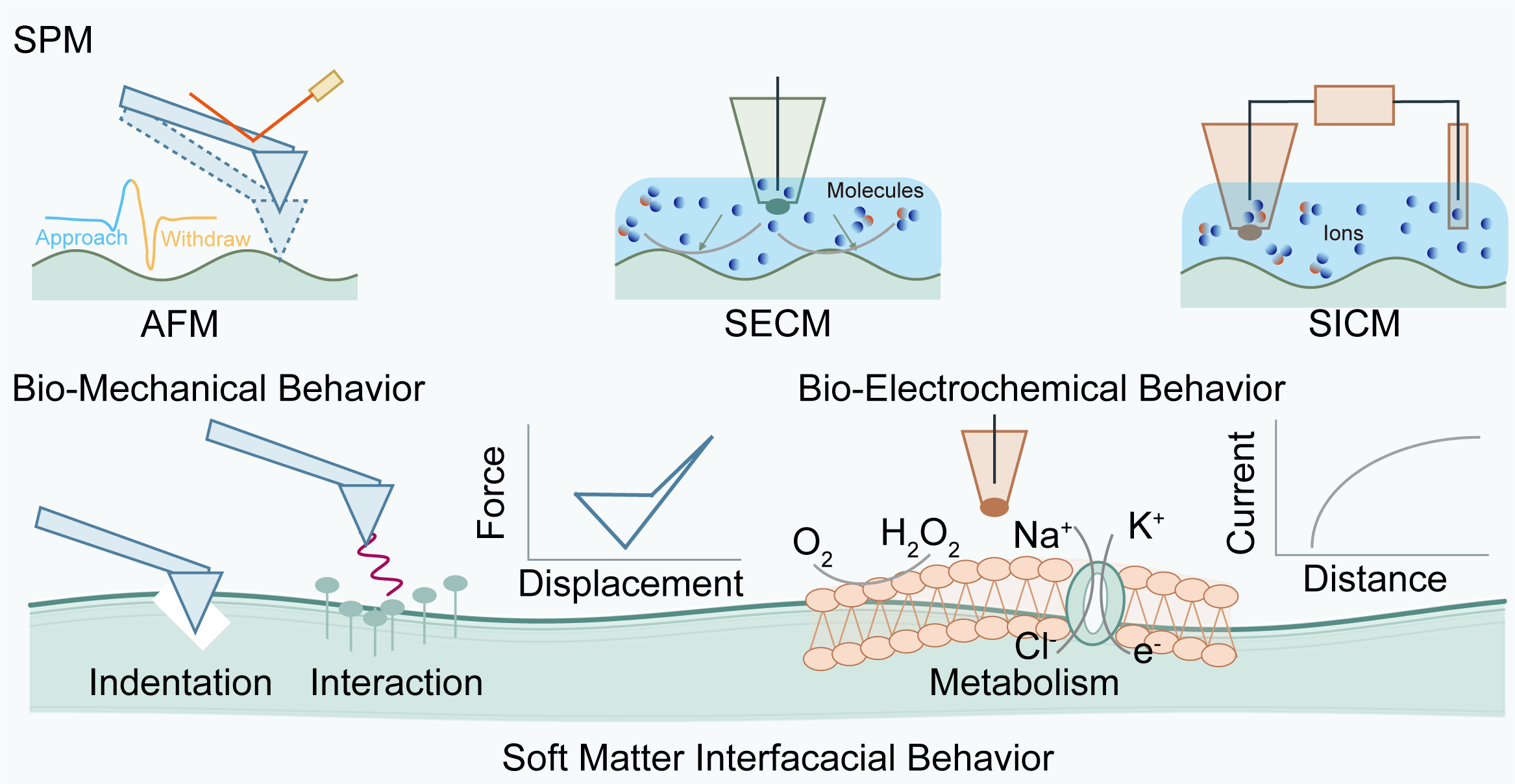
Biological soft matter interfaces govern many biochemical reactions, cellular processes, and disease-related phenotypes, yet their nanoscale mechanical and electrochemical properties remain difficult to measure under native or near-physiological conditions. Conventional ensemble and optical methods provide valuable molecular information, but they often lack the spatial resolution, label-free capability, or non-destructive operation needed to resolve dynamic interfacial processes. Scanning probe microscopy (SPM) addresses this gap by leveraging localized probe-sample interactions to map topography, mechanics, ionic conductance, and electrochemical fluxes at biological soft-matter interfaces. This review summarizes recent progress in atomic force microscopy, scanning electrochemical microscopy, and scanning ion-conductance microscopy for bioanalytical applications. We first outline the operating principles of these representative SPM techniques, then discuss their use in nanoscale mechanical characterization, molecular interaction analysis, single-cell electrochemical imaging, and metabolic monitoring. We further highlight integrated SPM platforms that combine force or ion-current feedback with spectroscopic and fluorescence readouts to link physical structure with chemical function. Together, these developments suggest that SPM-based approaches may provide a versatile route for non-invasive, multidimensional measurements of soft-matter interfaces and offer new opportunities for bioanalysis, disease research, and precision biomedical technologies.

Keywords

scanning probe microscopy; biological soft matter; interface; biomechanics; bioelectrochemistry

Preview