
 X
X WeiBo
WeiBo WeChat
 Facebook
 LinkedIn
 Reddit
 Bluesky
Robot assembly strategy optimization based on embodied skill learning
- Volume
- CitationLi F, Qi H, Jin L, Yao , Men Y, et al. Robot assembly strategy optimization based on embodied skill learning. Robot Learn. 2026(2):0017, https://doi.org/10.55092/rl20260017.
- DOI10.55092/rl20260017
- CopyrightCopyright2026 by the authors. Published by ELSP.
- Special Issue
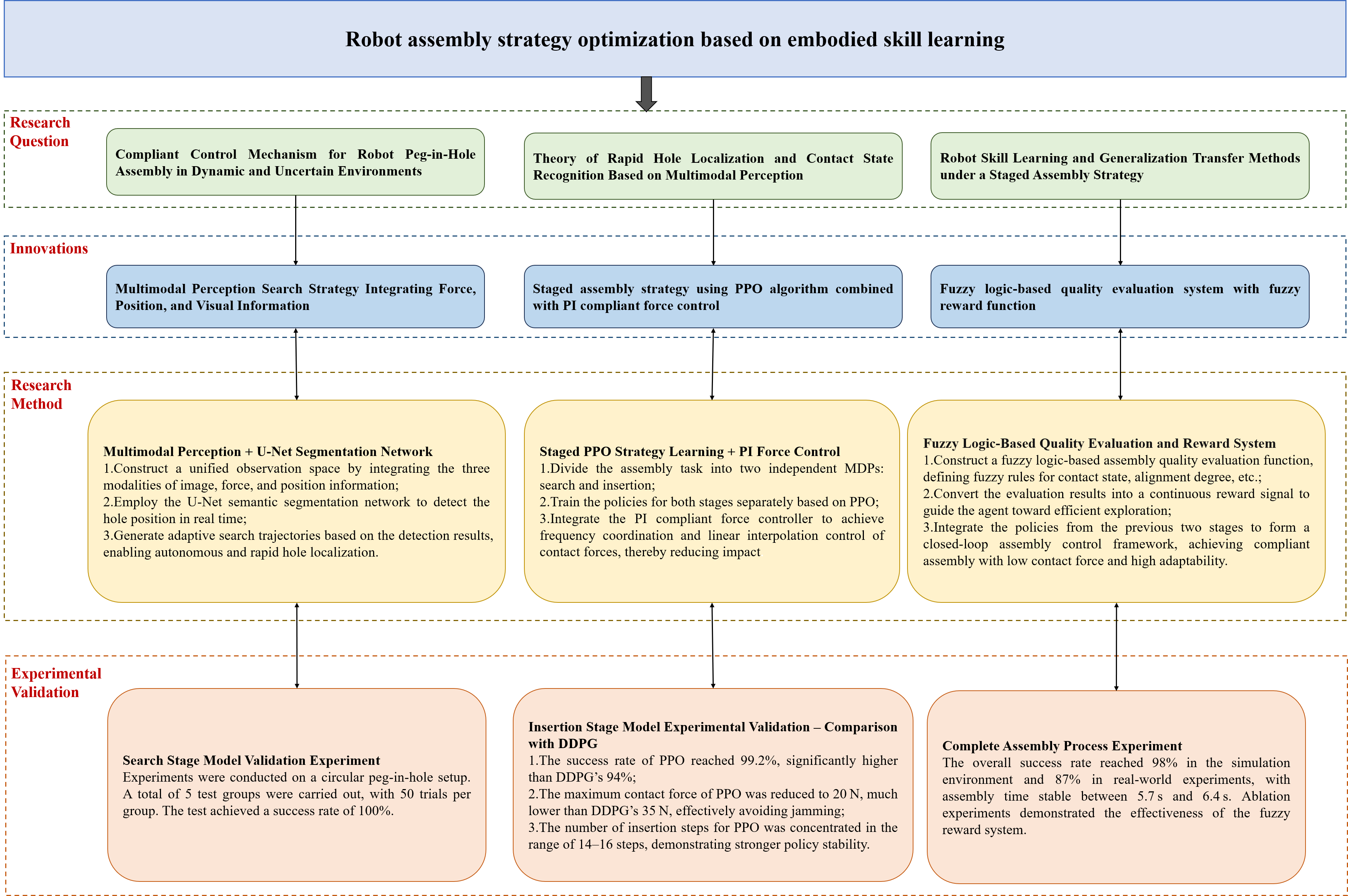
Robotic assembly is a crucial component of intelligent manufacturing, significantly enhancing the level of automation in the industry. Traditional robotic control strategies struggle to adapt to complex and dynamic industrial environments. Learning-based control methods, which incorporate perception, decision, and planning, can greatly improve the adaptability of assembly strategies. This paper addresses the diverse assembly production demands in dynamic operational scenarios and takes a deep dive into the mechanical characteristics at different stages of peg-in-hole assembly. Our research focuses mainly on the construction of compliant robotic embodied assembly strategy models and the acquisition of staged assembly skills, addressing the complexities of strategy models and the low efficiency of robotic skill learning during the peg-in-hole assembly process. Firstly, the peg-in-hole assembly task is divided into distinct stages, and a compliant force control method is proposed based on mechanical characteristics. Subsequently, a robotic assembly strategy model based on proximal policy optimization (PPO) is introduced, combined with a fuzzy quality evaluation system to achieve staged acquisition and optimization of the robotic compliant assembly strategy under the embodied strategy learning framework. Finally, experimental validation was conducted in a simulated peg-in-hole assembly environment. The success rate of this algorithm consistently remains above 98%, representing a 12% improvement over the deep deterministic policy gradient algorithm. The results confirm that the proposed embodied strategy offers an effective solution for acquiring sophisticated assembly skills in uncertain environments.
robotic assembly; deep reinforcement learning; compliant control; fuzzy logic
