
 X
X WeiBo
WeiBo WeChat
 Facebook
 LinkedIn
 Reddit
 Bluesky
Research development in intelligent generative design methods for steel modular structures
- Volume
- CitationLiu Y, Zhou K, Chen Z, Liu J, Liu H. Research development in intelligent generative design methods for steel modular structures. Smart Constr. 2026(1):0005, https://doi.org/10.55092/sc20260005.
- DOI10.55092/sc20260005
- CopyrightCopyright2026 by the authors. Published by ELSP.
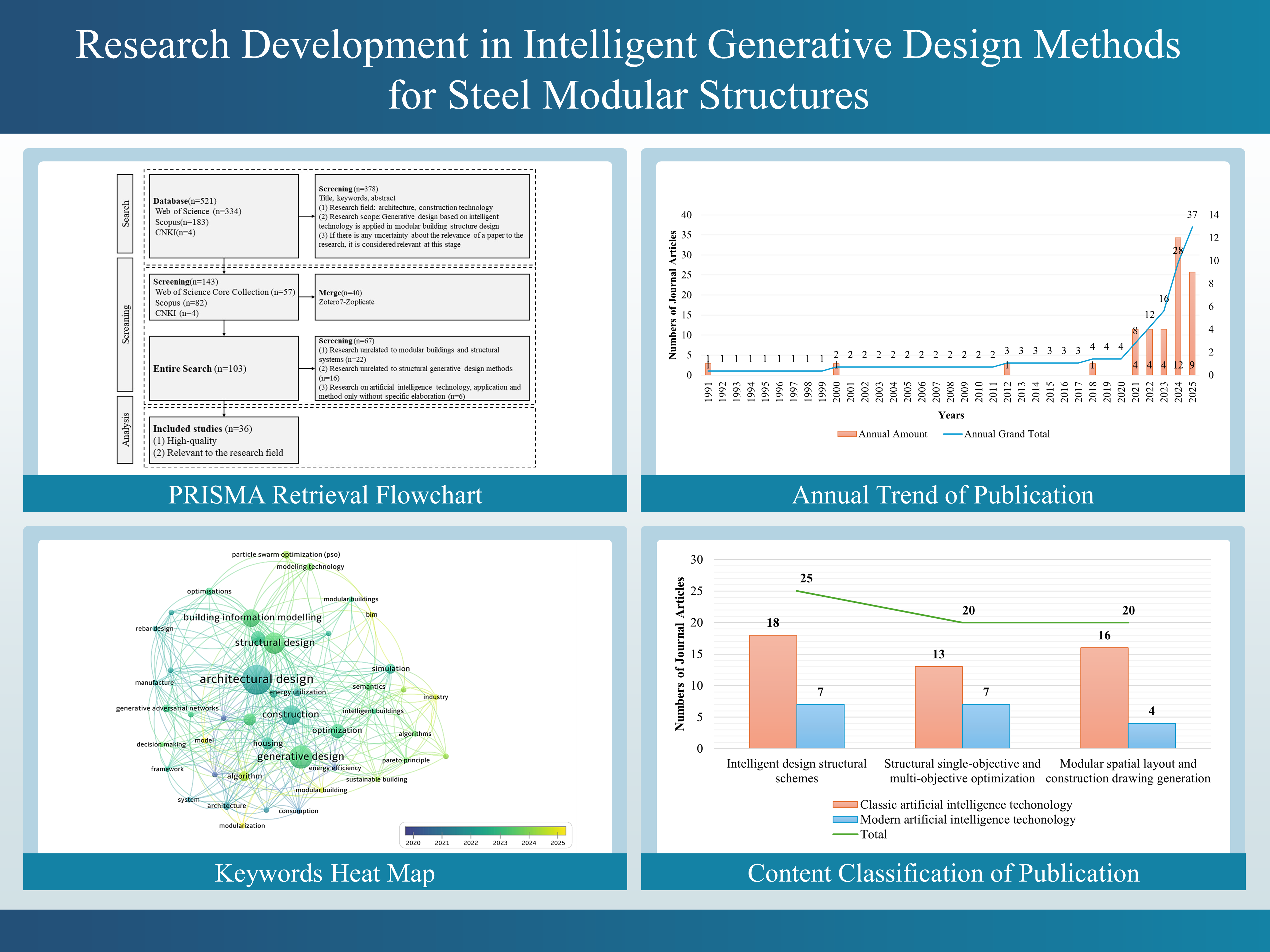
In recent decades; the field of artificial intelligence is undergoing rapid advancement; diverse technologies increasingly supporting the intelligent transformation of the construction industry. A key research challenge in modular construction is to generate structurally feasible designs that ensure both quality and efficiency. Although the concept of generative design has drawn great attention in this field; reviews of relevant research findings remains lacking. The analysis is structured around two technical scopes—classic artificial intelligence and modern artificial intelligence—and examines the application of various AI techniques across several core aspects of structural design: intelligent generation of structural schemes; single and multi-objective optimization; and modular spatial layout and construction drawing generation. Statistical findings reveal that AI technologies have progressively evolved from localized; single objective applications toward integrated; market-oriented; and sustainability-aware solutions for modular construction projects. Finally; this paper puts forward several future research directions; focusing on data-driven and knowledge-integrated approaches; validation in practical engineering contexts; and multi-objective sustainable optimization. These trends aim to enhance the overall capability of intelligent generative design for modular structures. What’s more; this paper encompasses modular systems of various materials; with the emphasis placed on their shared generative design methodologies.
generative design; modular construction; artificial intelligence; structural design
