
 X
X WeiBo
WeiBo WeChat
 Facebook
 LinkedIn
 Reddit
 Bluesky
Experimental investigation on cohesion-friction mechanical properties for early-age concrete
- Volume
- CitationLu D, Guo Z, Cai T, Wang G, Gao Z, et al. Experimental investigation on cohesion-friction mechanical properties for early-age concrete . Smart Constr. 2026(2):0012, https://doi.org/10.55092/sc20260012.
- DOI10.55092/sc20260012
- CopyrightCopyright2026 by the authors. Published by ELSP.
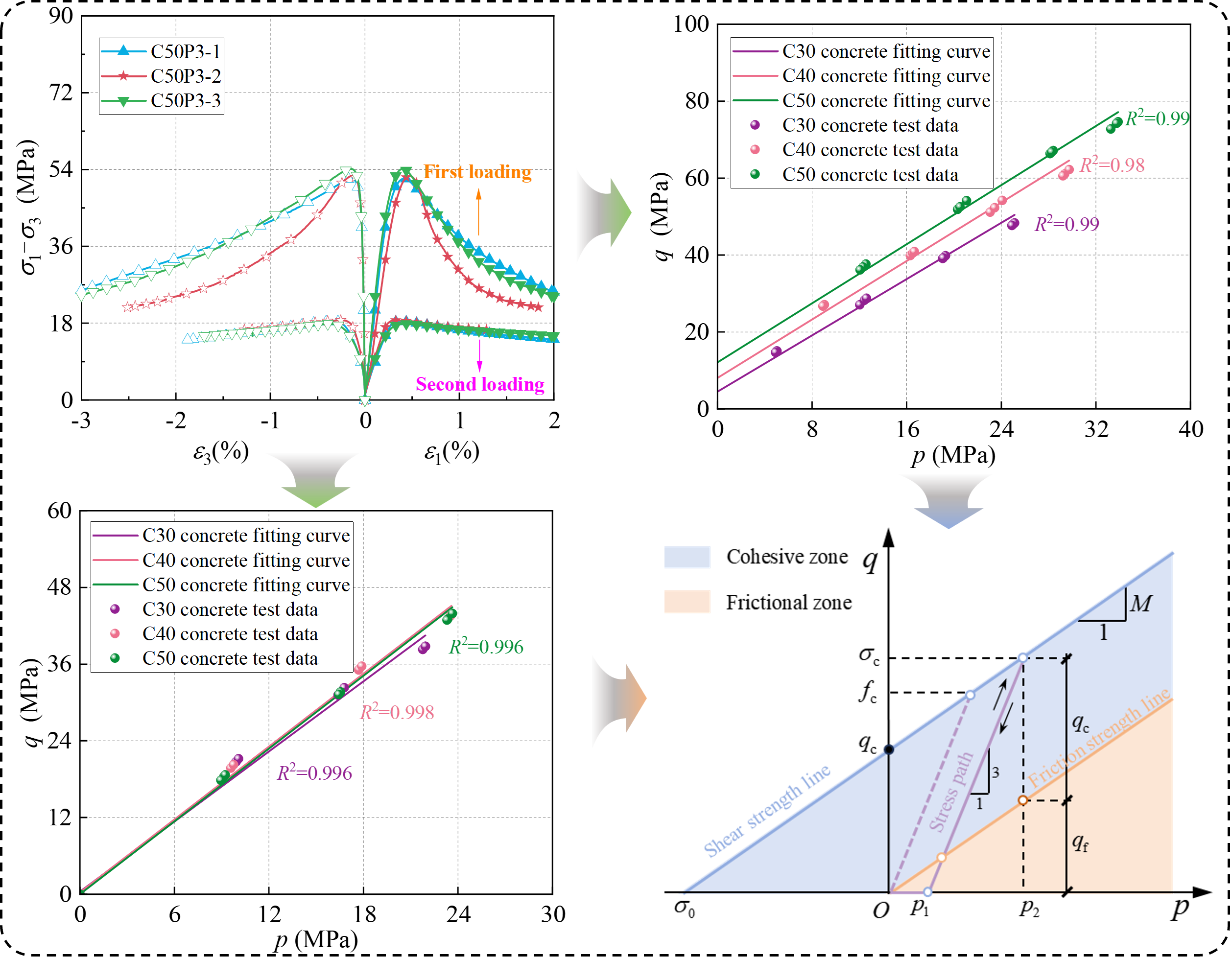
As a core material in modern construction, the early-age properties of concrete have a decisive impact on the safety and durability of civil engineering structures. However, systematic research on the mechanical properties of early-age concrete remains limited, particularly regarding the combined influence of cohesive and frictional properties on the material’s macroscopic mechanical behavior, which has not been thoroughly explored. To address this gap, this paper employs a decoupling method for testing the cohesion-friction mechanical properties of concrete, as proposed in previous work. This method successfully separates the cohesive and frictional properties of early-age concrete, validating its applicability under early-age conditions and obtaining typical failure modes following material performance degradation. Furthermore, by analyzing the evolution patterns of cohesive and frictional properties during deformation and strength development, the synergistic mechanism of cohesion-friction mechanical properties in early-age concrete was revealed. The results indicate that the responses of cohesive and frictional properties to hydrostatic pressure in early-age concrete exhibit significant differences. The reduction in macroscopic shear strength and stiffness is fundamentally attributed to the irreversible dissipation of cohesive strength. Ultimately, the mechanical behavior of early-age concrete gradually approaches that of granular materials without cohesion.
early-age concrete; triaxial test; cohesion-friction properties; deformation behavior; strength evolution
