
 X
X WeiBo
WeiBo WeChat
 Facebook
 LinkedIn
 Reddit
 Bluesky
MixStyle-based adversarial domain generalization for cross-domain bridge damage localization
- Volume
- CitationWei X, Lin Y, Ma H, Nie Z, Li J. MixStyle-based adversarial domain generalization for cross-domain bridge damage localization. Smart Constr. 2026(3):0015, https://doi.org/10.55092/sc20260015.
- DOI10.55092/sc20260015
- CopyrightCopyright2026 by the authors. Published by ELSP.
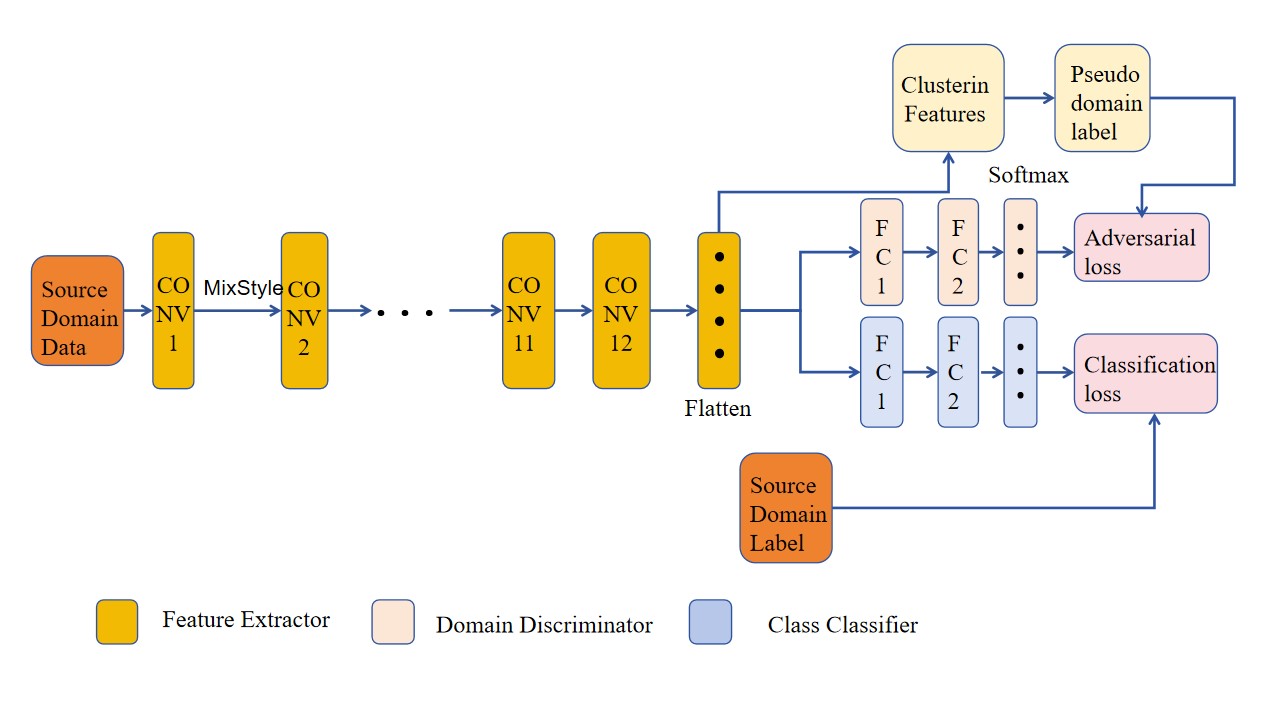
A critical challenge in structural health monitoring (SHM) is the extreme scarcity of labeled damage data from real-world bridges. Consequently, domain adaptation approaches that require target domain data with damage situation become nearly infeasible for real-world engineering applications. To address this limitation, this paper proposes a structural damage detection (SDD) method based on domain generalization, which constructs a highly generalizable damage recognition model by integrating style transfer and adversarial training. A latent domain with diverse styles is generated by mixing style features, such as mean and variance from different samples, followed by label generation through clustering. Adversarial training is then introduced to encourage the feature extractor to learn domain-invariant damage-sensitive features, thereby enabling the model to focus on essential features that are indicative of damage states. To validate the effectiveness of the proposed method, a simply supported beam model was established as the benchmark structure. Simulation results demonstrate that, compared to conventional damage identification algorithms, the proposed method exhibits superior damage localization performance on unseen target domain data. Furthermore, laboratory experiments confirm that the approach achieves excellent results in practical scenarios.
style transfer; domain generalization; bridge damage localization; adversarial training; structural health monitoring
