
 X
X WeiBo
WeiBo WeChat
 Facebook
 LinkedIn
 Reddit
 Bluesky
MIR2911 is a potential inhibitor for Nipah virus
- Volume
- CitationLei J, Xia L, Zhu X, Wu Y, Yu Z, et al. MIR2911 is a potential inhibitor for Nipah virus. ExRNA 2026(2):0005, https://doi.org/10.55092/exrna20260005.
- DOI10.55092/exrna20260005
- CopyrightCopyright2026 by the authors. Published by ELSP.
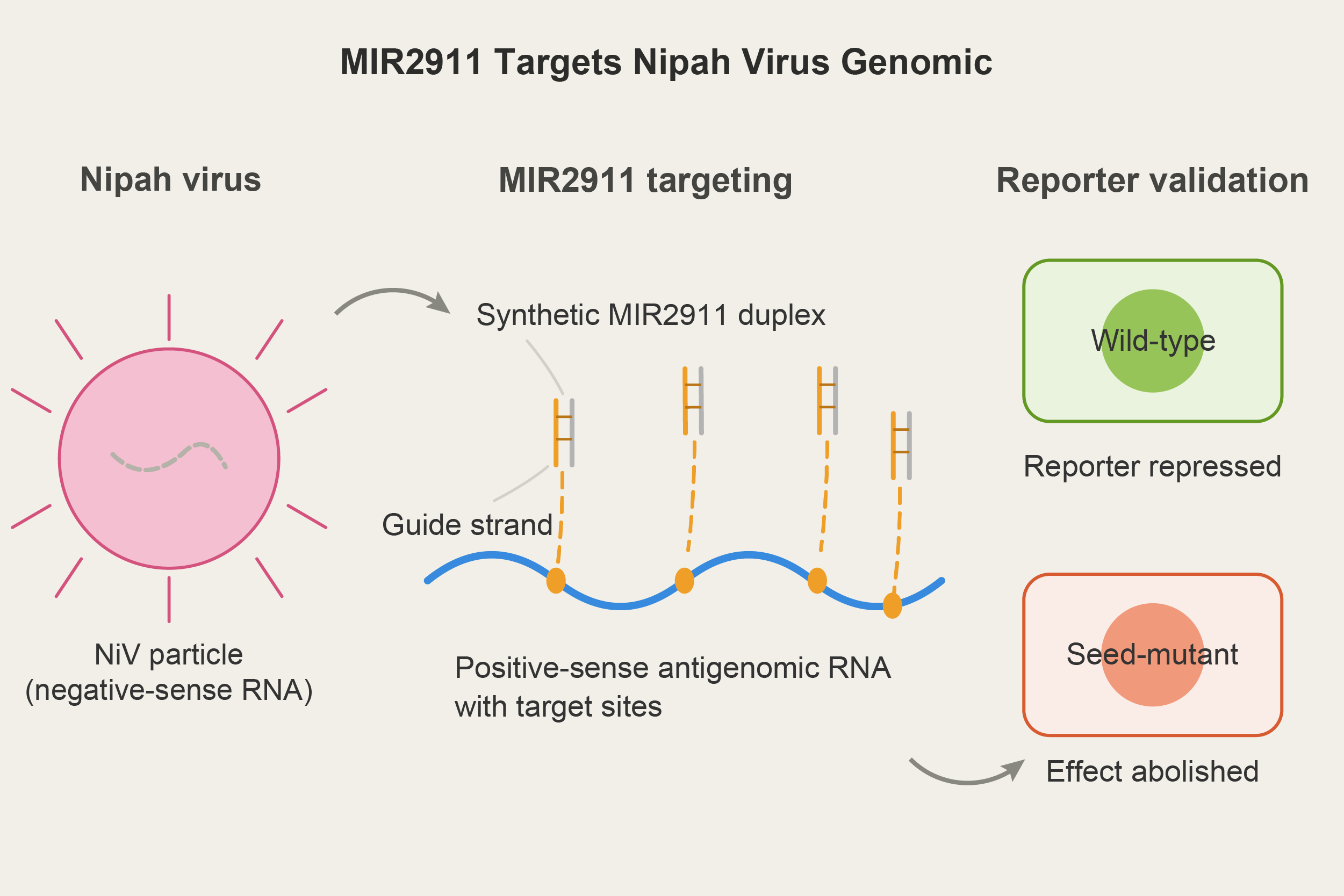
Nipah virus (NiV) is a highly pathogenic zoonotic virus for which no approved virus-specific antiviral therapy is currently available. MIR2911, a honeysuckle-derived small RNA, has shown antiviral activity against several RNA viruses. In this study, in silico screening of the NiV Malaysia strain (NiV-M) reference genome identified multiple candidate MIR2911-binding sites, from which a subset of high-confidence sites were selected for experimental validation. Dual-luciferase reporter assays showed that MIR2911 specifically reduced reporter activity driven by NiV target sequences, and this effect was abolished by mutation of the seed-matched regions. A tandem reporter containing multiple NiV target sites showed stronger repression than individual reporters, suggesting that multisite targeting may enhance MIR2911 activity. Although these findings were obtained in a heterologous reporter system that provides only an indirect readout of target function and does not recapitulate the multistep biological processes of authentic viral infection, they suggest that MIR2911 may specifically recognize NiV genomic sequences in vitro and justify further evaluation in infection-relevant models.
Nipah virus; MIR2911; honeysuckle; cross-kingdom RNA regulation; RNAhybrid target prediction; dual-luciferase reporter validation
