
 X
X WeiBo
WeiBo WeChat
 Facebook
 LinkedIn
 Reddit
 Bluesky
A probabilistic digital twin framework for corrosion-fatigue prognosis of floating offshore wind turbines
- Volume
- CitationAli Y, Elgammal A, Li C, Heng J, Dai K. A probabilistic digital twin framework for corrosion-fatigue prognosis of floating offshore wind turbines. Smart Constr. 2026(2):0013, https://doi.org/10.55092/sc20260013.
- DOI10.55092/sc20260013
- CopyrightCopyright2026 by the authors. Published by ELSP.
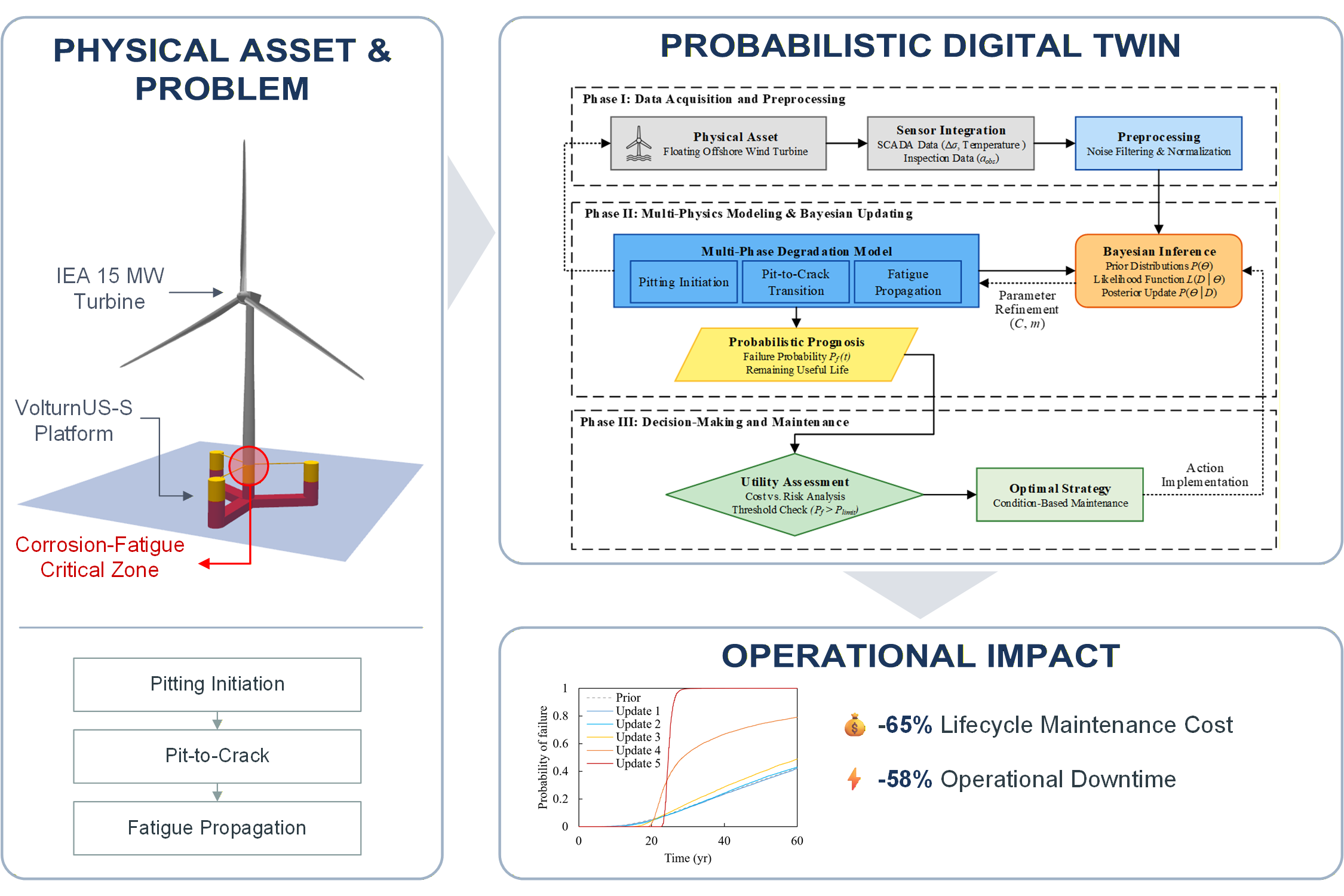
Floating offshore wind turbines face growing integrity-management challenges caused by coupled corrosion and fatigue in harsh marine environments. Existing digital-twin frameworks are not yet well suited to combine multi-phase degradation physics with dynamic uncertainty quantification for this problem. To address this gap, this paper proposes a probabilistic digital twin framework that integrates sensor data acquisition, multi-physics simulation, and Bayesian inference for corrosion-fatigue prognosis. A three-phase damage evolution model is formulated to represent the transition from corrosion pitting to short-crack growth and long-crack propagation. Operational observations are assimilated recursively to update fatigue parameters and remaining useful life estimates. The framework is demonstrated using the IEA 15 MW reference wind turbine. The updated model identifies the onset of accelerated crack propagation at year 20 and reduces the 95% remaining-useful-life confidence interval from 40.4 years to 3.4 years. A maintenance strategy based on the updated failure probability reduces operational downtime by 58% and lifecycle cost by approximately 64.9% compared with a fixed-interval strategy. The results indicate that probabilistic updating can support more transparent inspection and maintenance decisions for floating offshore wind turbine structures under corrosion-fatigue degradation.
floating offshore wind turbine; corrosion-fatigue; digital twins; structural health monitoring; condition-based maintenance; prognostic health management; remaining useful life; Bayesian inference
