
 X
X WeiBo
WeiBo WeChat
 Facebook
 LinkedIn
 Reddit
 Bluesky
Statistical evaluation of cementitious composites containing rice husk ash and recycled steel fibers
- Volume
- CitationKumar K, Chaudhary P, Dhanda A, Rustagi P, Rathee R, et al. Statistical evaluation of cementitious composites containing rice husk ash and recycled steel fibers. Smart Constr. 2026(2):0010, https://doi.org/10.55092/sc20260010.
- DOI10.55092/sc20260010
- CopyrightCopyright2026 by the authors. Published by ELSP.
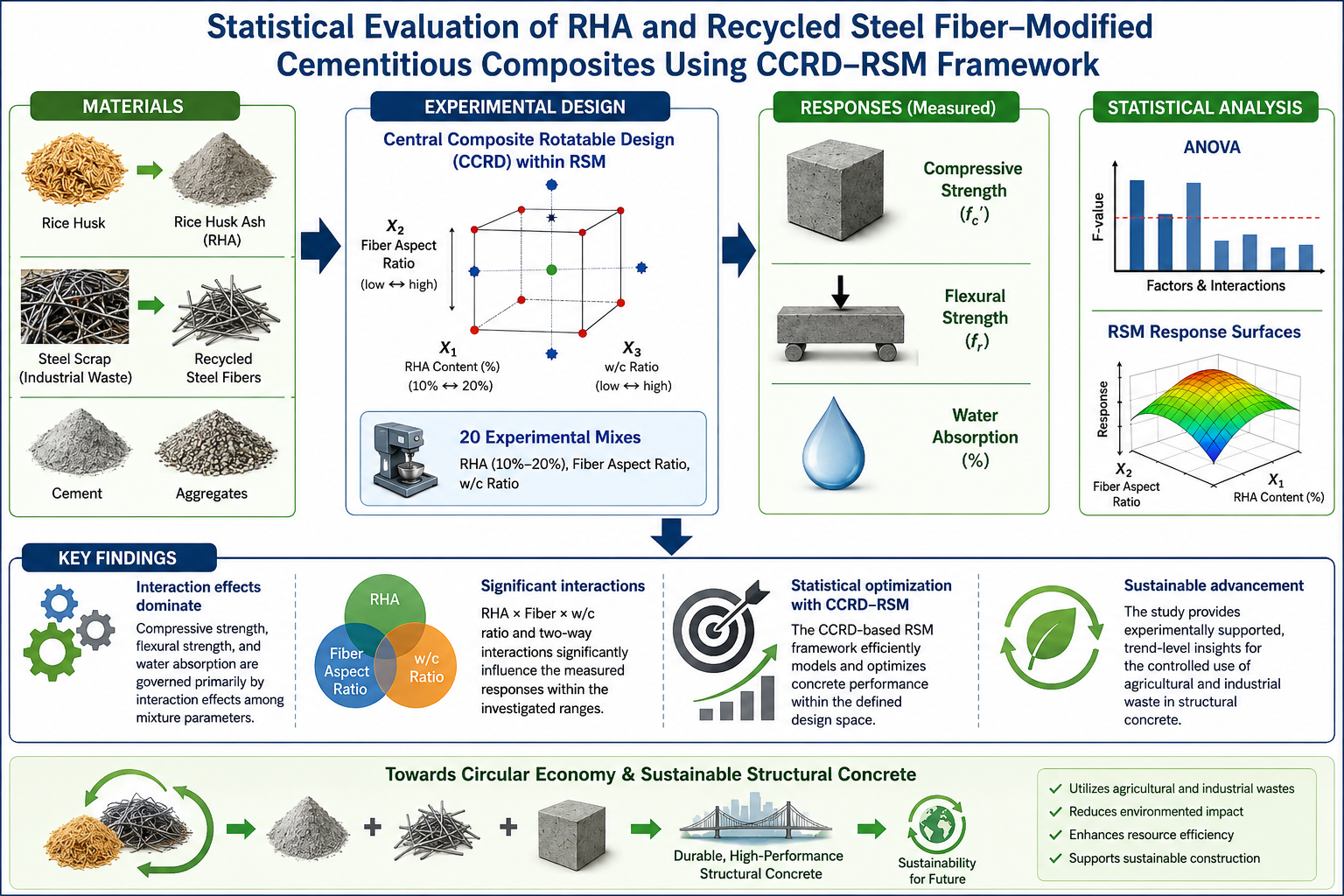
This study presents a statistical evaluation of cementitious composites incorporating rice husk ash (RHA) and recycled steel fibers using a structured experimental design. A Central Composite Rotatable Design (CCRD) within the framework of Response Surface Methodology (RSM) was employed to examine the combined influence of RHA content, recycled steel fiber aspect ratio, and water–cement ratio on selected properties of concrete. A total of twenty experimental mixes were prepared according to the design matrix, and compressive strength, flexural strength, and water absorption were measured as response variables. Material characterization was limited to X-ray fluorescence–based oxide composition for cement and RHA and scanning electron microscopy–energy dispersive spectroscopy (SEM–EDS) based morphological documentation for RHA. The experimental results were analyzed using analysis of variance to identify statistically supported trends and interaction effects within the investigated parameter ranges. The findings indicate that strength-related responses and water absorption are governed primarily by interaction effects among mixture parameters rather than by individual variables acting independently. The results are interpreted within the investigated design space (10%–20% RHA replacement), and no comparison with control mixtures (0% RHA) is implied. This study provides statistically supported, trend-level insights into the behavior of RHA- and recycled steel fiber–modified cementitious composites under the defined experimental conditions. The results contribute experimental and statistical evidence relevant to structural engineering applications where controlled modification of concrete mixtures is of interest.
cementitious composites; structural concrete; rice husk ash; recycled steel fibers; response surface methodology; sustainability; circular economy
