
 X
X WeiBo
WeiBo WeChat
 Facebook
 LinkedIn
 Reddit
 Bluesky
A mechanism-data fusion framework for process-microstructure prediction and optimization in laser directed energy deposition of Ti-6Al-4V using dual-level surrogate modeling
- Volume
- CitationZhang Y, Zhao T, Liu P, Zhou X, Wang X, et al. A mechanism-data fusion framework for process-microstructure prediction and optimization in laser directed energy deposition of Ti-6Al-4V using dual-level surrogate modeling. Adv. Equip. 2026(2):0006, https://doi.org/10.55092/ae20260006.
- DOI10.55092/ae20260006
- CopyrightCopyright2026 by the authors. Published by ELSP.
- Special Issue
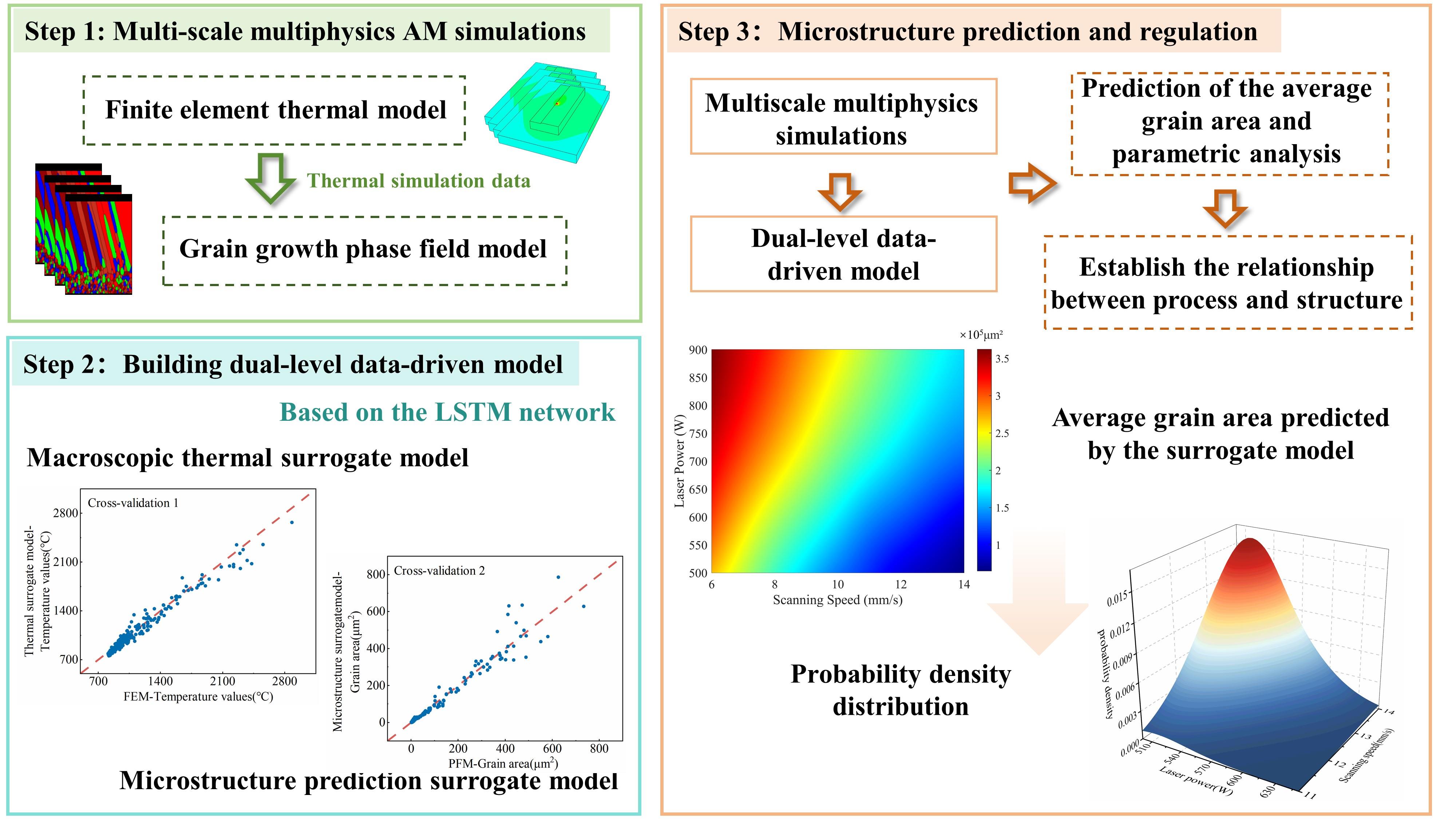
The laser-directed energy deposition (L-DED) process involves complex thermal and material interactions, posing challenges for controlling microstructural evolution in metal additive manufacturing. To enable rapid, efficient process optimization, this study develops a physics-informed mechanism-data fusion framework that couples macroscopic finite element method (FEM) and microscopic phase-field method (PFM) with a dual-level long short-term memory (LSTM) neural network. A multiscale physical model is employed to investigate grain growth behavior and the influence of process parameters on microstructural morphology. To map this non-linear temporal evolution, a dual-level data-driven surrogate model is developed. Compared to a conventional multilayer perceptron (MLP), the LSTM effectively captures time-dependent thermal accumulation. In recursive predictions, four initial input layers were identified as the optimal initialization length, enabling stable prediction and mitigating potential layer-wise error propagation, maintaining average R2 values of around 0.95. Using the average grain area as the primary microstructural control target, and incorporating the average grain width, a parameter range of 500–550 W and 13–14 mm/s was identified for achieving near-equiaxed β grains. The proposed framework is implemented as a modular computational pipeline that integrates finite element, phase-field, and surrogate models for reusable and extensible process-microstructure prediction in metal additive manufacturing.
laser-directed energy deposition; long short-term memory network; phase-field method; microstructure evolution; simulation optimization
