
 X
X WeiBo
WeiBo WeChat
 Facebook
 LinkedIn
 Reddit
 Bluesky
Highly vertically oriented 2D/3D tin perovskite films for efficient and stable solar cells
- Volume
- CitationKang Z, Ma M, Han Y, Zhang F, Zhang L, et al. Highly vertically oriented 2D/3D tin perovskite films for efficient and stable solar cells. AI Mater. 2026(3):0009, https://doi.org/10.55092/aimat20260009.
- DOI10.55092/aimat20260009
- CopyrightCopyright2026 by the authors. Published by ELSP.
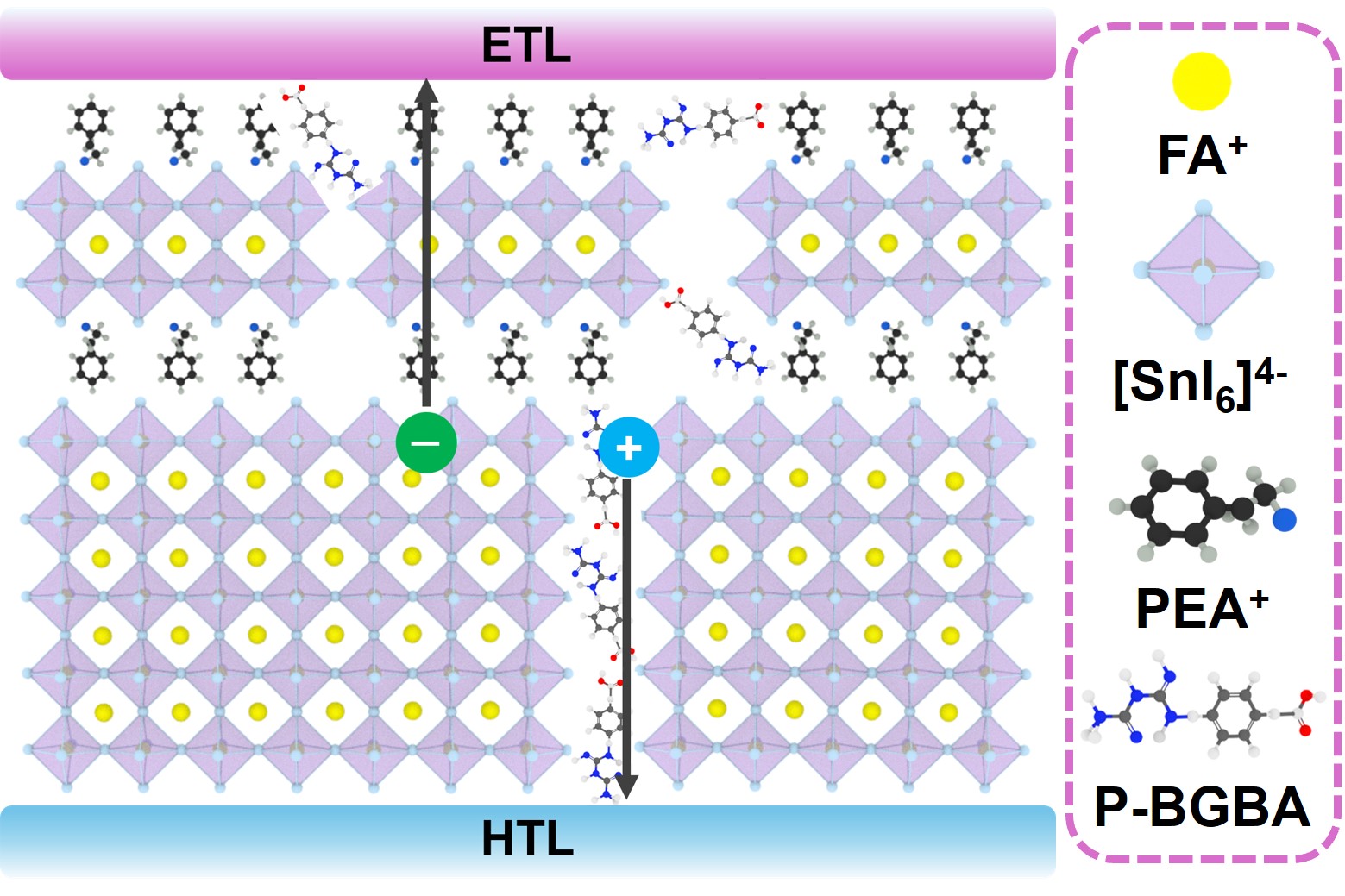
Two-dimensional/three-dimensional (2D/3D) tin perovskite solar cells (PSCs) have considerable potential for lead-free photovoltaics because of their low toxicity and favorable optoelectronic properties. However, their efficiency and stability remain limited by the difficulty of controlling the crystal orientation of 2D/3D perovskites. Here, a long-chain Lewis base molecule containing multiple functional groups, p-biguanidinobenzoic acid hydrochloride (p-BGBA), is introduced to regulate the crystallization kinetics of 2D/3D tin perovskites. The results show that p-BGBA effectively modulates the crystallization process through multiple interactions with the perovskite, thereby promoting the formation of high-quality films with a highly vertical crystal orientation. As a result, the resulting tin PSCs achieve a champion power conversion efficiency (PCE) of 14.96% and retain 91% of their initial performance after 2500 h of storage under a nitrogen atmosphere.
perovskite solar cells; 2D/3D tin perovskite; crystal orientation; lewis base molecules
