
 X
X WeiBo
WeiBo WeChat
 Facebook
 LinkedIn
 Reddit
 Bluesky
Analysis of dementia EEG signals using empirical mode decomposition variants and deep learning
- Volume
- CitationSenol Y, Akan A, Cura O. Analysis of dementia EEG signals using empirical mode decomposition variants and deep learning. Electron. Signal Process. 2026(1):0004, https://doi.org/10.55092/esp20260004.
- DOI10.55092/esp20260004
- CopyrightCopyright2026 by the authors. Published by ELSP.
- Special Issue
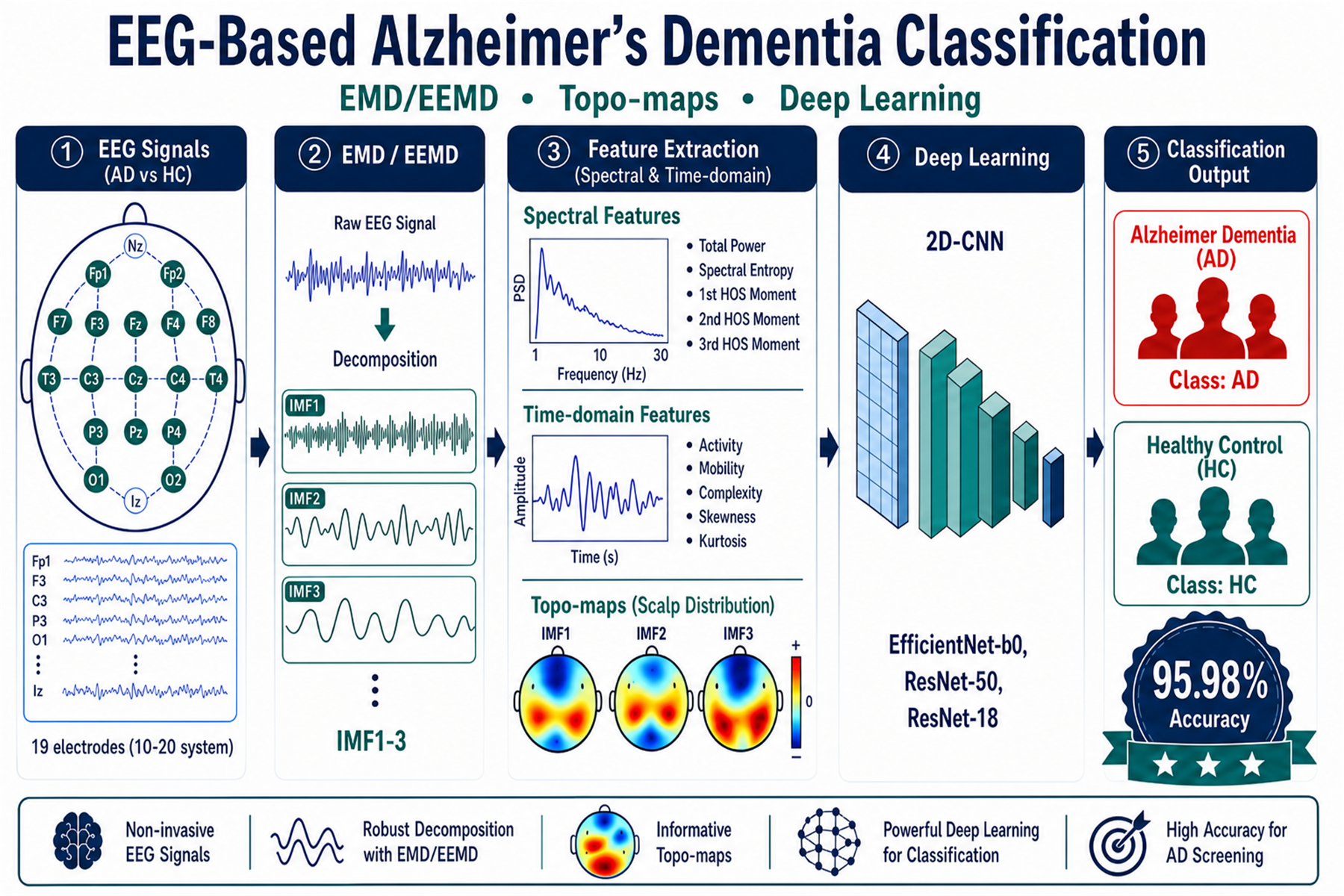
In recent years, Alzheimer’s dementia (AD) is the most common neurological condition caused by electrical activity changes in the human brain. The diagnosis of AD can be provided by using medical devices such as electroencephalography (EEG). In this study, EEG signals of AD patients and healthy control subjects were analyzed. Advanced signal decomposition methods, which are empirical mode decomposition (EMD) and ensemble empirical mode decomposition (EEMD), were used to further investigate EEG signals. The first three intrinsic mode functions (IMFs) were obtained using the EMD and EEMD methods. Spectral and time-domain features were extracted from IMFs and raw EEG signals. Then, topographical heat maps were generated from these features. Topographic Feature Map (Topo-map) were classified using a two-dimensional convolutional neural network (2D-CNN). Different CNN architectures were compared in terms of performance, including EfficientNet-b0, Resnet-50, and Resnet-18. The experimental results demonstrate that the proposed approach effectively captures the spatial and spectral characteristics of EEG signals associated with Alzheimer’s disease. 95.98% classification accuracy was achieved with the EfficienNet-b0 architecture.
Alzheimer dementia (AD); electroencephalography (EEG); empirical mode decomposition (EMD); ensemble empirical mode decomposition; convolutional neural network (CNN); intrinsic mode functions (IMFs)
