

International Journal of Environmental Epidemiology
ISSN: 3079-2746 (Print)
ISSN: 3079-2754 (Online)
Multi-pollutant indoor air quality, ventilation, and cognitive status among nursing home residents with dementia: a pilot cross-sectional environmental assessment in Oklahoma, USA
Background: Older adults in nursing homes (NHs), particularly those with Alzheimer’s disease and related dementias (ADRD), spend most of their time indoors and may be vulnerable to poor indoor environmental quality (IEQ). Multi-pollutant IEQ in U.S. dementia care facilities remain limited. Objectives: To characterize indoor air quality (IAQ), thermal comfort, and ventilation across residential and common rooms in three NHs serving residents with dementia, and to descriptively explore room-level environmental conditions with cognitive status. Methods: TSI AirAssure monitors were deployed in eight residential rooms and five common areas across three Oklahoma NHs (NH-A, NH-B, NH-C) in October 2023 and February 2024. Temperature, relative humidity (RH), CO2, PM2.5, PM10, total volatile organic compounds (tVOC), CO, NO2, and O3 were recorded at 1- or 15-minute intervals. Ventilation rates (air changes per hour, ACH) were estimated from CO2 decay curves. Residents’ cognitive status, depression scores, and clinical diagnoses were abstracted from the Minimum Data Set (MDS). Results: Temperature and RH generally met ASHRAE 55 guidelines, though the winter-monitored facility showed low-humidity exceedances. CO2 concentrations were predominantly below the 1000 ppm ASHRAE 62.1 threshold, although one residential room in NH-C exceeded this guideline 29.9% of the time. tVOC exceeded the Comité Européen action level (0.4 mg m−3) across 19.2%–100% of observations in every monitored location. PM2.5 and PM10 were generally low, with short duration spikes in several rooms in NH-B. Estimated ventilation rates ranged from 0.84 to 5.07 ACH. Conclusions: This pilot multi-facility assessment identifies IEQ concerns in Oklahoma NHs serving residents with dementia, particularly elevated tVOC levels, winter-season low humidity, and low estimated ventilation in selected rooms. The findings support targeted source control, humidity, ventilation, and motivate larger longitudinal studies to evaluate whether chronic indoor environmental exposures are related to cognitive or behavioral outcomes in this vulnerable population.

Clustering of green space qualities: evidence from three Australian cities
Background: Health-relevant features of green space are often referred to under the catch-all term ‘quality’, but this masks how some qualities may cluster geographically and manifest contrasting patterns with socioeconomic circumstances. We measured multiple green space qualities to derive cluster typologies and their socioeconomic patterning. Methods: Novel green space qualities clustering was developed using K-means clustering for “Amenity and Environment” and “Percentage-based Land Cover” schemes. Amenity and Environment qualities spanned access/topography, amenities (positive and negative), biodiversity, safety, surrounding trees, total green space and beaches/coastline. A one-way parametric Analysis of Variance (ANOVA) was conducted to analyse associations between these clusters and Australian Bureau of Statistics Index of Relative Socio-economic Disadvantage (IRSD). A quality check exercise was conducted with team members examining screenshots of cluster results and answering a 4-point Likert scale. Results: Leafy clusters were more likely to be found in areas of lower disadvantage (when IRSD was split into quintiles and reversed so that a value close to 1 is low disadvantage and value close to 5 is high, mean = 1.80, SE = 0.011 at 1600 m). Grassy clusters were more likely to be found in areas of higher disadvantage (mean = 3.44, SE = 0.012). Many inland areas of the three cities were typically low in all domains except safety. The quality check exercise showed that the clustering matched lived experiences between 70.6%–88.2% depending on the scheme and scale. Discussion: Many green space quality domains are co-located. A typology of clusters was shown to relate to socioeconomic circumstances with potential implications for different health benefits from green space exposure.

Climate change and human health: the critical role of anthropogenic heat in health impact assessment
Climate change is one of the most critical public health challenges of the 21st century, affecting human health through both direct and indirect pathways. While it is well known for increasing the frequency and intensity of natural disasters such as hurricanes, droughts, and rising sea levels, its health impacts go far beyond these immediate events. Increasing global temperatures lead to more heatwaves, change the spread of disease-carrying insects, and worsen air quality, all of which increase the risk of cardiovascular, respiratory, and metabolic diseases. However, many health impact assessments (HIAs) still focus on individual weather factors like ambient temperature, overlooking the combined effects of urbanization, energy consumption, and social inequalities. To address this limitation, anthropogenic heat (AH), the heat produced by human activities, has gained attention as a valuable indicator. It helps capture the complex links between climate, infrastructure, human behavior, and health outcomes.
Human health risks of waste incinerators: a narrative review of studies on municipal, hazardous and medical waste incineration
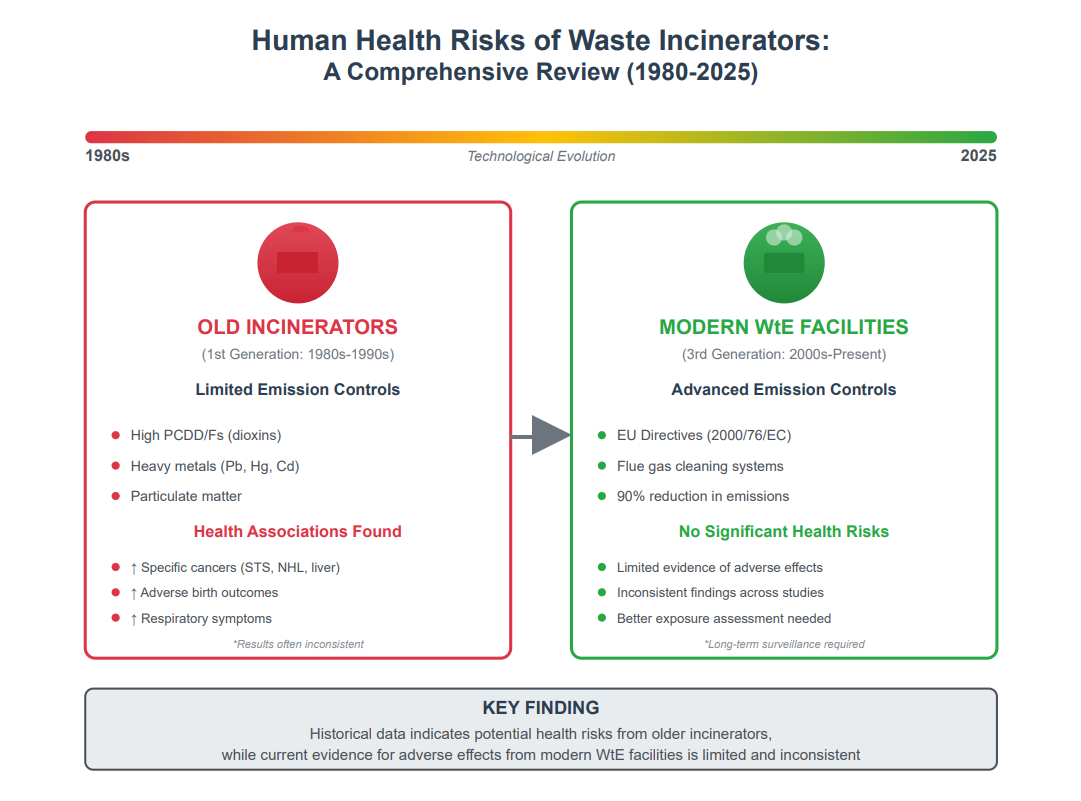
This narrative review synthesizes evidence on human health risks linked to emissions from municipal, hazardous and medical waste incinerators up to August 2025. For the search of information, the databases PubMed, Scopus, Web of Science, and Google Scholar were used. The analysis reveals meaningful differences in health outcomes depending on the age and emission control technology of facilities. Evidence from older, high-emission incinerators indicates elevated cancer risks, particularly for soft tissue sarcoma, non-Hodgkin’s lymphoma, and respiratory cancers in exposed communities. The evidence for adverse reproductive outcomes, including birth defects and adverse birth outcomes, is limited and inconsistent. Respiratory disease and symptoms have been reported in some populations living near older incinerators. Workers at incineration facilities show consistent evidence of elevated exposure to carcinogenic compounds. In contrast, studies on modern waste-to-energy plants with advanced emission controls show substantially diminished or limited health risks. However, the evidence base for newer facilities remains relatively small, and long-term health effects are not yet fully established. Major methodological limitations include crude exposure assessment (reliance on residential proximity), inadequate control for confounding factors, ecological study designs, and heterogeneity in study methods. This review highlights the critical importance of technological advancement in reducing health risks, while underscoring the need for continued surveillance, especially in regions with aging infrastructure or inadequate regulatory oversight.
Phthalate exposure and all-cause and cause-specific mortality in overweight and obese adults: a national cohort study
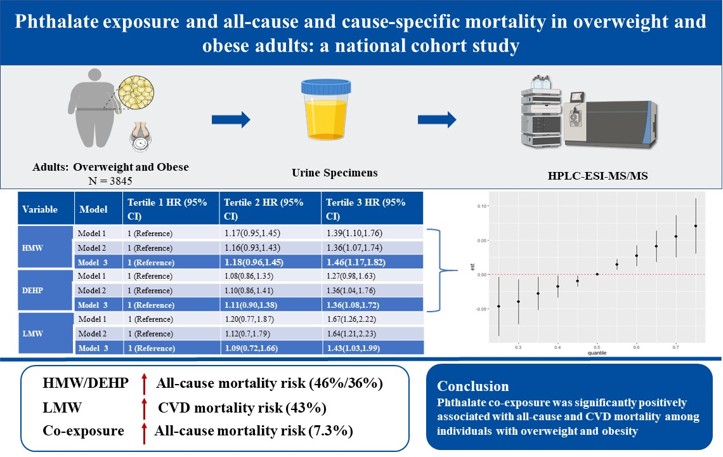
Importance: Phthalate exposure has been found to be associated with an increased risk of obesity. It remains unknown whether exposure to phthalates further impact the health of individuals who are already obese. Objective: To examine the risk of mortality associated with phthalate exposure among individuals with overweight and obesity. Design: A nationally representative sample of adults aged 40 years or older who participated in the US National Health and Nutrition Examination Survey 2001–2010 and provided urine samples for phthalate metabolite measurements. These participants were linked to mortality data from the survey date through December 31, 2019. Exposures: Phthalate metabolites in urine samples were measured by high-performance liquid chromatography-electrospray ionization-tandem mass spectrometry. Main Outcome Measures: Mortality from all causes, cardiovascular disease (CVD), and cancer. Results: This cohort study included 3,845 adults aged 40 years or older (mean age 56.5 [0.3] years). During 46,261 person-years of follow-up (median 12 years; maximum 19 years), 990 deaths occurred, of which 304 were from CVD and 246 were from cancer. Elevated concentrations of high-molecular-weight (HMW) urinary phthalate metabolites and di-2-ethylhexylphthalate (DEHP) were associated with a 46% and 36% increased risk of all-cause mortality, respectively. Regarding low-molecular-weight (LMW) phthalates, higher exposure was specifically linked to a 43% excess risk of CVD mortality. Bayesian kernel machine regression (BKMR) analyses indicated a 7.3% increase in all-cause mortality associated with phthalate co-exposure (75th vs. 50th percentile). Conclusions and Relevance: In this nationally representative study, phthalate co-exposure was significantly positively associated with all-cause and CVD mortality among individuals with overweight and obesity. Higher levels of HMW and DEHP exposure were linked to increased all-cause mortality, while high LMW exposure was associated with elevated CVD mortality. Further studies are necessary to confirm these findings and investigate the underlying mechanisms.
Parental preconception exposure to residential outdoor neighbourhood environments and adverse pregnancy and birth outcomes: a scoping review
Background: Preconception exposure to residential outdoor neighbourhood environments can influence perinatal outcomes by influencing fertility, gamete quality and foetal development through mechanisms such as oxidative stress, epigenetics and inflammation. Following our published protocol, this scoping review aims to synthesize the available evidence and identify gaps in the current understanding of this topic. Methods: We searched four databases (Cumulative Index to Nursing and Allied Health Literature, Ovid Medline, Ovid Embase and Scopus) for peer-reviewed publications on 20 December 2023. The search was restricted to English, without other restrictions. Two reviewers independently screened titles, abstracts and full texts. Findings were narratively synthesised. Results: We identified 82 eligible studies since 2010, all but one from upper-middle-or high-income countries. The largest proportion (43%) comprised retrospective cohort studies, with number of studies published since 2020 trending upwards. Although preconception was usually defined as the three months before pregnancy, most studies assigned these exposures using pregnancy or birth addresses, assuming residential stability since preconception. Among included studies, exposure to PM2.5 was associated with an increased risk of gestational diabetes mellitus (GDM), while PM10 was linked to birth defects. However, most exposure-outcome associations were inconsistent across included studies. The literature suggested the strongest consistency for PM10-birth defects associations, while evidence for O3-GDM associations was inconclusive. Research on other outdoor environmental factors, such as noise, light pollution, weather, built and natural environments, was lacking. Conclusions: Our review found that the existing evidence base is geographically skewed, concentrated on air pollution exposures, and notably lacking in research on paternal exposures. To advance the field, future studies should adopt more precise exposure assessments and expand the range of environmental factors, geographical diversity, and paternal exposure research.
