
International Journal of Environmental Epidemiology
ISSN: 3079-2746 (Print)
ISSN: 3079-2754 (Online)
PFOA impairs angiogenesis via PKA/GSK-3β/ β-catenin/Snail signaling, revealing a novel mechanism for cardiotoxicity
Background: Perfluorooctanoic acid (PFOA) is a widespread environmental contaminant associated with cardiovascular disease risk. However, the direct impact of PFOA on endothelial dysfunction and angiogenesis, critical processes in cardiovascular pathogenesis, remains poorly understood. Methods: Using a mouse model and human umbilical vein endothelial cells (HUVECs), we assessed aortic intimal damage, endothelial functions (proliferation, migration, tube formation), and performed RNA-sequencing to uncover the underlying mechanisms. Results: In vivo, PFOA exposure caused aortic intimal damage and significantly elevated blood pressure and aortic inflammatory/oxidative stress markers in mice. In vitro, PFOA inhibited HUVEC angiogenesis in a concentration-dependent manner (24 h, IC₅₀ = 463 μM), significantly reducing cell viability, migration, and tube formation at a subcytotoxic concentration of 40 μM. Mechanistically, PFOA suppressed PKA and GSK-3β phosphorylation, prevented β-catenin nuclear translocation, and downregulated Snail expression; restoration of these signaling nodes rescued the angiogenic defects. Conclusion: Our findings demonstrate that PFOA impairs angiogenesis by suppressing the PKA/GSK-3β/β-catenin/Snail signaling axis, revealing a novel mechanism for PFOA-induced cardiotoxicity and providing potential targets for intervention.

Strategies to outdoor artificial light at night (ALAN): to balance the urban development and human health
Light has played a pivotal role in shaping human evolutionary trajectories, and it continues to exert profound effects on human health in contemporary societies. Especially, with the advent of artificial light at night (ALAN), the global application of lighting increased diversely, covering indoor and outdoor building lighting, traffic/street lighting, commercial advertising, electronic entertainment and many other fields. ALAN has become one of the most critical global change phenomena may affect human health through both direct and indirect pathways.
Developmental time as a design principle for maternal and child exposomics
Maternal and child exposomics can characterize complex exposure profiles, but measurement remains uneven across the developmental continuum. Although prospective preconception cohorts and studies of minipuberty demonstrate the feasibility of early enrollment and infant hormone phenotyping, these windows are not routinely harmonized across cohort designs. We propose developmental-event-guided exposomics, combining core pregnancy and birth assessments with targeted preconception recruitment and infant sampling during biologically defined windows. Sampling frequency and specimen type should reflect chemical toxicokinetics, with paired external and internal measurements used to calibrate exposure estimates. Computational models should quantify uncertainty rather than obscure unobserved developmental states. Standardizing a limited set of sentinel windows could reveal modifiable sources while biological responses remain measurable, providing a stronger basis for timely exposure reduction before critical opportunities for prevention are lost.
Human health risks of waste incinerators: a narrative review of studies on municipal, hazardous and medical waste incineration
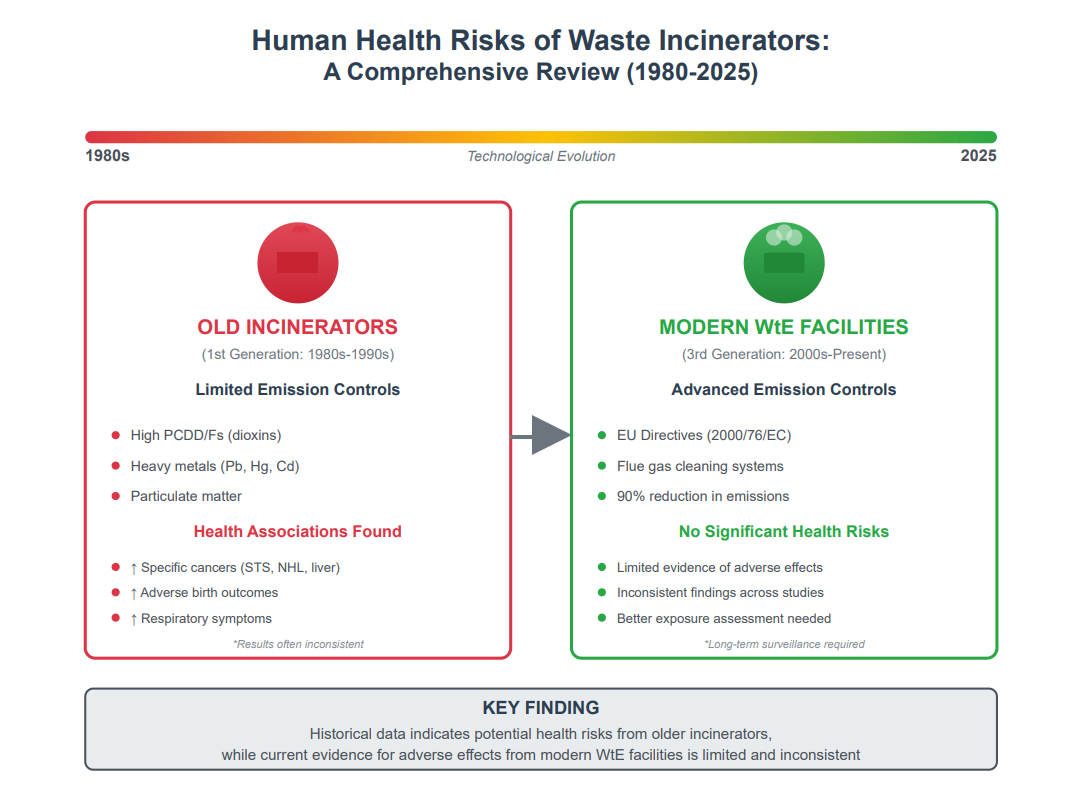
This narrative review synthesizes evidence on human health risks linked to emissions from municipal, hazardous and medical waste incinerators up to August 2025. For the search of information, the databases PubMed, Scopus, Web of Science, and Google Scholar were used. The analysis reveals meaningful differences in health outcomes depending on the age and emission control technology of facilities. Evidence from older, high-emission incinerators indicates elevated cancer risks, particularly for soft tissue sarcoma, non-Hodgkin’s lymphoma, and respiratory cancers in exposed communities. The evidence for adverse reproductive outcomes, including birth defects and adverse birth outcomes, is limited and inconsistent. Respiratory disease and symptoms have been reported in some populations living near older incinerators. Workers at incineration facilities show consistent evidence of elevated exposure to carcinogenic compounds. In contrast, studies on modern waste-to-energy plants with advanced emission controls show substantially diminished or limited health risks. However, the evidence base for newer facilities remains relatively small, and long-term health effects are not yet fully established. Major methodological limitations include crude exposure assessment (reliance on residential proximity), inadequate control for confounding factors, ecological study designs, and heterogeneity in study methods. This review highlights the critical importance of technological advancement in reducing health risks, while underscoring the need for continued surveillance, especially in regions with aging infrastructure or inadequate regulatory oversight.
Trifluoroacetic acid: a pressing need for human biomonitoring, chronic toxicity assessment, and epidemiological research
On May 26, 2025, the German Federal Office for Chemicals (BfC) officially classified trifluoroacetic acid (TFA) as a substance with reproductive toxicity and very persistent and very mobile (vPvM) properties, and submitted the corresponding classification proposal to the European Chemicals Agency (ECHA). Drawing on current evidence, this commentary examines the primary anthropogenic sources of TFA, synthesizes toxicological findings from mammalian studies, and reports the current state of human exposure. Currently, driven by continuous emissions from various anthropogenic sources, environmental concentrations of TFA have been steadily increasing. This widespread environmental exposure has directly led to the prevalent detection of TFA in human. Although the acute toxicity of TFA is relatively low, its ability to accumulate in human body fluids and its potential to bind to proteins collectively constitute long-term health risks that cannot be overlooked. However, data on the toxicological mechanisms of long-term TFA exposure, and epidemiological evidence remain very limited. In this context, we call for stricter regulation of such highly persistent substances while prioritizing research on human biomonitoring, chronic toxicity assessment, and epidemiological research of TFA and other short-chain PFAS, thereby providing scientific support for developing effective environmental control strategies.

Phthalate exposure and all-cause and cause-specific mortality in overweight and obese adults: a national cohort study
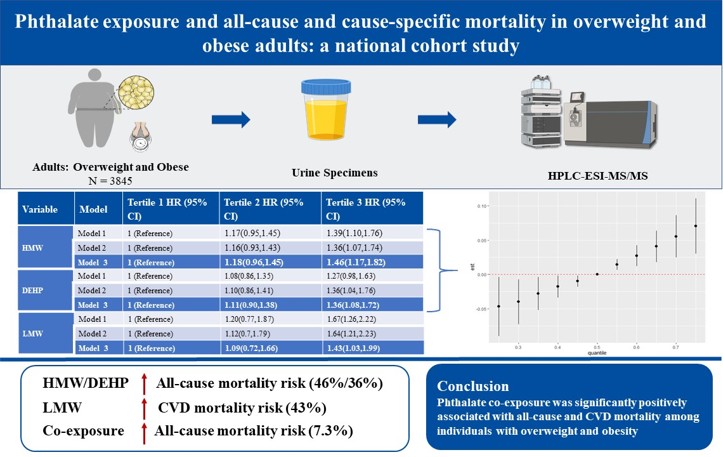
Importance: Phthalate exposure has been found to be associated with an increased risk of obesity. It remains unknown whether exposure to phthalates further impact the health of individuals who are already obese. Objective: To examine the risk of mortality associated with phthalate exposure among individuals with overweight and obesity. Design: A nationally representative sample of adults aged 40 years or older who participated in the US National Health and Nutrition Examination Survey 2001–2010 and provided urine samples for phthalate metabolite measurements. These participants were linked to mortality data from the survey date through December 31, 2019. Exposures: Phthalate metabolites in urine samples were measured by high-performance liquid chromatography-electrospray ionization-tandem mass spectrometry. Main Outcome Measures: Mortality from all causes, cardiovascular disease (CVD), and cancer. Results: This cohort study included 3,845 adults aged 40 years or older (mean age 56.5 [0.3] years). During 46,261 person-years of follow-up (median 12 years; maximum 19 years), 990 deaths occurred, of which 304 were from CVD and 246 were from cancer. Elevated concentrations of high-molecular-weight (HMW) urinary phthalate metabolites and di-2-ethylhexylphthalate (DEHP) were associated with a 46% and 36% increased risk of all-cause mortality, respectively. Regarding low-molecular-weight (LMW) phthalates, higher exposure was specifically linked to a 43% excess risk of CVD mortality. Bayesian kernel machine regression (BKMR) analyses indicated a 7.3% increase in all-cause mortality associated with phthalate co-exposure (75th vs. 50th percentile). Conclusions and Relevance: In this nationally representative study, phthalate co-exposure was significantly positively associated with all-cause and CVD mortality among individuals with overweight and obesity. Higher levels of HMW and DEHP exposure were linked to increased all-cause mortality, while high LMW exposure was associated with elevated CVD mortality. Further studies are necessary to confirm these findings and investigate the underlying mechanisms.