
 X
X WeiBo
WeiBo WeChat
 Facebook
 LinkedIn
 Reddit
 Bluesky
Low-frequency energy harvesting using a counterweighted pendulum for maritime applications
- Volume
- CitationWojkowski K, Mitchell I, Serjouei A. Low-frequency energy harvesting using a counterweighted pendulum for maritime applications. Renew. Sust. Energy 2026(1):0004, https://doi.org/10.55092/rse20260004.
- DOI10.55092/rse20260004
- CopyrightCopyright2026 by the authors. Published by ELSP.
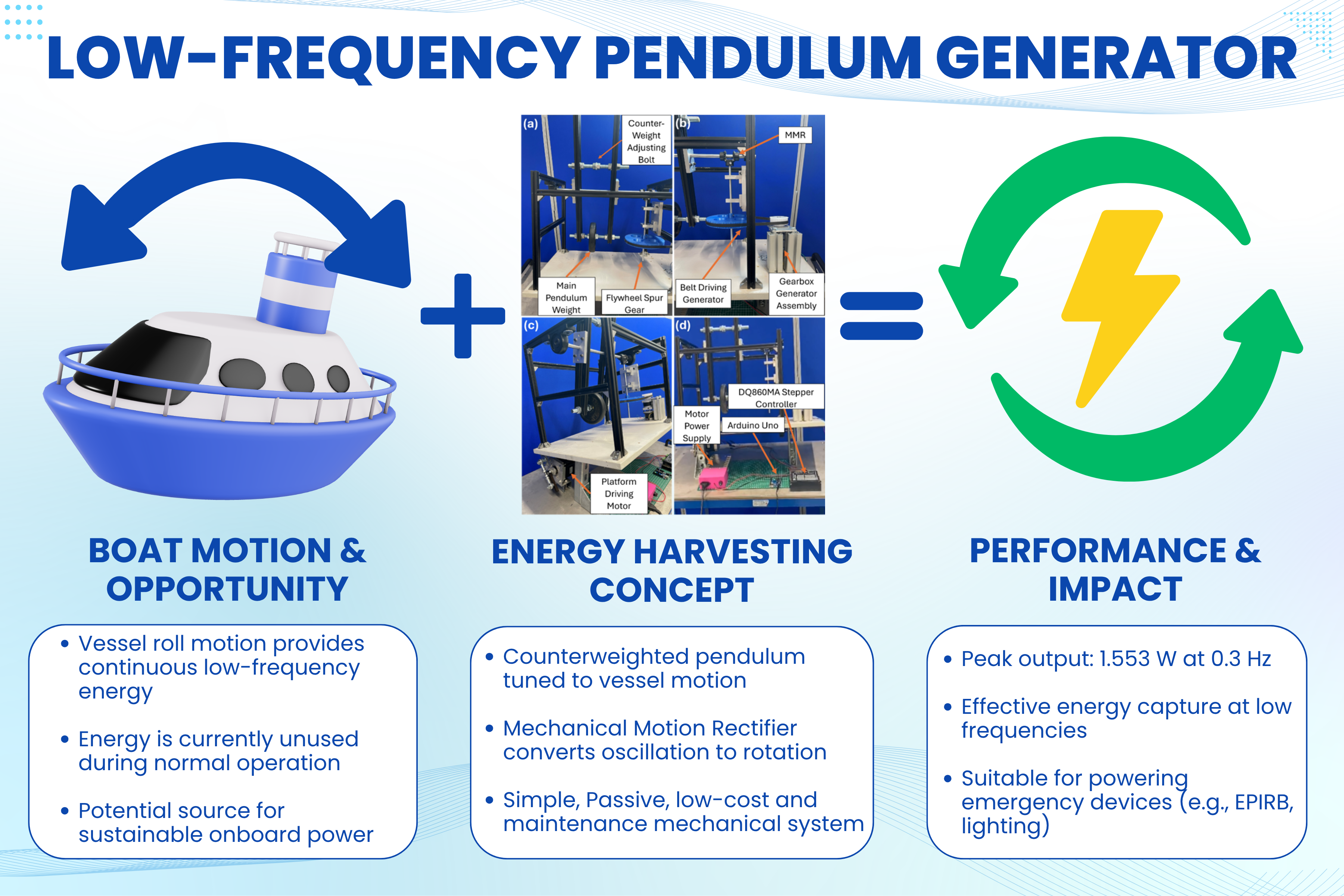
This paper presents the design, development, and experimental evaluation of a low-frequency energy harvesting device based on a counterweighted pendulum system. Targeting maritime applications, particularly as an emergency power source for lighting or homing beacons, the device converts mechanical oscillations into electrical energy using a stepper motor, a mechanical motion rectifier, and a flywheel. A key focus is tuning the system for resonance at low excitation frequencies typical of marine environments. Through a series of controlled tests, the system achieved a peak average power output of 1.553 W at 0.3 Hz using a 3.049 kg pendulum at a 25 cm length. Comparative analysis highlights the efficiency gains from tuning pendulum length, mass, and counterweight placement. The device architecture emphasizes low-maintenance operation, passive actuation, and the use of manufacturable, modular components suitable for scalable production and integration into maritime or industrial platforms. These attributes position the system as a sustainable energy-harvesting solution that can complement hybrid power architectures and contribute to circular manufacturing approaches by reducing reliance on disposable batteries in remote systems. The results demonstrate significant improvements over similar harvesting technologies operating at higher frequencies and lay the groundwork for broader deployment in resilient, sustainable marine systems.
energy harvesting; counterweighted pendulum; mechanical motion rectifier; stepper generator; low-frequency oscillation; renewable energy
