
 X
X WeiBo
WeiBo WeChat
 Facebook
 LinkedIn
 Reddit
 Bluesky
Autonomous collision avoidance for complex multi-ship encounters based on improved dynamic window approach
- Volume
- CitationMa X, Lyu H, Tan G, Kang X, Yin Y, et al. Autonomous collision avoidance for complex multi-ship encounters based on improved dynamic window approach. Robot Learn. 2026(3):0021, https://doi.org/10.55092/rl20260021.
- DOI10.55092/rl20260021
- CopyrightCopyright2026 by the authors. Published by ELSP.
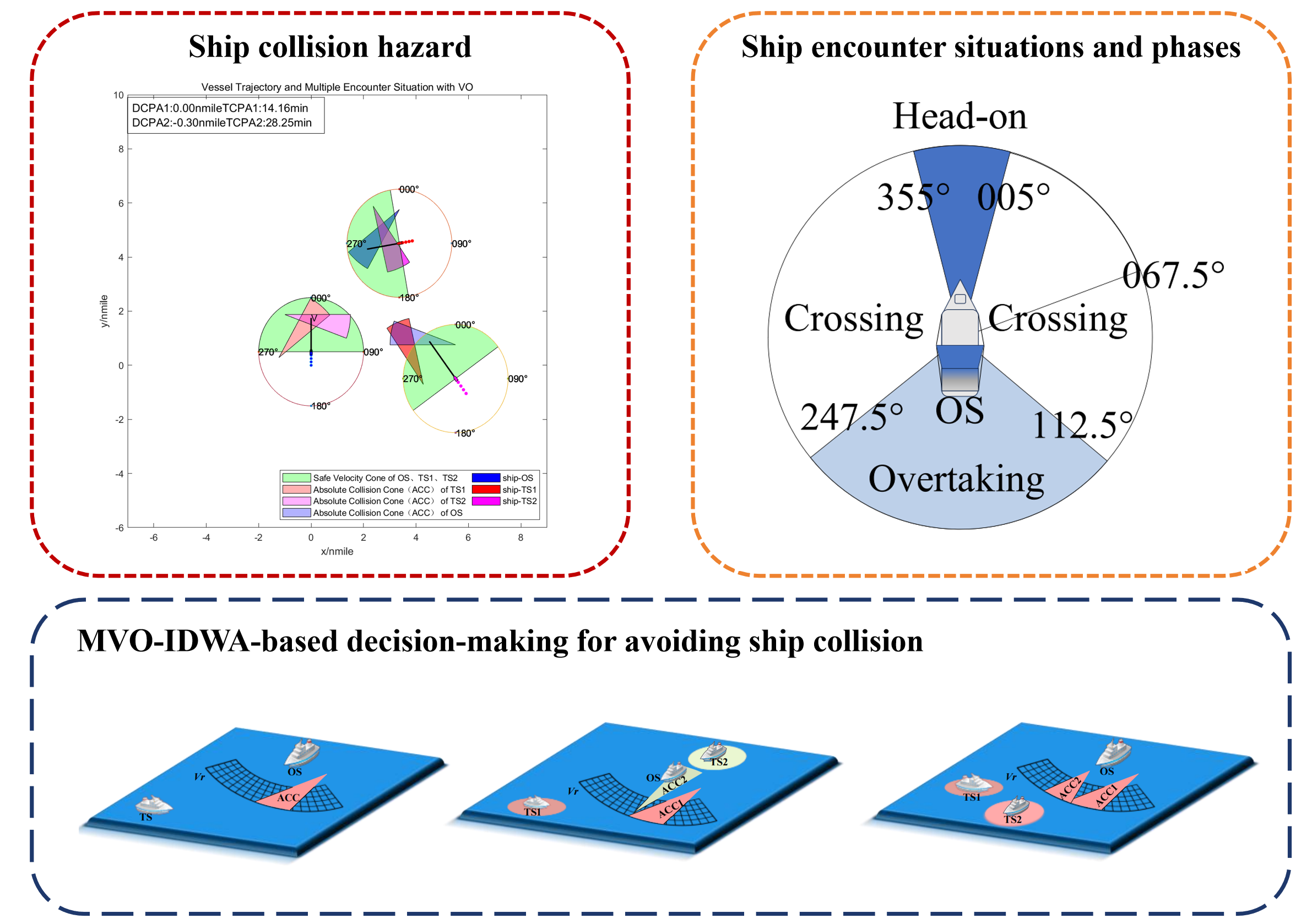
Achieving autonomous navigation requires Maritime Autonomous Surface Ships (MASS) to overcome difficulties in recognizing intricate multi-ship encounter situations and developing appropriate collision avoidance strategies. To address the above issues, this study first integrates the Velocity Obstacle (VO) with Closest Point of Approach/Time to Closest Point of Approach (CPA/TCPA) into the collision risk identification of ships. This enables the own ship (OS) to determine the risk posed by target ships (TSs) in the scenario. Secondly, the paper further discusses complex multi-ship encounter scenarios, based on 1972 International Regulations for Preventing Collision at Sea (COLREGs), it classifies responsibilities to determine the set of give-way ship and stand-on ship obligations. Finally, the derived responsibility set is incorporated into Dynamic Window Approach (DWA), allowing the enhanced Multi-Vessels Velocity Obstacle and Improved Dynamic Window Approach (MVO-IDWA) algorithm to automatically select optimal decisions in complex multi-ship encounter scenarios and ensure the ship reaches its destination safely. Centering on the challenge of avoiding collision decision in multi-ship complex encounter scenarios, this paper proposes the integration of ship responsibility sets with the MVO-IDWA algorithm. Analysis of the results establishes that the proposed algorithm can consider the inter-ship responsibilities, risk levels, and movement trends of TSs in multi-ship encounters, thereby realizing autonomous ship collision avoidance.
multi-ship encounter situation; autonomous collision avoidance; velocity obstacle; dynamic window approach
