
 X
X WeiBo
WeiBo WeChat
 Facebook
 LinkedIn
 Reddit
 Bluesky
Hybrid Ivy growth optimization and BP neural network model for accurate of building energy efficiency
- Volume
- CitationYuan F, Gao J, Xie T, Fan Y, Tian Z, et al. Hybrid Ivy growth optimization and BP neural network model for accurate of building energy efficiency. Renew. Sust. Energy 2026(1):0003, https://doi.org/10.55092/rse20260003.
- DOI10.55092/rse20260003
- CopyrightCopyright2026 by the authors. Published by ELSP.
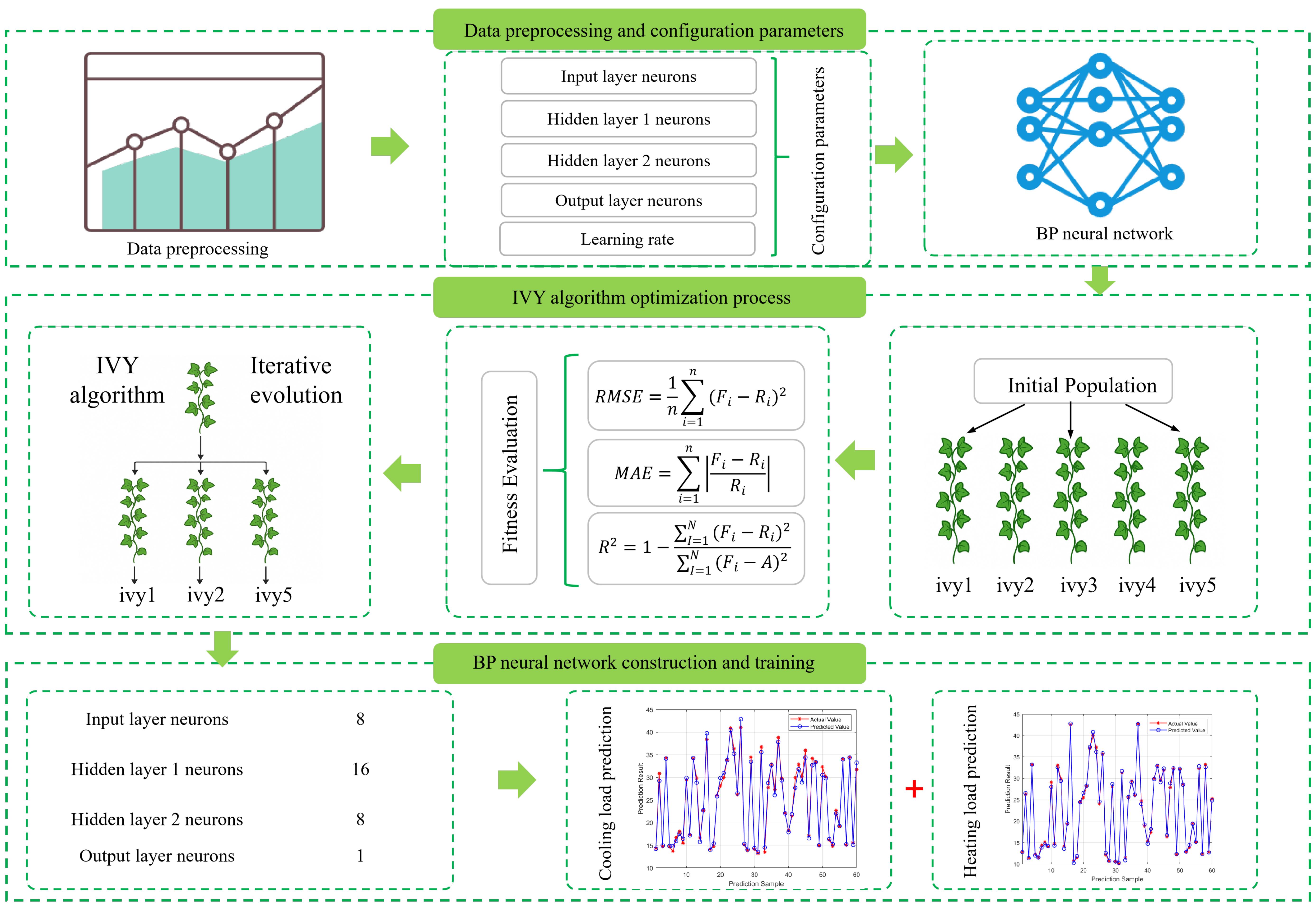
Accurate prediction of building energy consumption is crucial for optimizing energy efficiency and reducing carbon emissions. Although the Backpropagation (BP) neural network is widely adopted for its strong nonlinear mapping capability in modeling complex architectural-energy relationships, it often suffers from slow convergence and a tendency to become trapped in local minima. To address these limitations, this study proposes a novel hybrid forecasting framework, IVY-BP, which integrates the Ivy Growth Optimization (IVY) algorithm with a BP network. The model utilizes architectural features as inputs to precisely predict two key outputs: Heating Load (HL) and Cooling Load (CL). Specifically, the IVY algorithm is employed to globally optimize the initial weights and thresholds of the BP network, significantly enhancing its robustness. Utilizing the UCI Energy Efficiency dataset, the model’s performance was rigorously evaluated against benchmarks including CNN, RF, ELM, and GA-BP. Experimental results demonstrate that IVY-BP achieves superior accuracy, with R2 values reaching 0.9976 for HL and 0.9902 for CL, while maintaining the lowest MAE and RMSE. In conclusion, the proposed IVY-BP model provides a precise tool for smart building management systems, enabling intelligent regulation of HVAC systems to achieve sustainable energy goals.
IVY; BP neural network; cool load; heat load
