
 X
X WeiBo
WeiBo WeChat
 Facebook
 LinkedIn
 Reddit
 Bluesky
Formation mechanism and particle size distribution optimization of large fly ash particles
- Volume
- CitationDu J, Jia Z, Yang Z, Zhao Y, Zhu C, et al. Formation mechanism and particle size distribution optimization of large fly ash particles. Renew. Sust. Energy 2026(2):0006, https://doi.org/10.55092/rse20260006.
- DOI10.55092/rse20260006
- CopyrightCopyright2026 by the authors. Published by ELSP.
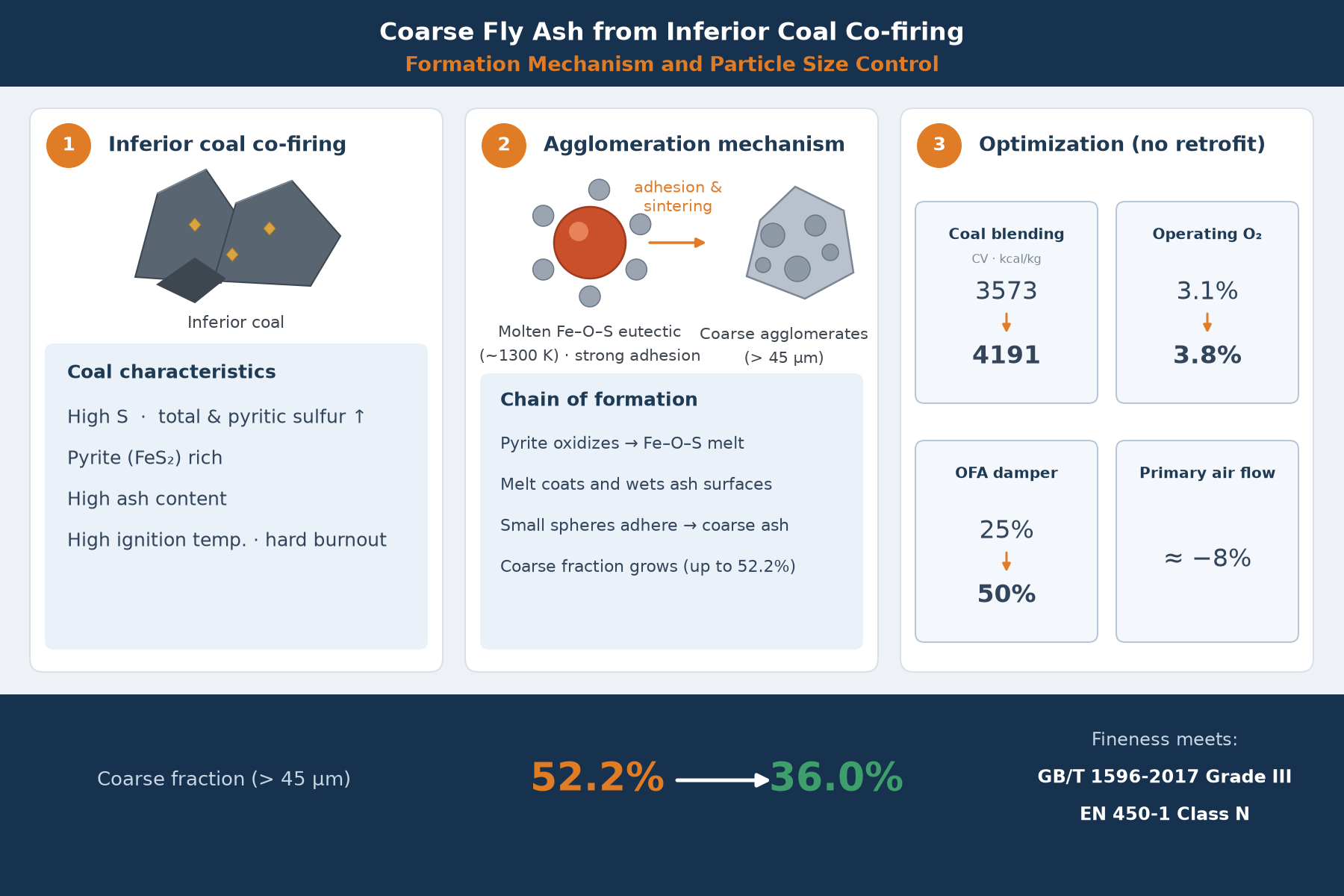
To address the issue of coarse fly ash particles resulting from co-firing inferior coal in utility boilers—which impairs resource utilization and economic performance of power plants—this study conducts laboratory-scale investigations on coal combustion characteristics and fly ash particle size distribution, alongside field tests on coal blending and combustion optimization for a 330 MW unit. The research is approached from the perspective of reducing technical costs while avoiding large-scale equipment modifications. The formation mechanism of large fly ash particles is systematically analyzed, and optimization strategies are proposed. Laboratory results demonstrate that the proportion of coarse fly ash particles exhibits significant correlations with sulfur and pyrite content in coal, fuel ignition temperature, combustion burnout difficulty, and slagging propensity. Higher sulfur content, elevated ignition temperatures (> 680 °C), and lower burnout rates correspond to increased proportions of particles larger than 45 μm (reaching up to 38.5%). The fundamental mechanism involves the adhesion of molten (Fe–O–S) eutectics—formed through the oxidation of iron and sulfur—to other particles, thereby generating larger agglomerates. Field tests indicate that by increasing the as-fired coal calorific value to 4191 kcal/kg, reducing sulfur content to 1.04%, decreasing the proportion of low-reactivity coal, and optimizing combustion parameters (oxygen concentration at 3.8%, reduced primary air flow, and appropriately increased over-fire air opening), the proportion of fly ash particles exceeding 45 μm decreased from 52.2% to 36.0%, meeting the utilization standard for Grade III fly ash. This research achieves the technical objective of reducing coarse fly ash proportions through optimization measures without equipment modification, providing an economically viable solution for the resource utilization of fly ash from utility boilers.
fly ash particle size; cause of large particles; blended coal combustion; combustion optimization; resource utilization
