

Optics and Photonics Research
ISSN: 3078-3798 (Print)
ISSN: 3078-3801 (Online)
Photoacoustic nondestructive evaluation for material characterization: recent advances and future perspectives
Photoacoustic (PA) nondestructive evaluation (NDE) is an emerging material characterization approach that converts optical absorption into acoustic information, enabling simultaneous access to optical absorption, structural features, and depth-dependent properties. Unlike conventional inspection techniques, PA NDE provides unique capabilities for quantitative evaluation of complex materials and structures. This Perspective summarizes recent advances in PA NDE platforms, including PA A-line sensing, PA microscopy, and all-optical PA systems such as PA remote sensing, and highlights their applications in energy storage, semiconductor manufacturing, civil infrastructure, transportation, aerospace, and other industrial fields. Representative examples demonstrate the potential of PA NDE for defect inspection, morphology monitoring, and material property characterization. Future development will require advances in non-contact inspection, wavelength-selective characterization, quantitative signal interpretation, image-based analysis, and measurement standardization. These efforts will be essential for translating PA NDE from laboratory demonstrations into reliable industrial characterization tools.

Arbitrary eigenmode reshaping induced by distributed non-reciprocity in non-Hermitian systems
Periodic non-reciprocal systems have attracted significant attention for their striking non-Hermitian skin effect (NHSE) and the development of a comprehensive non-Bloch theory. In contrast, aperiodic non-reciprocal systems have been rarely explored, owing to the intrinsic complexity induced by spatial non-uniformity and absence of predictable physical behavior. Here, we establish a theoretical framework for one-dimensional nearest-neighbor lattices under open boundary conditions, and reveal that the spatially varying non-reciprocal coupling can be interpreted geometrically as a designable imaginary gauge field, providing a tunable metric on the Hilbert space that serves as a powerful and deterministic knob to control the wave-functions of eigenmodes. By tailoring the non-reciprocity distribution in this specific system, we combine theory, proof-of-concept electric-circuit experiments, and high-frequency optical-lattice simulations with micro-ring resonators to demonstrate that the eigenmodes of a non-Hermitian system can be reshaped into arbitrary spatial profiles without altering their spectral distribution, a mode-field engineering strategy termed non-Hermitian reshaping engineering (NHRE). In the special case of a uniform non-reciprocity distribution, NHRE recovers the characteristic exponential mode localization in the conventional NHSE. While the full diagonalization framework underlying the inverse mapping is limited to one dimension, some of its design principles can be partially extended to arbitrary higher-dimensional systems, offering an efficient route to mode modulation and deepening our understanding of non-Hermitian physics.

Illuminating the shadow: a new vision for photonics publishing
It is a fair question to ask: does the community truly need another journal in the bustling, highly saturated field of optics and photonics? When the landscape of optical publishing is already as densely packed as WDM, the justification for a new entrant must go beyond merely providing another venue. While we remain committed to the highest standards of peer-reviewed rigor for cutting-edge optical research, this journal was founded on the belief that the current format of scientific storytelling is incomplete. We tend to publish the destination, but we rarely map the journey.
Nanoimprint lithography for scalable manufacturing of optical metasurfaces
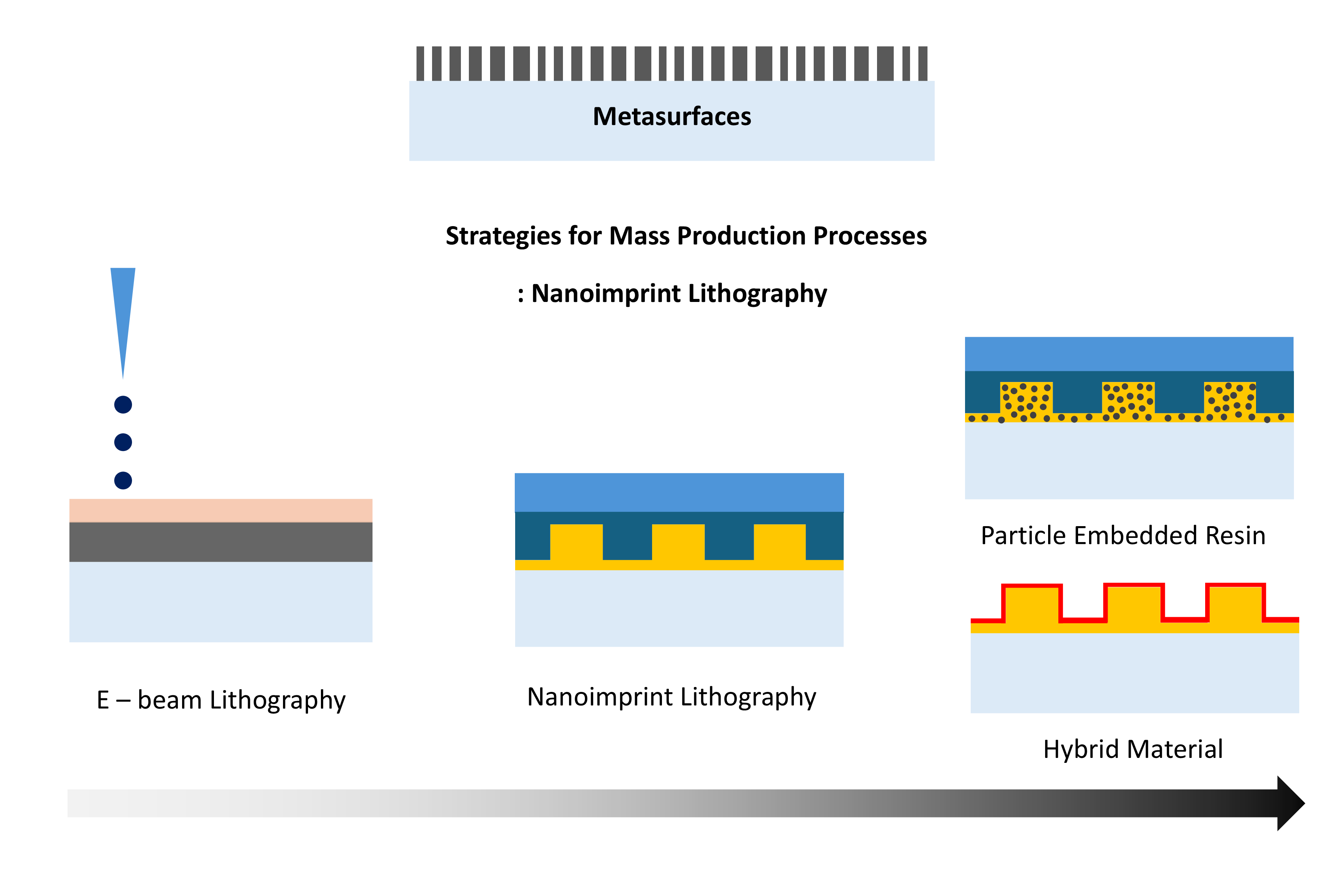
Metasurfaces, composed of two-dimensional meta-atoms with subwavelength dimensions, enable precise manipulation of light wavefronts, facilitating lensing, color filtering, holography, and augmented reality in a compact form factor. To realize desired optical functionalities, metasurface fabrication requires nanoscale patterning of high‑refractive‑index (high-index) materials. Conventionally, electron beam lithography (EBL) has been widely utilized in combination with deposition techniques such as plasma-enhanced chemical vapor deposition. Despite offering high-resolution capabilities, EBL suffers from low throughput, high cost, and limited scalability due to its direct-writing nature. To overcome these limitations, nanoimprint lithography (NIL) has emerged as a promising low-cost, high-throughput alternative. However, conventional NIL resins have low refractive indices (~1.5), restricting their direct optical use and necessitating additional steps to enhance the refractive index. To address this challenge, we review two strategies for the scalable fabrication of metasurfaces: hybrid materials, which apply high‑index atomic layer deposition (ALD) coatings onto imprinted patterns, and particle‑embedded resins (PERs), which incorporate high‑index nanoparticles directly into the imprint resin. This review highlights recent progress in these NIL‑based approaches and discusses their potential to bridge the gap between laboratory‑scale demonstrations and large‑scale industrial production of metasurfaces.
Use of natural minerals toward cost-effective fabrication of layered structural colors by physical vapor deposition
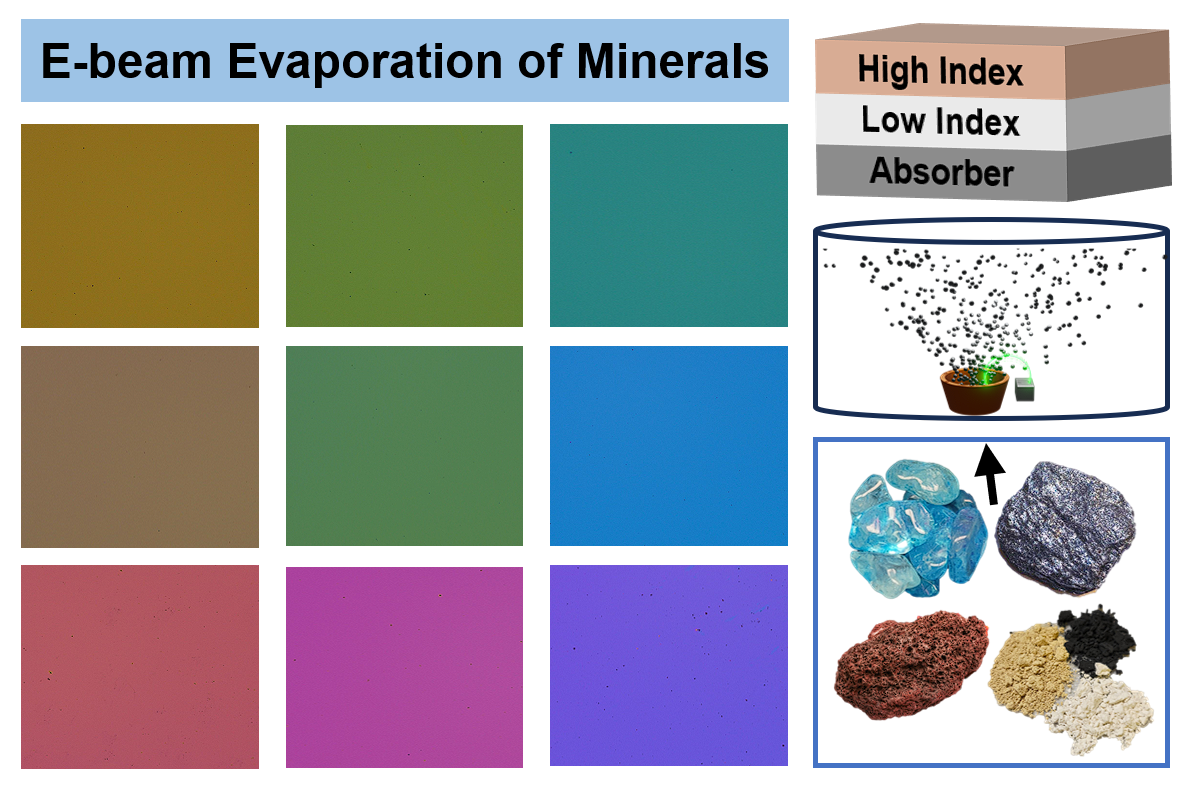
Structural color coatings offer exceptional vibrancy and durability but remain limited in many applications due to high material costs and fabrication complexity. This work aims to address the former limit and demonstrates multilayer optical coatings fabricated from un-processed natural mineral powders using electron beam evaporation. By using SiO₂ and TiO₂ based mineral materials as dielectric layers and a CuO–Fe₂O₃ mixture as an absorbing base, High-Low-Absorber (HLA) structures were fabricated that exhibit the desired reflection color. Refractive indices of TiO₂ films derived from ceramic powder are shown to be reproducible under controlled vacuum and source conditions, while the CuO–Fe₂O₃ mixture forms a stable film with high absorption and long-term conductivity. Structural colors deposited on both silicon and glass substrates exhibit strong agreement with optical simulations and are validated by reflectance spectra, ellipsometry, and X-ray photoelectron spectroscopy. This approach highlights a cost-effective pathway for producing optical coatings using minimally refined raw materials, with potential applications in photonics, optoelectronics, and sustainable color technologies.
Arbitrary eigenmode reshaping induced by distributed non-reciprocity in non-Hermitian systems
Periodic non-reciprocal systems have attracted significant attention for their striking non-Hermitian skin effect (NHSE) and the development of a comprehensive non-Bloch theory. In contrast, aperiodic non-reciprocal systems have been rarely explored, owing to the intrinsic complexity induced by spatial non-uniformity and absence of predictable physical behavior. Here, we establish a theoretical framework for one-dimensional nearest-neighbor lattices under open boundary conditions, and reveal that the spatially varying non-reciprocal coupling can be interpreted geometrically as a designable imaginary gauge field, providing a tunable metric on the Hilbert space that serves as a powerful and deterministic knob to control the wave-functions of eigenmodes. By tailoring the non-reciprocity distribution in this specific system, we combine theory, proof-of-concept electric-circuit experiments, and high-frequency optical-lattice simulations with micro-ring resonators to demonstrate that the eigenmodes of a non-Hermitian system can be reshaped into arbitrary spatial profiles without altering their spectral distribution, a mode-field engineering strategy termed non-Hermitian reshaping engineering (NHRE). In the special case of a uniform non-reciprocity distribution, NHRE recovers the characteristic exponential mode localization in the conventional NHSE. While the full diagonalization framework underlying the inverse mapping is limited to one dimension, some of its design principles can be partially extended to arbitrary higher-dimensional systems, offering an efficient route to mode modulation and deepening our understanding of non-Hermitian physics.