Advanced Manufacturing
ISSN: 2959-3263 (Print)
ISSN: 2959-3271 (Online)
CODEN: AMDAE3
CiteScore 2025: 1.1
Jidoka 4.0 as a data-driven lean capability: a structural model linking smart automation to sustainability outcomes in manufacturing
Lean manufacturing is now called Industry 4.0, in which traditional production tools are data-driven and have implications for corporate sustainability. Jidoka (JIDO) has been transformed into JIDO 4.0, which employs Internet of Things (IoT) systems and sensors to gather data from the production process for real-time monitoring and decision making. Based on three hypotheses, this study proposes a structural equation model (SEM) to examine the relationships between JIDO 4.0, digital sustainability (DISU), and environmental sustainability (ENSU) in manufacturing companies. The SEM was tested with data from 834 responses to a questionnaire for managers, engineers, and supervisors, validated using Lawshe’s content validity ratio and Aiken’s V. The Warp3 algorithm in WarpPLS 8.0 was used to detect nonlinear relationships between constructs. The results indicate that the three proposed hypotheses are supported, showing that JIDO has the greatest direct effect on DISU (β = 0.588), and DISU is the most influential predictor of ENSU (β = 0.553). The indirect effect of JIDO on ENSU, mediated by DISU (β = 0.325), was nearly equal to the direct effect (β = 0.342), indicating that DISU acts as a bridge between intelligent autonomy and environmental benefits. A sensitivity analysis based on conditional probabilities indicated that when DISU was high, the probability of achieving a high ENSU was 64.8%. These results indicate that JIDO is a data-driven organizational capability with direct and indirect effects on ENSU, and that it provides managers with empirical evidence to prioritize their investments in smart and lean technology.

Uncertainty-aware deep neural network for multi-scale temporal modeling in industrial equipment prognostics
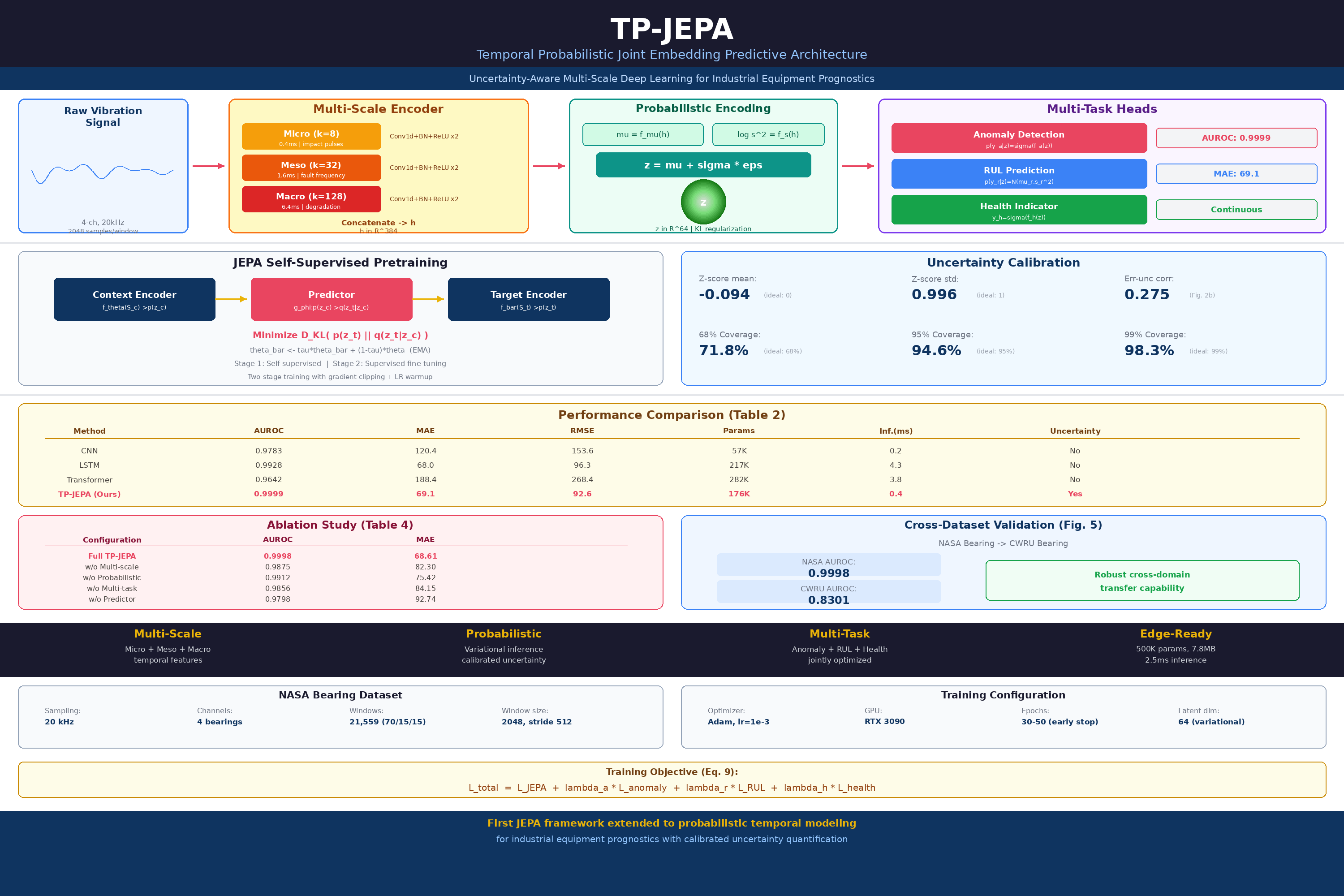
Predictive maintenance for industrial equipment is critical for improving production safety, reducing maintenance costs, and optimizing equipment utilization. However, existing deep learning methods face two key challenges in industrial equipment prognostics: the lack of uncertainty quantification to support risk-informed decision-making and the inability to simultaneously capture multi-scale temporal patterns in equipment degradation processes. This paper presents the Temporal Probabilistic Joint Embedding Predictive Architecture (TP-JEPA), a novel deep neural network framework that learns robust representations of equipment health states by predicting probabilistic distributions of future states in latent space. TP-JEPA’s innovations include: (1) a probabilistic encoding mechanism that extends deterministic representations to distributions, inherently quantifying prediction uncertainty; (2) a multi-scale temporal encoder designed to extract hierarchical features from high-frequency transients to long-term degradation trends; and (3) a multi-task learning paradigm that jointly optimizes anomaly detection, remaining useful life (RUL) estimation, and health state assessment, enabling synergistic task enhancements. Evaluations on the National Aeronautics and Space Administration (NASA) bearing dataset demonstrate that TP-JEPA achieves an Area Under the Receiver Operating Characteristic curve (AUROC) of 0.9999 for anomaly detection—outperforming state-of-the-art methods—and a mean absolute error of 69.1 cycles for remaining useful life prediction, with well-calibrated uncertainty estimates (95% confidence interval coverage of 94.6%). Cross-dataset validation and ablation studies confirm the framework’s efficacy and robustness.
Laser additive manufacturing of metallic lattice structures: material-structure-property concept, and future perspective
Metallic lattice structures have emerged as revolutionary lightweight materials with exceptional specific strength and multifunctional capabilities, particularly in aerospace applications. This review comprehensively examines the state of the art in laser additive manufacturing (LAM) of metallic lattice structures, focusing on selective laser melting (SLM) and electron beam melting (EBM). We critically analyze recent advances in materials development, including nickel-based superalloys (GH4169/IN718, K465), titanium alloys (Ti-6Al-4V), and functionally graded composites. The review addresses key design considerations, including unit cell topology optimization, node reinforcement strategies, and gradient structures. We examine mechanical properties under various loading conditions, thermal management capabilities, and failure mechanisms through both experimental and numerical perspectives. Advanced detection methods, including micro-CT imaging and AI-based defect identification, are evaluated for quality assurance. Critical challenges, including surface roughness control, residual stress management, and size limitations, are discussed alongside emerging opportunities in machine-learning-assisted design and multi-material systems. This review provides essential insights for researchers and engineers seeking to advance lattice-structured applications in next-generation aerospace systems.