
Artificial Intelligence & Autonomous Systems
ISSN: 2959-0744 (Print)
ISSN: 2959-0752 (Online)
CODEN: AIASBB
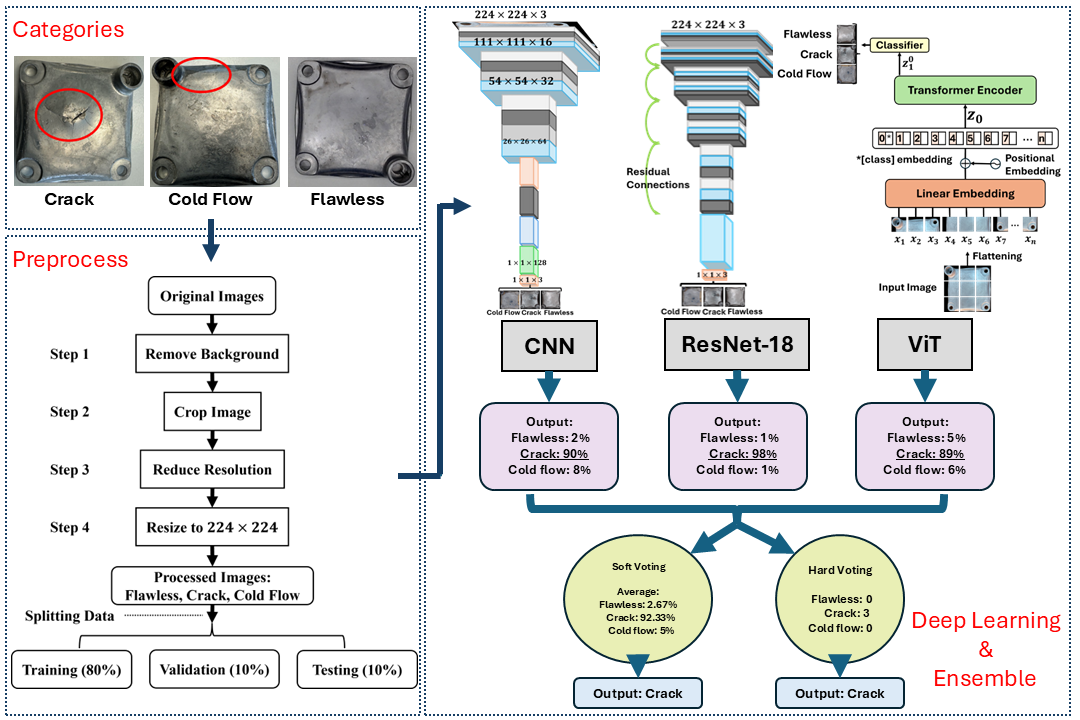
An ensemble deep learning approach for surface defect detection in aluminum die-cast gas meter lids
Aluminum die-cast products often exhibit surface defects that vary in type and severity depending on product function and design requirements. Current defect detection primarily relies on manual inspection, which demands significant expertise, raises health and fatigue concerns, and is prone to human error. Automated defect detection offers a promising solution to reduce costs, improve efficiency, resolve occupational safety and health concerns, and mitigate challenges in labor shortages and training. This paper presents an ensemble deep learning (DL) approach for detecting surface defects in aluminum die-cast lids for residential gas meters, a quality-critical component with stringent safety standards. Specifically, we implement and evaluate three state-of-the-art DL architectures: a convolutional neural network (CNN), residual networks (ResNet-18), and Vision Transformer (ViT). In addition, we develop an ensemble model to further enhance performance. We leverage grid search and cross-validation for hyperparameter tuning and train/test each model ten times for comprehensive performance evaluation. Experiments on a large real-world dataset demonstrate that all models achieve high accuracy, precision, and recall, with CNN and ResNet-18 slightly outperforming ViT. The ensemble model further improves prediction accuracy and robustness. The paired t-tests showed that the ensemble model significantly performed better compared to CNN and ViT model. In summary, this study contributes to the advancement of automated inspection of surface defects in die-cast products by systematically comparing state-of-the-art deep learning methods, discussing model selection criteria, and optimizing ensemble strategies. Centered on CNN, ResNet-18, and ViT architectures, it proposes a rigorous methodological framework for surface defect detection and provides a foundational basis for subsequent research in in-situ quality control. Our codes are available at https://github.com/Alexruoyun/Aluminum-Die-Casting-Surface-Defect-Detection.
Multimodal trajectory prediction based on dynamic scene encoding and relational reasoning
Autonomous vehicles require effective prediction of potential future trajectories of surrounding agents. The current trajectory prediction methods have limitations, firstly, traditional feature fusion methods merge scene features sequentially in a simplistic manner, often overlooking the intricate interrelations among scene elements, leading to incomplete selection and insufficient utilization of useful features; secondly, in multimodal trajectory prediction, the mode collapse issue inherent to probabilistic approaches results in inadequate expression of agent intent uncertainty, while overly anchor-dependent proposal-based methods can generate implausible trajectories. To address these limitations, We present a Dynamic scene and Relational reasoning Transformer (DRTR), a novel multimodal trajectory prediction method based on dynamic scene encoding and relational reasoning. A pivotal aspect of DRTR is the dynamic closed-loop modeling framework that effectively combines scene features to output three dynamic features: dynamic traffic flow, dynamic agents, and interactions between agents. This innovative framework ensures a comprehensive capture of the dynamic scene and its intricate interrelations. Then, DRTR initializes a set of trajectory suggestions representing various modalities and carefully refines these suggestions by sequentially fusing and querying dynamic scene features, ensuring predictions are both accurate and reflect multimodality. To further enhance model expressiveness, we introduce a feature selection network based on relational reasoning, which can recognize deep relationships between scene elements and select beneficial contextual features. Experiments on the Argoverse 1 dataset indicate that DRTR exhibits superior performance, particularly in multimodal trajectory prediction.

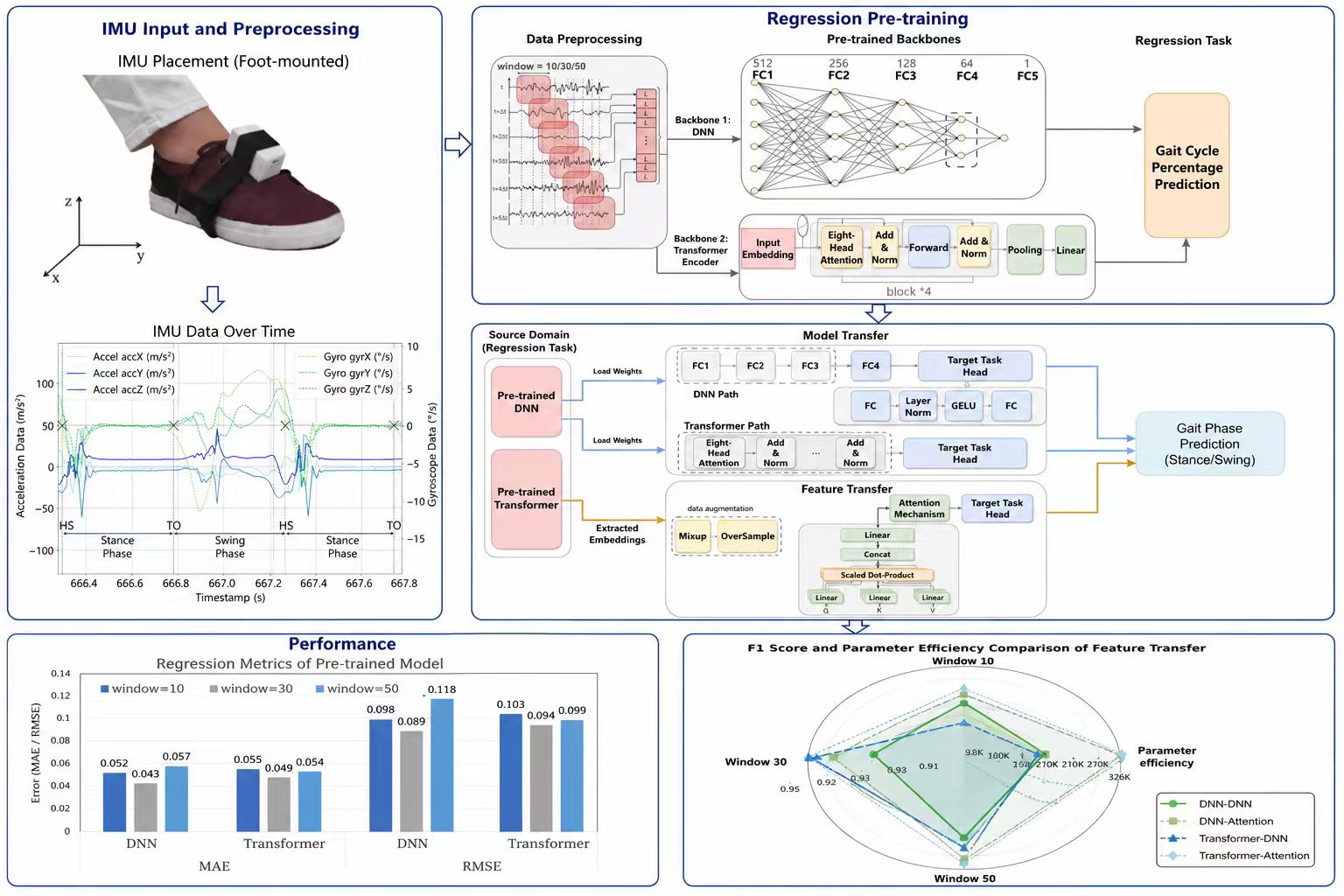
Transfer learning from gait cycle percentage prediction to gait phase classification using wearable sensors
Reliable gait phase classification is essential for wearable-based locomotion analysis. Although gait cycle percentage prediction and gait phase classification are biomechanically related, knowledge transfer across these distinct objectives remains underexplored. In this paper, we propose a regression-to-classification transfer learning framework that utilizes temporal representations learned from continuous gait cycle progression to improve discrete phase recognition. We pre-train neural backbones on a regression task and transfer the learned representations to the classification task through model transfer (fine-tuning backbone weights) and feature transfer (using the backbone as a fixed feature extractor). To identify the optimal configuration for resource-constrained environments, we compare a compact Deep Neural Network (DNN) with 0.3 M parameters and a Transformer model across multiple sliding window sizes. Our experimental results demonstrate that model transfer achieves a superior F1-score of 0.9788, outperforming the feature transfer baseline and models trained from scratch. Efficiency tests show that the compact DNN achieves a Central Processing Unit (CPU) latency below 0.07 ms, supporting real-time data processing. Validation on an independent dataset further confirms cross-population robustness, achieving a classification accuracy of 92.3%. These findings suggest that regression pre-training captures effective temporal features, providing a practical framework for wearable-based gait analysis.
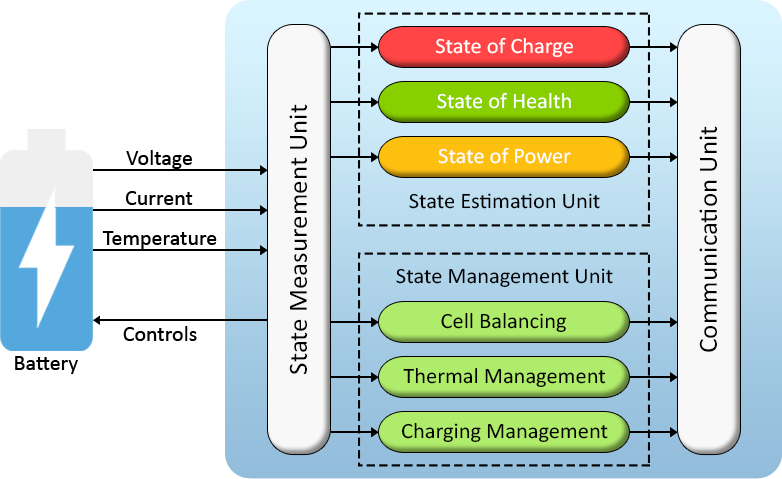
Machine learning driven digital twin model of Li-ion batteries in electric vehicles: a review
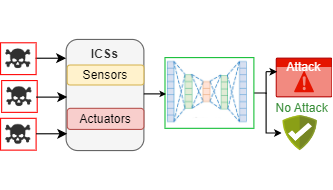
Cyberattack detection on SWaT plant industrial control systems using machine learning
Detecting cyberattacks is critical for maintaining the security and integrity of industrial control systems (ICSs). This study introduces a machine learning approach for identifying cyberattacks on the Secure Water Treatment (SWaT) plant testbed. The dataset, sourced from the Singapore University of Technology and Design, includes data from 51 sensors and actuators. The research employs a Long Short-Term Memory (LSTM) network alongside traditional machine learning algorithms like Random Forest (R.F.), Support Vector Machine (SVM), and K-Nearest Neighbour (KNN) to classify cyberattacks. The LSTM model outperformed the other methods, achieving a test accuracy of 98.02% (cyberattack: 97.80%, non-attack: 98.30%). Given the imbalanced nature of the dataset, additional metrics such as precision, recall, and F1 score were evaluated, further confirming the LSTM model’s robustness compared to traditional algorithms. This research demonstrates the LSTM network’s effectiveness in enhancing cybersecurity for ICSs and underscores the need for proactive strategies in detecting and mitigating cyber threats.
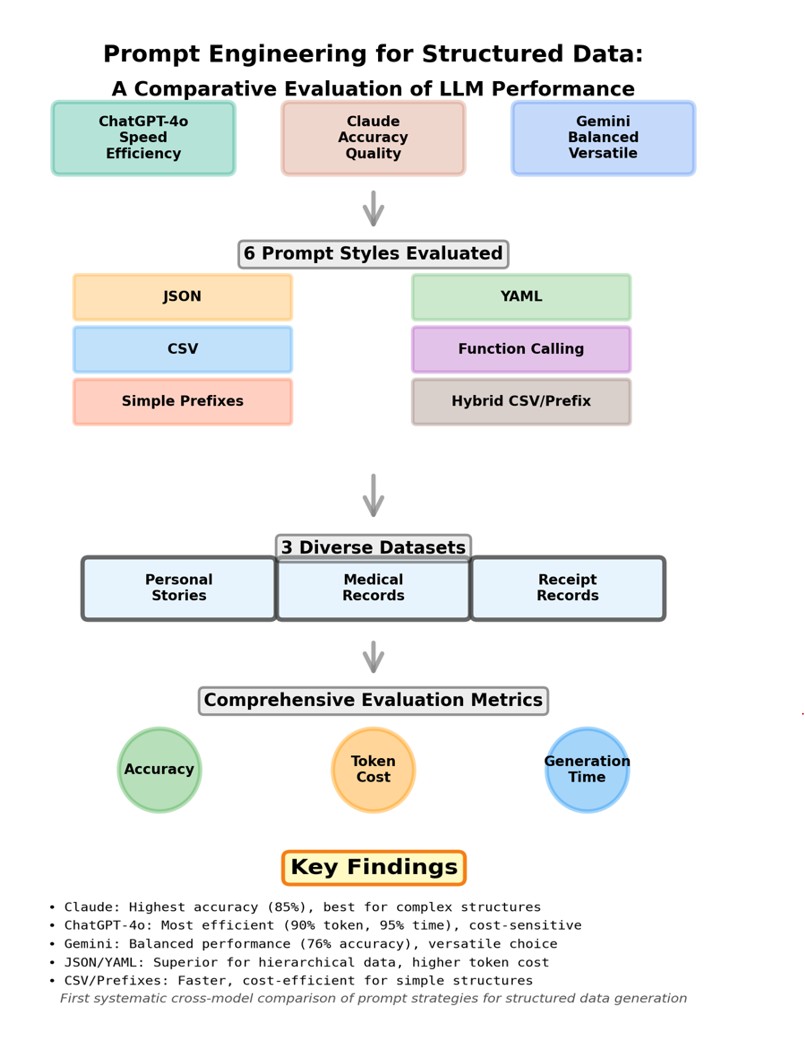
Prompt engineering for structured data: a comparative evaluation of styles and LLM performance
Prompt engineering for structured data is an evolving challenge as large language models (LLMs) grow in sophistication. Earlier studies, including prior work by the authors, tested only a limited set of prompts on a single model such as GPT-4o. This paper broadens the scope by evaluating six styles—JSON, YAML, CSV, function-calling APIs, simple prefixes, and a hybrid CSV/prefix—across three leading LLMs: ChatGPT-4o, Claude, and Gemini. Using controlled datasets, we benchmark accuracy, token cost, and generation time to deliver the first systematic cross-model comparison of prompt strategies for structured outputs. Our approach employs structured validation and custom Python utilities to ensure reproducibility, with results visualized through Technique vs. Accuracy, Token Cost, and Time graphs. Our analysis reveals clear trade-offs: simpler formats often reduce cost and runtime with little accuracy loss, while more expressive formats offer flexibility for complex data. These findings underscore how prompt design can be tuned to balance efficiency and versatility in real-world applications. Our results show prompt choice directly shapes both quality and efficiency. Claude consistently achieves the highest accuracy, ChatGPT-4o excels in speed and token economy, and Gemini provides a balanced middle ground. By extending beyond single-model evaluations, this study offers practical guidance for selecting prompts based on model capabilities and application demands, advancing prompt engineering with a comprehensive, multi-model framework for optimizing structured data generation.