
Asymmetry
ISSN: 3006-2950 (Print)
ISSN: 3006-2969 (Online)
CODEN: ASYMAJ
Matching of perturbative and exponentiated initial state radiation corrections to e+e−-annihilation
The behavior of higher-order radiative corrections due to initial state radiation in processes of electron-positron annihilation is analyzed. Numerical results for energies of future colliders are presented. Uncertainties of the known results on these corrections are estimated. A modified scheme for simultaneous exponentiation of pure photonic and non-singlet pair corrections is presented. Matching of the exponentiated results with the existing analytic higher-order calculations is constructed. A new subtraction scheme is suggested. The results obtained are important for increasing the relative accuracy of the theoretical description of processes that will be studied in future electron-positron colliders to a level of approximately 10-5.

Validating apparent violations of Onsager reciprocity in charged membrane models
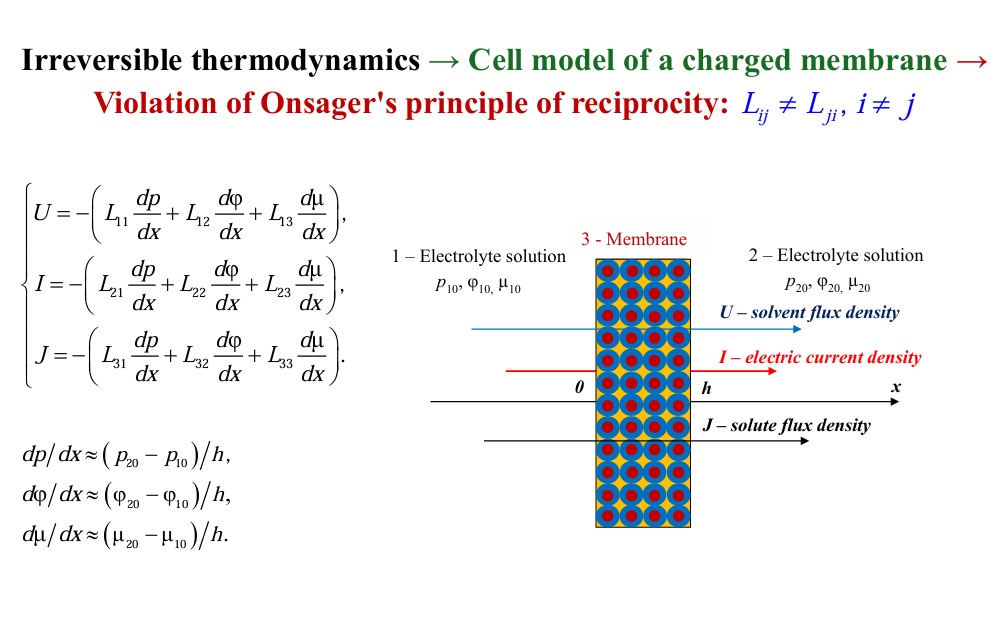
Apparent violations of Onsager reciprocity continue to be reported in models of transport through charged membranes and concentrated electrolytes, with asymmetric cross-coefficients frequently interpreted as evidence of broken microscopic reversibility. We develop a thermodynamic framework that clarifies when such asymmetries represent genuine non-reciprocal behaviour and when they are artefacts of modelling and data reduction. Using a charged-membrane cell model as a case study, we formulate entropy production in terms of conjugate flux–force pairs, construct the full symmetric Onsager matrix, and then analyse how variable reduction, spatial averaging, and concentration-dependent parameterisation affect the resulting reduced kinetic coefficients. Numerical reconstructions of published cross-coefficients, together with controlled examples based on explicitly symmetric Onsager matrices, show that nonlinear, concentration-dependent reductions can generate pronounced and systematically ordered separations between effective coefficients, even when the underlying phenomenological matrix remains exactly symmetric. We further distinguish equilibrium linear-response coefficients from finite-amplitude, steady-state effective parameters and discuss the impact of temporal memory effects in concentrated electrolytes. Taken together, these results demonstrate that the reported asymmetries in charged-membrane models do not constitute a violation of Onsager reciprocity and provide practical criteria for testing reciprocity claims in complex coupled transport systems.

Advances in asymmetric catalysis: from mechanisms to applications
I am delighted to see the launch of this Special Issue, “Advances in Asymmetric Catalysis: From Mechanisms to Applications”, edited by Guest Editors Mario Waser and Shengcai Zheng. Having had the opportunity to propose the theme of this Special Issue, I am especially pleased to see it come to fruition. The synthesis of chiral compounds in high optical purity is critically important in medicinal and agrochemical chemistry. K. Barry Sharpless, Ryoji Noyori, and William S. Knowles were awarded the 2001 Nobel Prize in Chemistry for their pioneering contributions to asymmetric oxidation and asymmetric reduction catalysis. These transformations have been primarily achieved using transition-metal catalysts based on elements such as titanium, ruthenium, and rhodium. Subsequently, a wide variety of asymmetric carbon–carbon bond-forming reactions employing chiral Lewis acid and chiral Lewis base catalysts were developed, leading to remarkable advances in asymmetric catalysis.