
Continent and Life Evolution
ISSN: 3008-0851 (Print)
ISSN: 3008-086X (Online)
CODEN: CLEABK
Mechanism of influence of root system distribution patterns on the shear strength of root-reinforced sand
Due to the loose and non-cohesive nature of sandy soil, road subgrade slopes in sandy regions are highly unstable, often experiencing adverse geological disasters such as shallow landslides and uneven settlement. To mitigate these hazards and promote sustainable development, vegetation root systems are frequently employed for slope stabilization. This paper investigates the reinforcing efficiency of roots in sand matrix via single-root tensile tests and mixed-level orthogonal direct shear tests. The tensile tests reveal that the peak tensile force (F) exhibits a robust linear increase with root diameter (d) (F = 26.81d − 11.33, R2 = 0.80), whereas the ultimate tensile strength (RM) decays non-linearly via an inverse power function. Orthogonal direct shear tests demonstrate that root orientation is the governing factor controlling both composite shear strength and apparent cohesion, exhibiting a hierarchical influence priority of Orientation > Quantity > Diameter. Specifically, root inclusions primarily enhance the ultimate shear strength by increasing the cohesion, with negligible variation in the internal friction angle. The optimal root configuration for maximizing overall shear strength adopts 1.5 mm-diameter roots, a root number of 6, and an inclined orientation. Mechanistically, shear strength enhancement of the composite arises from a cooperative effect of interface friction, axial tensioning/anchoring, and structural interlocking, forming an anisotropic, parameter-specific system rather than a uniform strength upgrade. Thicker roots, under inclined or vertical arrangements, actively mobilize their tensile capacity (F) to resist shearing force. Conversely, three-dimensional vertical-horizontal (cross) networks maximize spatial confinement and structural interlocking, selectively optimizing the apparent cohesion to a peak value of 15.67 kPa. These findings provide a mechanical reference and root-architecture optimization strategies for slope stabilization projects in arid environments.

Nitrogen isotope constraints on Terreneuvian shallow-marine redox evolution in the Aksu area, Tarim Basin
The Cambrian Explosion witnessed the rapid radiation of nearly all animal phyla in three distinct evolutionary phases. Recent studies from South China have proposed that the prevalence of suboxic environments in the Terreneuvian shallow ocean facilitated the diversification of lophotrochozoans with relatively low oxygen requirements during the second phase of the Cambrian Explosion. To further test this hypothesis, we present a high-resolution δ15N record from the inner-ramp Penglaiba section in the Aksu area, Tarim Basin, an independent paleocontinent with exceptionally well-preserved Terreneuvian successions. Our results document a progressive decrease in δ15N values from > +4‰ to < +1‰ in the lower unit of the Yuertusi Formation, followed by stable δ15N values of ~+3‰ in the upper unit. This isotopic pattern records a two-stage redox history for the shallow Tarim Basin, with progressive intensification of water-column deoxygenation succeeded by partial reoxygenation. Integrated with published regional δ15N data, our results demonstrate the existence of a persistent depth-dependent redox gradient throughout the Terreneuvian, with denitrification intensity decreasing systematically from anoxic deep-basin to suboxic inner-ramp environments. These findings provide cross-basin validation for the hypothesis that stepwise oxygenation of the shallow ocean modulated the multi-phase evolutionary trajectory of metazoans during the Cambrian Explosion.

Continent and life evolution: an international platform for earth system science
Among the planets currently known, Earth is unique not only because it harbors life, but also because its continents, oceans, atmosphere, climate, and biosphere have co-evolved as an integrated and self-transforming system over billions of years. The emergence and long-term persistence of habitable environments have not resulted from any single process, but from sustained interactions among deep Earth dynamics, surface processes, environmental change, and biological evolution. Since the formation of Earth approximately 4.6 billion years ago, continental growth and reworking, plate tectonics, ocean–atmosphere evolution, climatic transitions, biological innovation, mass extinctions, and Earth surface processes have been coupled within a dynamic Earth system (Wilde et al. 2001; Santosh 2010; Zerkle 2018; Zhai and Peng 2020; Zhu et al. 2021; Young et al. 2023; Zhao et al. 2023; Stern and Gerya 2024). Continents have not merely provided a passive physical substrate for weathering, sedimentation, nutrient cycling, ecological diversification, and human civilization; they have also actively regulated the environmental conditions under which life originated, diversified, and repeatedly reorganized. Conversely, life has profoundly reshaped Earth’s surface environments through the ecological engineering of reef structures and shell beds, modifying atmospheric composition, mediating biogeochemical cycles, influencing mineral formation, and transforming sedimentary and ecological systems (Peccerillo 2021; Hamidi 2022). Comparative studies of other terrestrial planets further broaden this perspective, particularly for reconstructing early Earth conditions where the geological record remains fragmentary. Understanding these long-term feedbacks among solid Earth processes, surface environments, and biological evolution is essential not only for reconstructing the history of our planet, but also for evaluating its future trajectory under climate change, biodiversity loss, resource exploitation, environmental degradation, and increasing human disturbance (Costanza et al. 2007; Bonan and Doney 2018; Folke et al. 2021). At the same time, Earth science is being rapidly transformed by the convergence of artificial intelligence and big-data analytics, cloud computing, human–machine interaction, quantum technologies, genomics and genome editing, nanoscience, polymer nanomaterial, and clean-energy technologies (Melnikov et al. 2018; Nayfach et al. 2021; Hultman et al. 2024). These technological breakthroughs provide opportunities and challenges for continent and life evolution under extreme conditions, spanning scales from microscopic mechanisms to planetary-scale processes and integrating insights across multiple scientific disciplines.
Geochronology and geochemistry of mafic rocks in the Wutai area, North China: constraints on the latest Neoarchean–Paleoproterozoic tectonic setting of the Trans-North China Orogen and the onset of plate tectonics
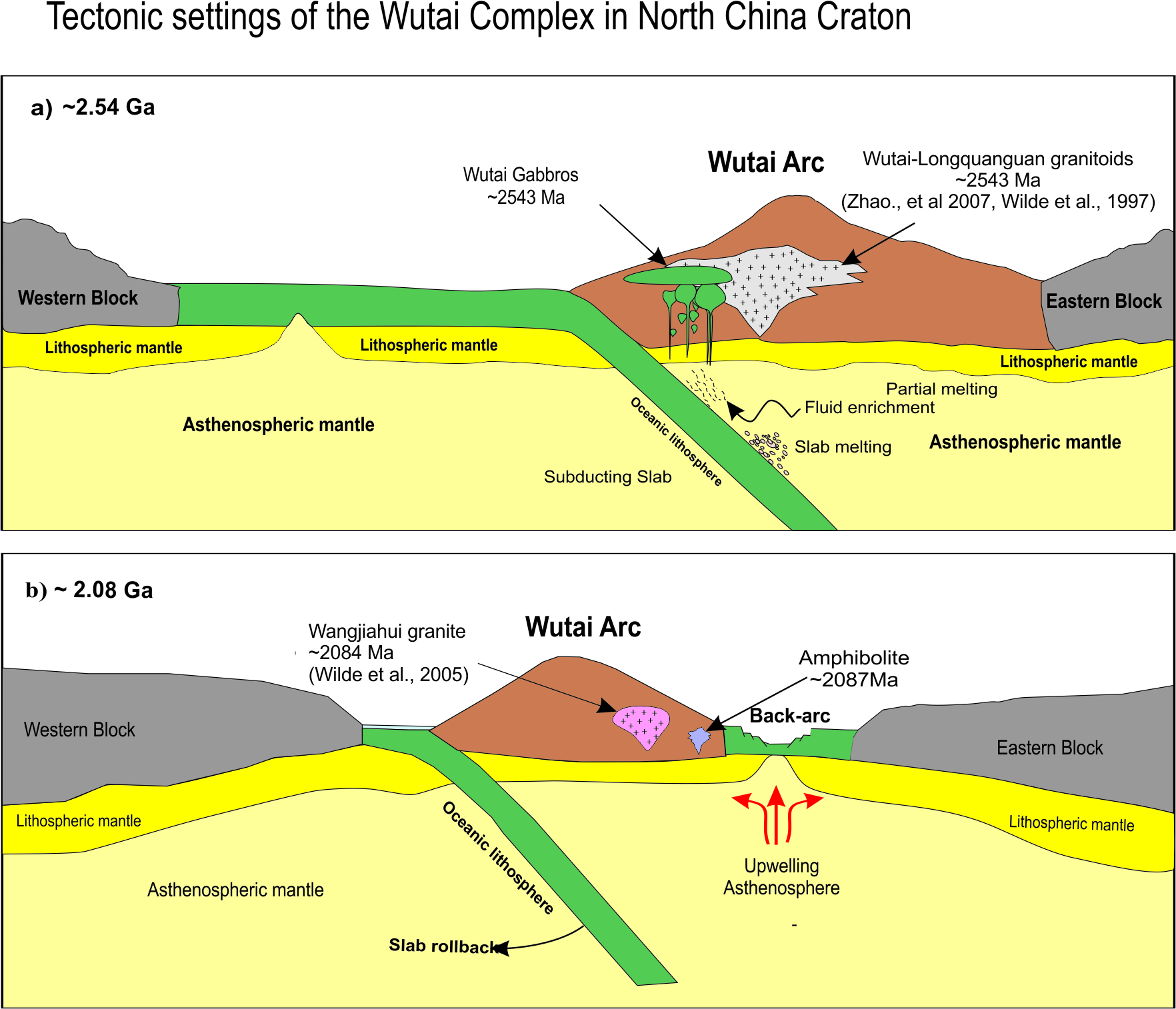
The Neoarchean-Paleoproterozoic is a key period for the North China Craton due to the formation of continental crust and the beginning of oceanic subduction. The amalgamation of the Eastern and Western blocks of the North China Craton remains debated, particularly regarding the timing, directionality (eastward vs. westward subduction), and number of collisional phases. Previous studies disproportionately focus on felsic lithologies, creating a critical mafic blind spot that obscures insights into mantle dynamics and crust-mantle interactions. Systematic investigation of Late Archean to Paleoproterozoic mafic suites was essential to reconcile conflicting tectonic models and refine the craton’s amalgamation history. In order to constrain the complex geological processes more clearly, we present new whole-rock geochemistry and zircon U-Pb geochronology for mafic rocks in the Wutai Complex. The Late Archean (2.56~2.54 Ga) gabbros are characterized by relatively depleted Nb–Ta and Zr–Hf anomalies, slightly positive Eu* anomalies, low K₂O concentrations, enrichments of LILE (Ba, CS, Th, and Rb), differentiated HFSE patterns and moderate Mg# values (43–53). They show positive εNd (t) values (+4.9–+6.1) and high (⁸⁷Sr/⁸⁶Sr)i ratios (0.70063–0.70091). Additionally, these gabbros have high Nb concentration (13.3–23.3) and display enrichments in light rare earth elements (LREE) (La/Yb)N = 7.00–8.96), high-field strength elements (HFSE, e.g., Nb, Ta, Zr), and high Nb/U and Nb/La ratios, suggesting a derivation from an arc-like mantle source. The gabbro melts were generated by a low degree of 4%–5% partial melting of garnet-spinel lherzolite mantle. The Paleoproterozoic (2.16~2.08 Ga) amphibolites also display depleted Nb-Ta and Zr-Hf anomalies, enriched light rare earth elements (LREEs), but show lower Eu* anomalies, εNd(t) values (+0.9–+1.2), and (⁸⁷Sr/⁸⁶Sr)i ratios (0.69770–0.69930). The amphibolites exhibit a geochemical signature marked by LREE enrichment, negative HFSE anomalies, and distinct Sm-Nd isotopic composition, suggesting a subduction-related magma source. The enrichment of Cs, Rb, Ba, and the depletion of Nb, Ta, P, and Ti, imply that their magma source was significantly modified by subducted crustal materials. The trace element ratios, such as K/Rb, Rb/Y, Nb/Y, Th/Zr, and so on, further indicate that the gabbros were derived from a mantle substantially altered by siliceous slab-derived melts, whereas the amphibolites originated from a mantle influenced by slab-derived melts and fluids. The amphibolites were generated by the 15% partial melting of garnet-spinel lherzolite and the 15% melting of spinel lherzolite at a shallower mantle source. In combination with the previously published data of mafic rocks in the Wutai Complex, we infer that the Late Archean gabbros suggest their derivation in a subduction-related setting, whereas the Paleoproterozoic amphibolites formed in a back-arc basin setting. These findings underscore a tectonic transition from Late Archean oceanic subduction to Paleoproterozoic lithospheric extension in the North China Craton, indicating that plate tectonics at least partly happened most likely in the latest Neoarchean.
Stratigraphic refinement unveils high-resolution shallow marine biotic dynamics immediately preceding the Late Ordovician Mass Extinction in South China
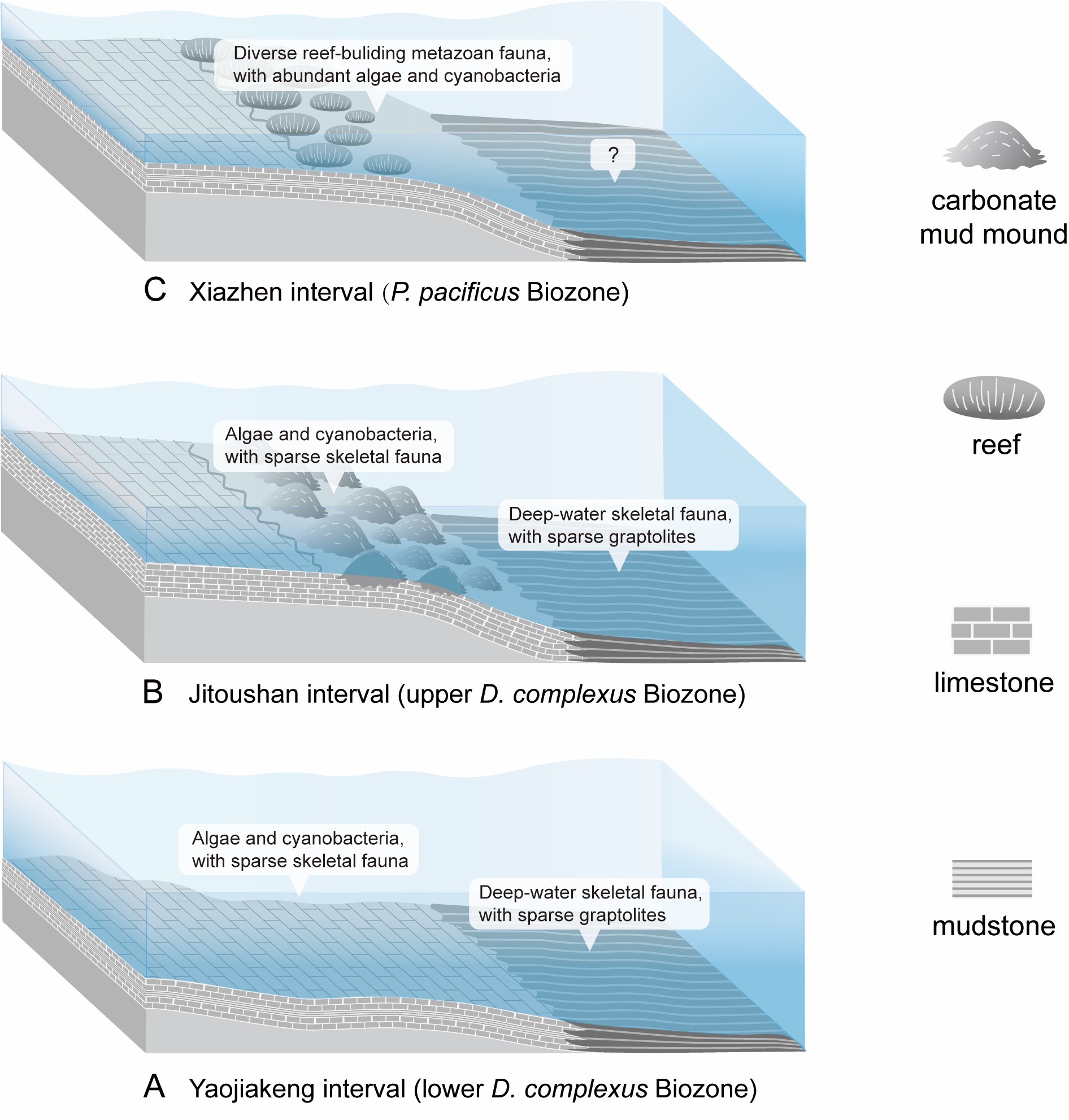
Exceptionally preserved Late Ordovician successions in South China offer a globally significant archive for investigating both the Great Ordovician Biodiversification Event (GOBE) and the Late Ordovician Mass Extinction (LOME). In contrast to the graptolitic facies that dominate much of the region, the late Katian carbonate deposits in the Jiangshan–Changshan–Yushan (JCY) area of East China (South China paleoplate), formerly referred to as the Sanqushan Formation (or its equivalents), are virtually the only strata in South China preserving diverse shallow marine biotas, providing rare ecological snapshots of the final biodiversity peak of the GOBE immediately preceding the LOME. Despite their importance, the lithostratigraphic framework and age constraints of these fossiliferous rocks remain debated. The prevailing view interprets the Xiazhen Formation as a nearshore equivalent of the Sanqushan Formation, with both units broadly assigned to a generalized late Katian age. Based on a critical review of integrated sedimentologic and paleontologic data, supplemented by new field observations, we support the interpretation that the Xiazhen Formation represents the upper portion of the ‘Sanqushan Formation’, and propose to elevate the latter to group rank to represent platform facies of this entire interval. The revised Sanqushan Group comprises, in ascending order, the Yaojiakeng, the Jitoushan, and the Xiazhen formations. The Yaojiakeng and the Jitoushan formations correlate more precisely with the Dicellograptus complexus Biozone, while the Xiazhen Formation aligns with the Paraorthograptus pacificus Biozone. This refined stratigraphic framework enables high-resolution reconstruction of biotic evolution prior to the LOME, offering new insights into regional ecological dynamics and their broader global significance.
Obliquity-modulated poleward rain-belt shifts recorded in the Pliocene-Pleistocene sequence, northern Chinese Loess Plateau
Earth’s axial tilt modulates meridional insolation gradients and, in turn, the latitude of the tropical rainbelt/Intertropical Convergence Zone (ITCZ). We test this mechanism at the northern limit of the Asian summer monsoon using a 63.5-m red clay–loess succession on the northern Chinese Loess Plateau (CLP). New magnetic susceptibility (χ) and grain-size (< 5 μm) series, anchored by magnetostratigraphy and refined by astronomical tuning, reveal statistically significant 405 kyr eccentricity, ~173 kyr obliquity modulation, and ~1.2 Myr bands. We iteratively tuned the χ series to the astronomical solution using the ~173 kyr obliquity-modulation filter, and independently validated the chronology against the 405 kyr eccentricity band; evolutive spectral analysis further verifies the cyclic pacing and phase relationships. Band-pass reconstructions show that χ maxima broadly coincide with obliquity amplitude highs, consistent with strengthened summer monsoon and northward rainbelt displacement. Coherence with χ from nearby CLP sections (Wujiamao, Lingtai) and with benthic δ18O–δ13C further supports regional to global controls. We interpret the CLP record as an obliquity-gated archive of ITCZ poleward pulses during the Pliocene-Pleistocene, modulated by 173 kyr (Earth-Saturn) and ~1.2 Myr (Earth-Mars) beats, superposed on the long-eccentricity metronome. The tuned framework provides a physically grounded chronology for future multi-proxy work and a benchmark for testing monsoon-ITCZ dynamics in warm-climate simulations.
