Robot Learning

ISSN: 2960-1436 (Print)

ISSN: 2960-1444 (Online)

CODEN: RLABAV

About This Journal
Special Issues
View more
Learning Based Robot Path and Task Planning
Special Issue Editor:   Guangliang Li, Shiqi Zhang, Dachuan Li
Submission Deadline:  31 July 2026
Human-in-the-Loop Robot Learning in the Era of Foundation Models: Challenges and Opportunities
Special Issue Editor:   Jianzhuang Zhao, Xing Liu, Marta Lagomarsino, Francesco Tassi, Shufei Li, Chao Zeng, Chenguang Yang, Wansoo Kim
Submission Deadline:  01 October 2026
Human-Robot Interaction and Human-Centered Robotics
Special Issue Editor:   Anqing Duan, Shuo Ding, Junling Fu, Elisa Iovene, Sipu Ruan, Peng Zhou, Chenguang Yang
Submission Deadline:  31 December 2026
Intelligent Vision-Driven Robotics
Special Issue Editor:   Peng Zhou, David Navarro-Alarcon
Submission Deadline:  31 July 2026
Latest Articles
View more
Design of a soft gripper with a changeable adapter for enhanced grasping and manipulation
Chengqi Song,Jingxiang Wang,Qinglei Bu,Jie Sun,Qinyao Liu
Article21 Jul 2026OPEN ACCESS

Soft grippers utilize compliant materials to achieve adaptable grasping, yet they often face challenges in accommodating objects with widely varying dimensions due to their fixed kinematic structures. This paper presents the design, fabrication, modeling, and control of a novel soft gripper featuring a rigid-flexible coupled variable range adapter. By integrating a motorized crank-slider mechanism with soft pneumatic fingers, the gripper achieves a dynamic volumetric workspace capable of manipulating objects ranging from compact to large geometries. Theoretical modeling and experimental characterization reveal that the adapter serves a dual purpose: it not only expands the effective workspace but also functions as a mechanical force amplifier, capable of exponentially boosting the contact force through kinematic reconfiguration. Furthermore, an intuitive Human-in-the-Loop (HITL) teleoperation strategy is established using wearable flex sensors. This control framework maps human gestures to robotic actuation, leveraging human visual feedback as a high-level perception loop to validate the open-loop response of the soft actuators. Experimental results demonstrate that this integrated system significantly improves adaptability and payload stability for diverse object geometries compared to fixed-base counterparts.

PDF
Autonomous collision avoidance for complex multi-ship encounters based on improved dynamic window approach
Xiaoru Ma,Hongguang Lyu,Guifu Tan,Xikai Kang,Yong Yin,Tongtong Guo
Article07 Jul 2026OPEN ACCESS

Achieving autonomous navigation requires Maritime Autonomous Surface Ships (MASS) to overcome difficulties in recognizing intricate multi-ship encounter situations and developing appropriate collision avoidance strategies. To address the above issues, this study first integrates the Velocity Obstacle (VO) with Closest Point of Approach/Time to Closest Point of Approach (CPA/TCPA) into the collision risk identification of ships. This enables the own ship (OS) to determine the risk posed by target ships (TSs) in the scenario. Secondly, the paper further discusses complex multi-ship encounter scenarios, based on 1972 International Regulations for Preventing Collision at Sea (COLREGs), it classifies responsibilities to determine the set of give-way ship and stand-on ship obligations. Finally, the derived responsibility set is incorporated into Dynamic Window Approach (DWA), allowing the enhanced Multi-Vessels Velocity Obstacle and Improved Dynamic Window Approach (MVO-IDWA) algorithm to automatically select optimal decisions in complex multi-ship encounter scenarios and ensure the ship reaches its destination safely. Centering on the challenge of avoiding collision decision in multi-ship complex encounter scenarios, this paper proposes the integration of ship responsibility sets with the MVO-IDWA algorithm. Analysis of the results establishes that the proposed algorithm can consider the inter-ship responsibilities, risk levels, and movement trends of TSs in multi-ship encounters, thereby realizing autonomous ship collision avoidance.

PDF
Deep learning for underwater object detection: a comprehensive survey of models, datasets, and challenges
Hari Bhandari,Pengcheng Liu
Survey16 Jun 2026OPEN ACCESS

This survey provides a comprehensive synthesis of methods, datasets, metrics, and deployment strategies from the evolution of convolutional neural network (CNN)-based detectors to emerging transformer and hybrid architectures. It unifies fragmented literature into a structured taxonomy while integrating results from 2014–2025 studies. The paper reviews benchmark datasets, discusses evaluation protocols and reproducibility standards, and proposes a deployment playbook considering latency, energy, and hardware constraints. Beyond technical performance, it addresses responsible AI practices and ethical challenges in marine observation. By highlighting open problems in multimodal fusion, self-supervised learning, and on-device adaptation, this work aims to guide future research and practical deployment of underwater vision systems. A comprehensive survey of underwater object detection covering classic CNN-based detectors, modern transformer and hybrid models, training and evaluation practices under challenging aquatic conditions, the dataset landscape, deployment constraints (latency/VRAM/energy), and open problems for real-world marine applications.

PDF
Top Downloaded
View more
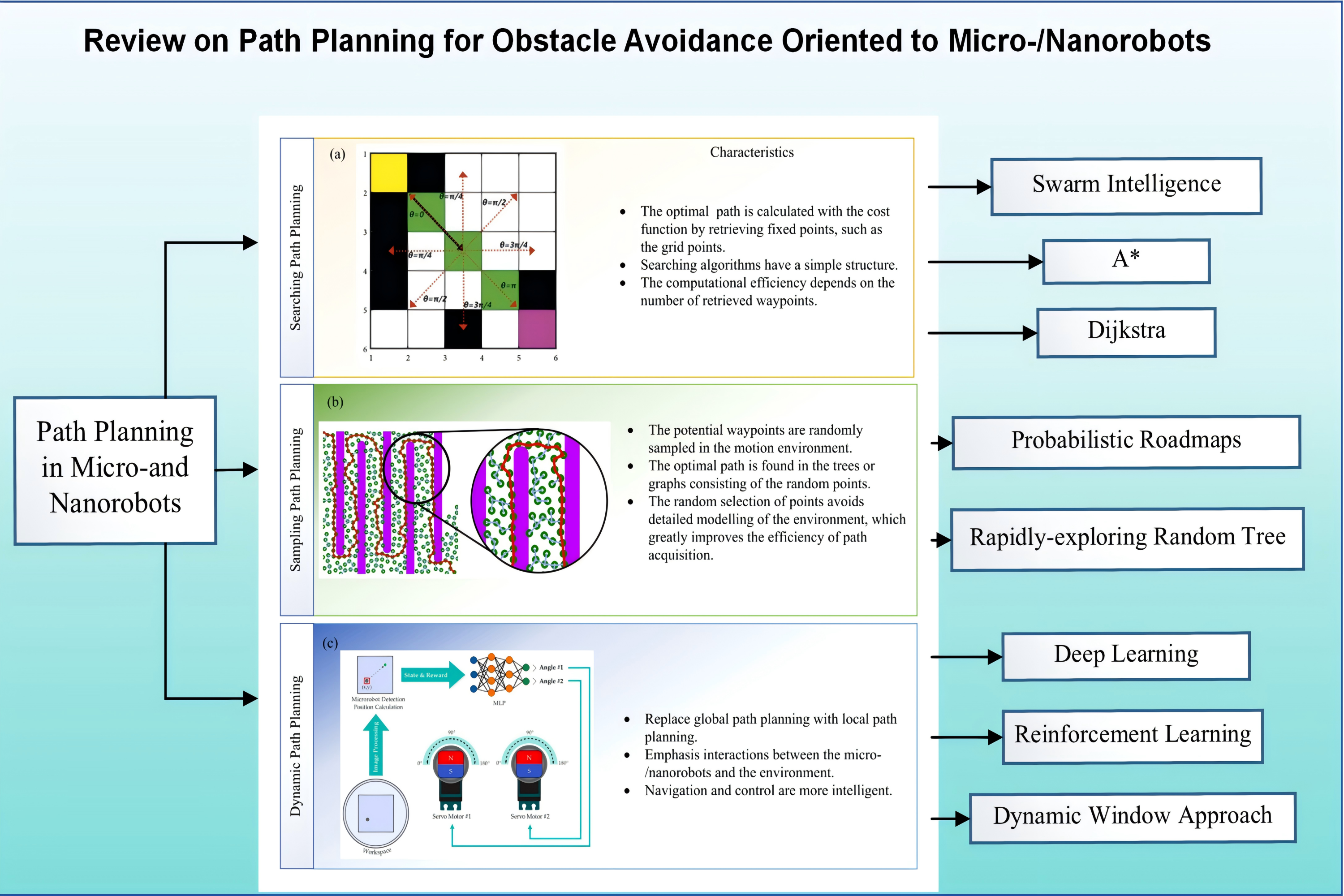
Review on path planning for obstacle avoidance oriented to micro-/nanorobots
Tongzhou Ye,Tianhao Peng,Lidong Yang
Review14 Nov 2024OPEN ACCESS
Path planning algorithms are indispensable for controlling micro-/nanorobots through complex and unknown environments in the biomedical and medical fields. With the tasks performed becoming more complex, higher-quality paths are required to avoid obstacles for ensuring the safe and efficient movement of micro-/nanorobots. A comparative analysis of path planning algorithms is conducted to elucidate the algorithm’s application and optimization for different environments. According to the environment modeling approach, existing path planning algorithms are classified into searching, sampling, and dynamic aspects. Searching path planning algorithms directly retrieve the global path possessing minimum cost from the modeled static waypoints. Sampling path planning algorithms employ randomly sampled waypoints within the target space, which eliminates the necessity for environmental modeling. Dynamic path planning algorithms utilize local paths to regulate the motion of micro-/nanorobots in real time. Deep learning networks based on big data will become an important research direction for the control and navigation of micro-/nanorobots. The advantages and limitations of path planning algorithms in varied spatial contexts are elucidated through detailed examples and descriptions, providing a comprehensive understanding of performance and applicability. This review underscores recent advancements in this emerging domain and stands as a testament to the dynamic landscape of micro-/nanorobotics and the continual pursuit of superior motion control solutions.
PDF References
Survey on heterogeneous aquatic robot systems: communication, perception, navigation, control, decision-making and energy management
Ruonan Liu,Xiuzhong Hu,Zihan Jiang,Junzhi Wang,Weidong Zhang
Survey30 May 2025OPEN ACCESS
Heterogeneous aquatic robot systems, consisting of ROVs, AUVs, ASVs, and UAVs, are vital for environmental exploration, monitoring, and task execution. This paper presents advancements in critical technologies within these systems, focusing on communication (underwater acoustic, radio, and optical), multi-sensor fusion, and collaborative navigation techniques. It reviews control strategies like deep reinforcement learning, end-to-end control, and large model-based methods, addressing autonomous decision-making and adaptability in complex environments. The paper also discusses energy management strategies for efficient storage, utilization, and recovery. Furthermore, it explores the ethical and environmental impacts of deploying such systems, emphasizing sustainability and minimizing ecological disruptions. Finally, case studies and applications in ocean exploration and environmental monitoring are highlighted, showcasing the real-world utility and future potential of heterogeneous aquatic robot systems. This work provides valuable insights into the technological, ethical, and practical considerations for developing these systems.
PDF
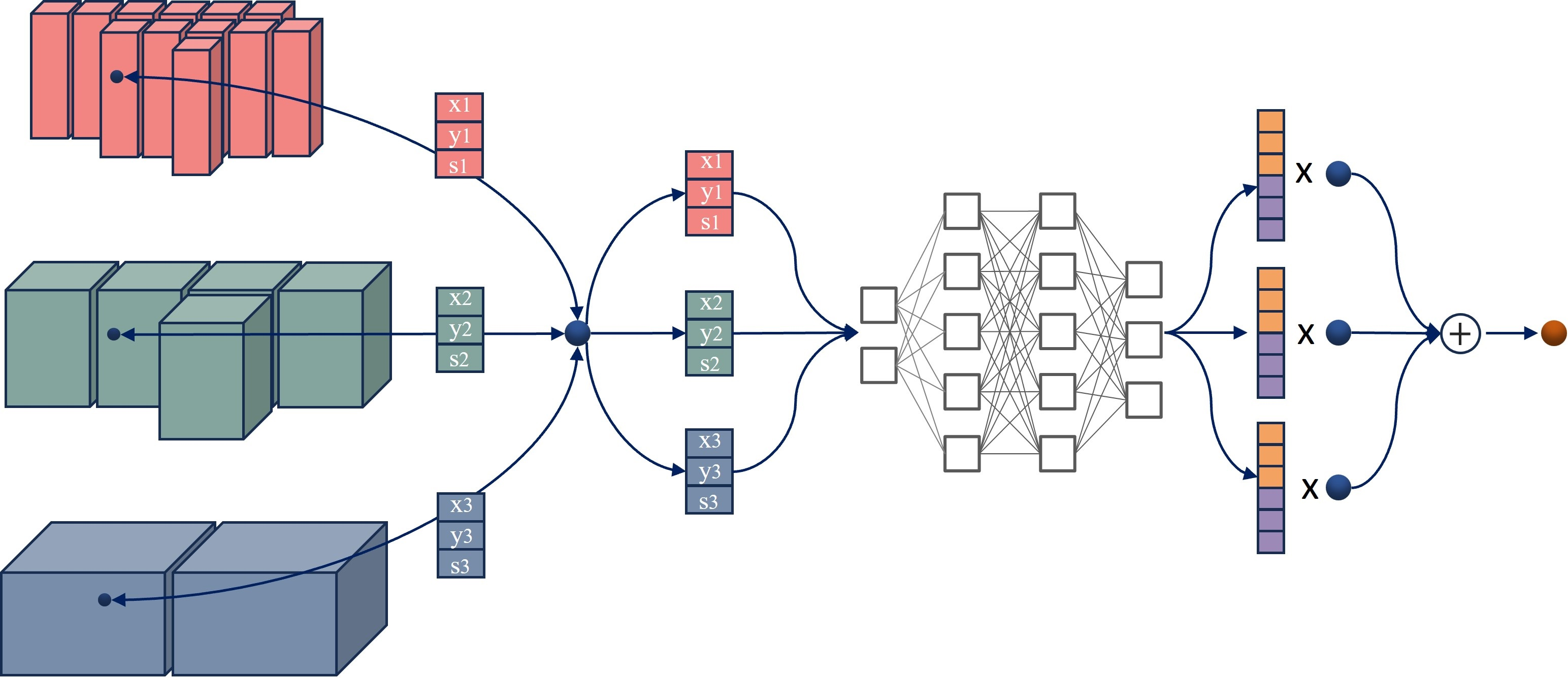
Optimizing scene flow with neural rigidity prior
Zhiheng Feng,Jiuming Liu,Hesheng Wang
Article28 Nov 2024OPEN ACCESS
Scene flow estimation provides the 3D low-level motion understanding in dynamic scenes. In this paper, we propose an optimization-based scene flow estimation method with neural rigidity prior for the autonomous driving environment. Specifically, we utilize the rigidity prior of dynamic scenes to partition the point clouds into pillars of different resolutions. Then, the flow vector of a point is represented as the average of local rigid transformations associated with the different pillars to which it belongs. To model local rigidity, we employ the neural implicit representation for encoding the intrinsic constraints of pillars. Our method achieves state-of-the-art accuracy on three commonly-used autonomous driving datasets: Argoverse, Waymo, and nuScenes, and even surpasses previous supervised learning-based methods. Experiment results demonstrate the effectiveness of our method, particularly on sparse points in the autonomous driving scene.
PDF