
Electronics and Signal Processing
ISSN: 2959-913X (Print)
ISSN: 2959-9148 (Online)
CODEN: ESPLA8
Analysis of dementia EEG signals using empirical mode decomposition variants and deep learning
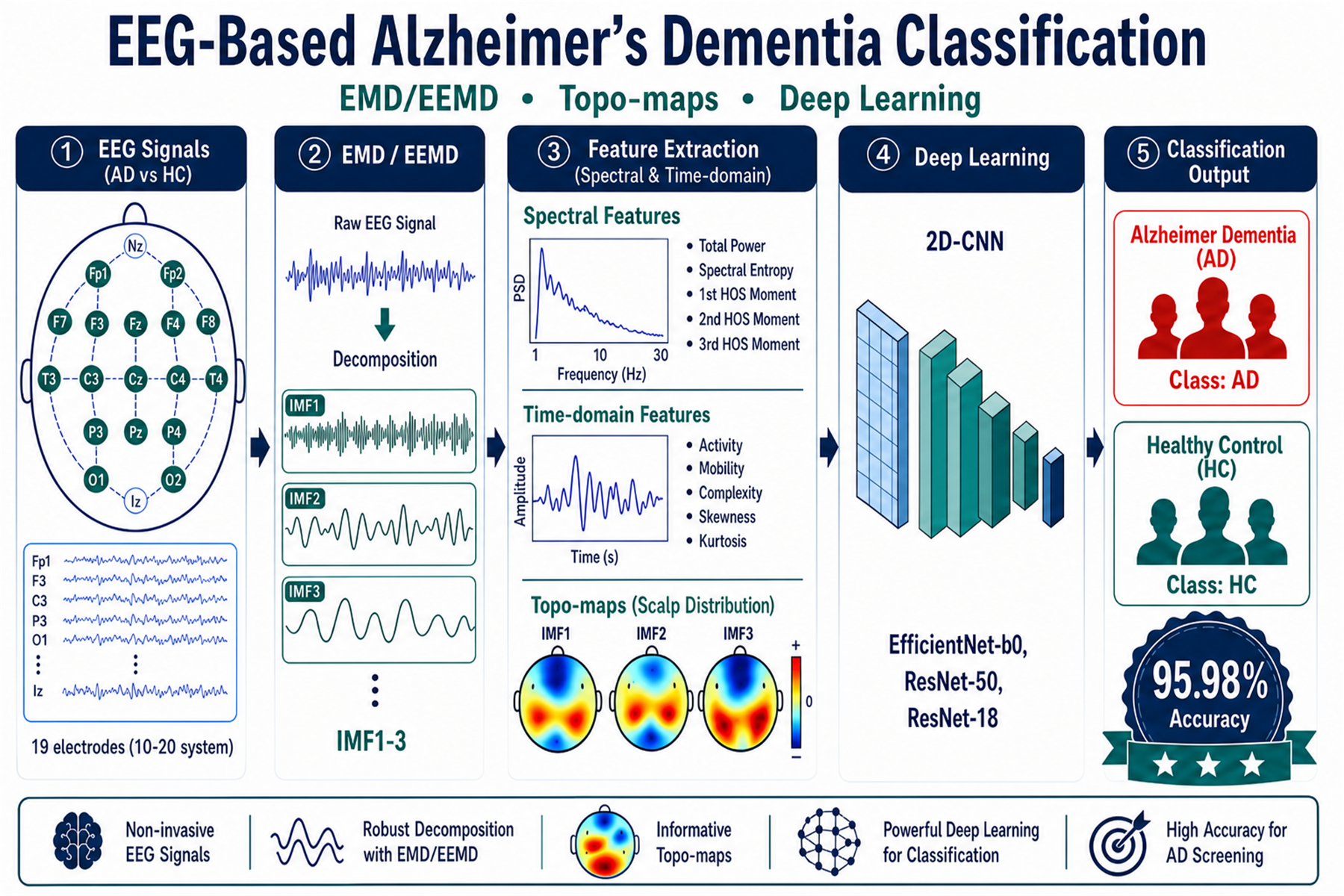
In recent years, Alzheimer’s dementia (AD) is the most common neurological condition caused by electrical activity changes in the human brain. The diagnosis of AD can be provided by using medical devices such as electroencephalography (EEG). In this study, EEG signals of AD patients and healthy control subjects were analyzed. Advanced signal decomposition methods, which are empirical mode decomposition (EMD) and ensemble empirical mode decomposition (EEMD), were used to further investigate EEG signals. The first three intrinsic mode functions (IMFs) were obtained using the EMD and EEMD methods. Spectral and time-domain features were extracted from IMFs and raw EEG signals. Then, topographical heat maps were generated from these features. Topographic Feature Map (Topo-map) were classified using a two-dimensional convolutional neural network (2D-CNN). Different CNN architectures were compared in terms of performance, including EfficientNet-b0, Resnet-50, and Resnet-18. The experimental results demonstrate that the proposed approach effectively captures the spatial and spectral characteristics of EEG signals associated with Alzheimer’s disease. 95.98% classification accuracy was achieved with the EfficienNet-b0 architecture.
Magnetic tunnel junctions for neuromorphic computing: from device physics to network architectures
Neuromorphic computing is one of the most promising technologies to solve the von Neumann bottleneck, which has the advantages of fast processing speed and low energy consumption in performing complex tasks. The development of neuromorphic computing is currently driven by several kinds of novel devices. Magnetic tunnel junctions (MTJs) are rich in nonlinear properties and can be regulated by multiple physical fields such as magnetic field, current and temperature. Meanwhile, MTJ has the advantages of good stability and low power consumption, which makes it an ideal device for neuromorphic computing. This paper starts by examining individual MTJ devices and then extends the discussion to full neural networks. First of all, we sorted out the various properties of MTJ, from the structure to physical mechanism and response characteristics. Secondly, the biological neuron model, synaptic properties and related studies on simulating neurons and synapses based on MTJs are introduced. Then, we review the neural network system-level architectures that have been explored with MTJ devices. Finally, the challenges and the future development trend are summarized for advancing MTJ-enabled neuromorphic computing.

Artificial Intelligence (AI)-enabled multimodal & cross spectrum photodetectors for management of diabetic foot ulcers
Diabetes mellitus represents a major public health concern worldwide, with an estimated prevalence of approximately 9.1% of the population in Europe imposing a substantial economic burden on healthcare systems. One of the main complications of diabetes is the presence of Diabetic Foot Ulcers (DFUs) arising primarily from neuropathic and vascular impairments. Recent advances in sensing devices and photonics have stimulated the launch of sensors and imaging modules that can early diagnosis and prevent DFUs. In this paper we present the results of a new innovative, reliable, and cost-effective photonic-based system for the monitoring and management of DFUs, designed for large-scale clinical and home use. The system, developed within the framework of the H2020 PHOOTONICS project, integrates passive infrared photodetectors with active illuminators to achieve enhanced diagnostic capability. In PHOOTONICS project, two new photonic technologies for the early diagnosis and the management of diabetic foot have been developed; The professional device, called PRO and the home device called, HOME. The PRO version is dedicated for physicians at their offices or at hospitals. In this article, we present the clinical validation results of the new photonic-based device for diabetic foot ulcer. The results have been validated across four hospitals; ATTIKON University Hospital (Greece), VBMS University Hospital (Romania), CHARITE University Hospital (Germany), LEIDEN University Hospital (Netherlands). The validation includes (i) requirement process of diabetic and non-diabetic patients, patients stratification procedures, existence of comorbidities and an AI-based assessment of the results. For the latter we utilize ResNet deep models.

A study of SerDes logic for visible light communication using 8B13B code
Visible light communication (VLC) has been increasingly implemented in data transmission to overcome the limitations faced by radio wave communication. However, obtaining specialized equipment, particularly serializers and deserializers, remains a significant challenge for the realization of the VLC systems. In this study, we developed an 8B13B coding scheme for VLC that enables reliable synchronization and effectively addresses pulse-width variations. The proposed serializer and deserializer (SerDes) logic was implemented in Verilog hardware description language (Verilog HDL) and deployed on a field-programmable gate array (FPGA), which interfaces with Raspberry Pi via the serial peripheral interface (SPI), forming a simple yet effective communication system. Although the overall communication speed relies on the data transfer frequency between the FPGA and Raspberry Pi, the bit rate was 3.48 Mbit/sec. We evaluated the communication quality of the system in environments with ambient light interference and achieved stable communication over a distance of approximately 3 m between the light emitting diode (LED) light source and receiver. The ability to use the VLC with the widely popular and commonly used Raspberry Pi is expected to promote the advancement of research and development of applications utilizing this communication system.